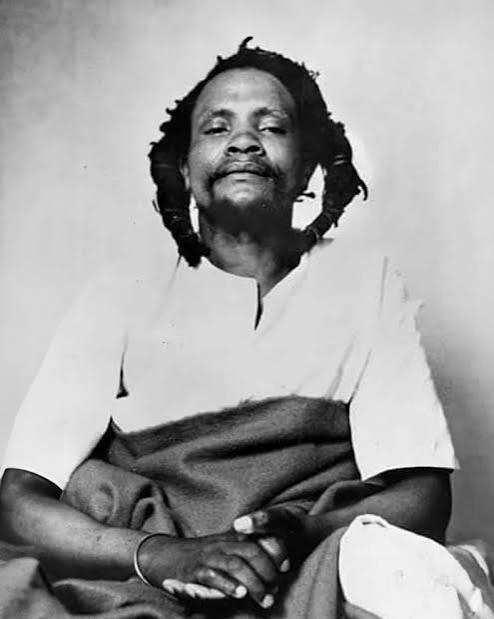
The foundations of the Kenyan struggle for independence cannot be fully understood without examining the life of Dedan Kĩmathi Waciũri. Born on October 31, 1920, his early life was rooted in the Nyeri District of the Central Province in what was then British colonial Kenya. He was a member of the Ambui clan, which is part of the Agikuyu or Kikuyu tribe, Kenya’s largest ethnic group. Raised by his mother, Waibuthi, after the early death of his father, Kimathi grew up in a landscape deeply scarred by colonial exploitation.
Kimathi began his formal education at Karuna-ini Primary School and later attended the Tumutumu CMS School. Although his school records indicated he was exceptionally intelligent with a talent for English, poetry, and debate, he was also known for his fierce, rebellious nature. His peers reportedly nicknamed him “Njangu,” a Kikuyu word translating to “rough and treacherous”. Eventually, his rebellious behavior and a lack of finances led to his departure from formal education.
In the 1940s, Kimathi sought various avenues of employment. He enlisted in the British army to serve in World War II, joining the King’s African Rifles as a sweeper in 1941, but his military career was short-lived. He was discharged shortly after, allegedly due to his shock at the terrible conditions African soldiers endured, alongside accusations of misconduct. He later worked as a primary school teacher, but his strong will and tendency to challenge administrative authorities on issues of fairness led to his dismissal.
The Spark of the Mau Mau Uprising
The backdrop to Kimathi's radicalization was the systemic oppression of the Kenyan people. The British colonial government had stripped the native population of their ancestral lands, handing prime real estate over to white settlers. Indigenous people were pushed onto small, inadequate reserves, forced to carry identity passes, and subjected to a heavy “hut tax”. Because this tax had to be paid in British currency, Africans were essentially forced into wage labor for the very settlers who had stolen their land.
Driven by these profound injustices, Kimathi joined the Kenya African Union (KAU) between 1946 and 1947. By 1950, he had become the secretary of the KAU branch in Ol Kalou. It was here that he fully immersed himself in the militant wing of the nationalist movement, eventually becoming a foundational leader of the Kenya Land and Freedom Army (KLFA).
This militant organization became widely known by the British as the Mau Mau, a term whose origins are debated, but which the fighters later adapted to mean a Swahili phrase translating to: “Let the foreigner go back to Europe, so the African can regain independence”. Kimathi became a primary administrator of the Mau Mau oath, a ritual deeply tied to Kikuyu traditions that ensured absolute loyalty and solidarity among the fighters.
The Forest War
In late 1952, the British administration declared a State of Emergency in Kenya to crush the growing rebellion. In response, Kimathi retreated into the dense, unforgiving terrain of the Mount Kenya and Nyandarua forests. From these forests, he spent the next four years building and commanding a highly organized guerrilla army made up of displaced farmers and men who had nothing left to lose.
Kimathi was instrumental in creating formal military structures within the movement, forming the Kenya Defence Council in 1953 to coordinate the forest fighters, and declaring himself a Field Marshal. Because they lacked heavy weaponry, the Mau Mau relied on their intimate knowledge of the land, launching strategic night attacks against British forces and colonial infrastructure.
However, the war was incredibly complex and brutal. The Mau Mau fought not only the British but also targeted Kikuyu loyalists, home guards, and civilians who refused to take the oath or collaborated with the colonial regime. The British response was one of the most ruthless counter-insurgency operations in the history of the empire. The colonial forces killed over 10,000 Kenyans and detained anywhere from 80,000 to an estimated 320,000 Kikuyu people in brutal concentration camps. The British employed mobile gallows, torture, starvation, and forced labor in what they deceptively labeled as “rehabilitation”.
The Trial of Dedan Kimathi
The British viewed Kimathi as the focal point of the rebellion, believing that without him, the forest fighters would collapse. A massive, obsessive manhunt was launched, led by British colonial police officer Ian Henderson. Early on the morning of October 21, 1956, Kimathi was finally cornered in the emergency trenches separating the native reserves from the forest. He was shot in the leg and captured by a tribal policeman named Ndirangu Mau.
To demoralize the remaining fighters, the British distributed over 120,000 leaflets featuring images of the wounded Field Marshal being carried away on a stretcher. Despite leading a massive armed liberation army, the British refused to charge him as a prisoner of war. Instead, the infamous trial of Dedan Kimathi centered on a technicality under the Emergency Regulations. He was tried while lying in a bed at the General Hospital in Nyeri and charged with the unlawful possession of a .38 Webley Scott revolver and six rounds of ammunition.
On November 19, 1956, Chief Justice Kenneth O’Connor found Kimathi guilty and sentenced him to death. His appeals were swiftly dismissed.
The Dedan Kimathi Death and the Secret Grave
The days leading up to the death of Dedan Kimathi were filled with a quiet, unyielding resolve. The day before his execution, he wrote a letter to a Catholic priest, Father Marino, asking the church to ensure his son received an education. He also expressed deep concern for his wife, Mũkami Kimathi, who was detained at Kamĩtĩ Prison, asking that she be comforted by the mission sisters.
On the morning of his execution, Mũkami was granted permission to see him one last time. During their two-hour conversation, Kimathi told her that he had committed no crime other than being a Kenyan revolutionary. He bravely declared that he had no regrets, famously stating, “My blood will water the tree of Independence”.
At dawn on February 18, 1957, the 36-year-old freedom fighter was executed by hanging at the Kamĩtĩ Maximum Security Prison. The colonial authorities, fearing his resting place would become a revolutionary shrine, buried him in an unmarked grave within the prison grounds and kept the location a closely guarded secret.
For decades, his widow Mũkami relentlessly asked the British and subsequent Kenyan governments a single question: “Where is my husband buried?” Her pleas were ignored for over half a century. In 2019, the Dedan Kĩmathi Foundation reported that the grave site had finally been identified at the Kamĩtĩ Prison grounds, but his remains have yet to be officially returned to his family. Mũkami Kimathi passed away in May 2023, having never been able to give her husband the proper burial he deserved.
An Enduring Legacy
The blood of Dedan Kimathi did indeed water the tree of independence, with Kenya officially breaking free from British rule in 1963. Yet, for many years, the early post-colonial administrations of Jomo Kenyatta and Daniel arap Moi largely ignored the sacrifices of the Mau Mau, leaving veterans and Kimathi's own family to live in poverty.
The global stage, however, never forgot him. In 1990, just five months after his release from 27 years of apartheid imprisonment, Nelson Mandela visited Kenya. Mandela deeply admired Kimathi, noting that the Kenyan leader's struggle had inspired his own fight against injustice. Mandela's very first request upon arriving in Nairobi was to visit Kimathi's grave and meet his widow. The Kenyan government was deeply embarrassed as they could not locate the grave or Mũkami, and Mandela left empty-handed. It was not until 2005 that Mandela was finally able to meet Mũkami and Kimathi's children.
The turning point for the official Dedan Kimathi biography came in the 21st century. In 2003, the administration of Mwai Kibaki formally registered the Mau Mau movement, legally erasing the colonial-era branding of them as “terrorists”. On February 18, 2007, exactly fifty years after his execution, the Kenyan government unveiled a magnificent 2.1-meter bronze statue of Kimathi in central Nairobi. The monument depicts Kimathi in military regalia, proudly holding a rifle and a dagger.
Today, his name is etched into the very fabric of the nation he died to create. Streets across East Africa bear his name, and the prestigious Dedan Kimathi University of Technology in Nyeri stands as a testament to his intellect and vision. The Dedan Kimathi story remains a powerful reminder that while empires may try to erase the heroes of liberation, the spirit of a true freedom fighter can never be buried.