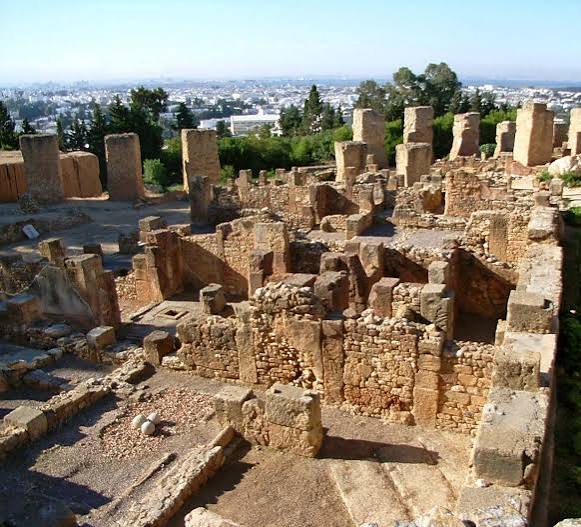
History is written by the victors, and nowhere is that more painfully obvious than in the story of Ancient Carthage. When the Roman Republic finally obliterated the North African metropolis in 146 BC, they did not just burn the buildings; they systematically incinerated Carthaginian libraries, erased their records, and spent the next two millennia painting their fallen rivals as treacherous, baby-sacrificing barbarians. They even coined the phrase fides Punica (Punic faith) as a slur meaning dishonesty and betrayal.
For centuries, the world only heard Rome’s side of the story through biased historians like Livy, Polybius, and Appian. However, modern archaeology and critical historical analysis have shattered the Roman lie. Located in modern-day Tunisia, Carthage was not a den of savages. It was a breathtakingly advanced, multicultural African superpower, an empire of master engineers, agricultural pioneers, and maritime geniuses whose constitutional government was praised by Aristotle himself.
Queen Elissa and the Rise of an African Metropolis
According to ancient tradition, the city was founded around 814 BC (or 825 BC in some accounts) by Phoenician settlers from Tyre, located in modern-day Lebanon. In their native Semitic tongue, they called it Qart-Ḥadašt, meaning New City.
The founding legend centers on a brilliant royal woman: Queen Elissa, known to the Greeks and Romans as Dido. After her tyrannical brother, King Pygmalion of Tyre, murdered her wealthy husband to seize his fortune, Elissa gathered her loyalists, loaded a fleet with royal gold, and sailed west to North Africa.
Upon landing on the coast of Tunisia, she negotiated with the local Berber (Libyan) chieftain, Iarbas, who agreed to sell her only as much land as could be covered by a single oxhide. Outsmarting him, Elissa sliced the hide into microscopic strips, tied them together, and encircled the entire hill of Byrsa, establishing the strategic heart of her new kingdom. While digging the foundation, the settlers unearthed the skull of a horse, a potent Phoenician symbol of courage and war that became the enduring emblem of the state.
While starting as a trading post that paid rent to the indigenous Libyan tribes until 550 BC, Carthage quickly outgrew its mother city. Following the Babylonian and Persian subjugation of Tyre in the 6th century BC, waves of wealthy refugees fled to North Africa, and Carthage emerged as the undisputed protector and hegemon of the western Mediterranean.
Crucially, while Carthaginians preserved their Phoenician language (Punic) and customs, they were deeply rooted in North Africa. Modern genetic and craniometric studies of Punic remains reveal a diverse, heterogeneous population blending indigenous Maghreban (Berber), North African, Sicilian, and Mediterranean ancestry, forming a distinct Liby-Phoenician civilization.
The Architecture of a Superpower: Trade, Iron, and the Cothon
By the 4th and 3rd centuries BC, the Carthage Empire stretched across coastal North Africa from Morocco to western Libya, encompassing southern Spain (Iberia), Sardinia, Corsica, Malta, the Balearic Islands, and western Sicily. The capital city itself housed up to 500,000 people (with some ancient estimates reaching 700,000), protected by 37 kilometers (23 miles) of towering defensive walls that reached 13 meters in height and 10 meters in thickness. Inside the Hannibal district on Byrsa hill, citizens lived in multi-story buildings, some six stories tall, alongside 6-meter-wide grid streets equipped with advanced underground cisterns and drainage systems.
The wealth of the Carthaginian state was legendary, built on three pillars:
- Global Maritime Monopoly: Carthaginian merchant fleets guarded their trade routes with lethal secrecy. They monopolized the Iberian and British tin trade (essential for making bronze) and controlled rich silver mines in Spain, one of which yielded 300 Roman pounds of silver daily. Their explorers pushed the boundaries of the known world: Himilco the Navigator sailed north to Britain, while Hanno the Navigator led a massive expedition down the West African coast, reaching Senegal and potentially as far as Mount Cameroon. Overland, they sent trade caravans across the Sahara Desert and invented the commercial practice of sale by auction.
- Industrial & Agricultural Mastery: Excavations at Bir Massouda reveal that Carthage mastered iron metallurgy and steel production as early as the mid-8th century BC. They also ran massive industrial operations harvesting murex sea snails to produce Tyrian purple dye, worth up to twenty times its weight in gold. In the fertile North African hinterland, they pioneered crop rotation, complex canal irrigation, and invented the horse-driven rotary mill and threshing board. A retired general named Mago wrote a 28-volume agricultural encyclopedia so advanced that when Rome later burned Carthage's libraries, the Roman Senate ordered Mago's work spared and translated into Latin.
- The Cothon Naval Base: Nothing rivaled Carthaginian naval engineering. Their dual-harbor system, the Cothon, featured a rectangular merchant port connected to a heavily fortified, circular military harbor 325 meters wide. Ringed by 220 individual dry-dock slipways and a central admiralty island, the Cothon allowed technicians to build and repair warships using standardized, serial-production parts behind iron chains that sealed the harbor from prying eyes.
Governance, Faith, and the Tophet Controversy
Unlike the autocratic empires of the era, Carthage transitioned from a monarchy in the 6th century BC into a sophisticated oligarchic republic. The state was headed by two annually elected suffetes (judges) who held civil and judicial power. They governed alongside the Adirim (a supreme council of 30 wealthy elders) and a Popular Assembly where everyday citizens had the deciding vote whenever the leaders deadlocked.
Uniquely in the ancient world, Carthage strictly separated political and military power. Generals (rab mahanet) were elected or appointed purely for military campaigns and held no civic authority. To keep these commanders in check, the state created the Tribunal of the One Hundred and Four, a ruthless judicial body that audited generals after every war and did not hesitate to crucify commanders who failed or acted recklessly.
Spiritually, the Carthaginians worshipped a pantheon led by Baal Hammon and his consort, Tanit, the virgin mother goddess of war and fertility whose outstretched-arm symbol adorned monuments across North Africa.
It was within their religious enclosures, known as tophets (such as at Salammbô), that archaeologists uncovered thousands of urns containing the cremated bones of infants and lambs. While Roman propagandists claimed Carthage conducted mass, systematic child slaughters, modern forensic and archaeological evidence paints a far more nuanced picture. Many scholars argue these sites were sacred necropolises for infants who died of natural causes or stillbirth in an era of high infant mortality, while studies confirming ritual sacrifice note it was an exceedingly rare, desperate measure during existential crises, affecting roughly 0.005% of the population, nowhere near the bloodthirsty caricature invented by Rome.
Clash of Titans: The Sicilian and Punic Wars
For centuries, Carthage’s primary rival was Greek Syracuse. Beginning in 480 BC at the Battle of Himera, the two powers fought three grueling Sicilian Wars, trading control of the island as Carthaginian armies were repeatedly halted not by Greek swords, but by devastating outbreaks of plague.
However, the true existential threat emerged from Italy. After centuries of peaceful commercial treaties, competition over Sicily ignited the Punic Wars (264–146 BC) between Carthage and the expanding Roman Republic.
- The First Punic War (264–241 BC): Triggered by a dispute in Messana, the war saw Rome reverse-engineer a shipwrecked Carthaginian warship and invent the corvus, a spiked boarding bridge that turned naval battles into land fights on water. Defeated at sea, Carthage surrendered Sicily and paid a heavy war indemnity. Immediately afterward, Carthage survived the brutal Mercenary War (241–238 BC), when 20,000 unpaid foreign soldiers and heavily taxed Libyan subjects mutinied before being crushed by General Hamilcar Barca. Taking advantage of Carthage's exhaustion, Rome illegally seized Sardinia and Corsica.
- The Second Punic War (218–201 BC): Swearing a blood oath to avenge his homeland, Hamilcar’s 26-year-old son, Hannibal Barca, launched the most audacious military campaign in human history. Commanding a multiethnic army of Liby-Phoenicians, Iberians, Gauls, Balearic slingers, and elite Numidian cavalry, backed by North African war elephants, Hannibal marched overland from Spain and crossed the freezing Alps into Italy. For 15 years, Hannibal terrorized the Roman heartland, annihilating Roman legions at Trebia, Lake Trasimene, and the tactical masterpiece at Cannae (216 BC), where he encircled a vastly larger Roman force and slaughtered 60,000 soldiers in a single day. Yet Rome refused to surrender, cutting off Hannibal’s supplies in Spain under Scipio Africanus and invading North Africa. Crucially, Rome secured the defection of the Numidian king Masinissa, whose unmatched African cavalry helped Scipio defeat Hannibal at the Battle of Zama in 202 BC.
- The Third Punic War (149–146 BC): Stripped of its empire and navy, Carthage miraculously used its agricultural and mercantile brilliance, spearheaded by Hannibal serving as suffet, to pay off its debt and prosper once more. Terrified of an African resurgence and coveting its rich farmlands, Roman Senator Cato the Elder ended every speech with the cry, Carthago delenda est! (Carthage must be destroyed!). Using border skirmishes provoked by Numidia as a pretext, Rome demanded Carthage abandon its coastal home. The Carthaginians refused, turning their city into a giant workshop that forged 140 shields, 300 swords, and 500 spears a day and held off a massive Roman siege for three years.
In 146 BC, Scipio Aemilianus breached the walls. After six days of brutal house-to-house combat up to the Byrsa citadel, the Romans burned the metropolis to the ground, killing hundreds of thousands and selling the 50,000 survivors into slavery. (The myth that Rome sowed the earth with salt was a 19th-century fabrication.)
The Immortal African Legacy
Rome tried to murder the memory of Carthage, but the civilization was too deeply woven into the fabric of North Africa to die. A century later, Julius Caesar rebuilt Roman Carthage on the exact same site, and it rapidly grew back into a city of 500,000, serving as the wealthy breadbasket of the empire and a foundational center of early Christianity.
More importantly, Punic identity endured. Cities across North Africa continued electing suffetes for centuries. In the 3rd century AD, the Libyan-Punic general Septimius Severus ascended the throne as Emperor of Rome, speaking Latin with a thick Punic accent. As late as the 5th century AD, 600 years after the city's fall, the North African theologian Augustine of Hippo noted that local farmers still proudly spoke the Punic tongue. Carthage was not a footnote to Roman greatness; it was an African titan that shaped the ancient world.