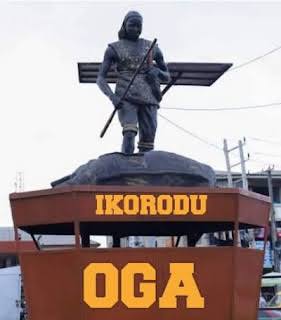
There are cities that merely exist on a map, and then there are cities whose very stones tell a living story of migration, diplomacy, resilience, and identity. Ikorodu, affectionately celebrated as “Ilu kekere oko ilu bantata” (the small town that commands big towns), is precisely the latter.
Tucked quietly along the northeastern edge of the Lagos Lagoon, just a stone's throw from the Ogun State border, Ikorodu's metamorphosis from a dense, untamed forest into the second-most populous Local Government Area in Lagos State is a masterclass in African community-building. Through the intellectual depth of Cheikh Anta Diop, the cultural fidelity of Toyin Falola, the poetic resonance of Maria Popova, and the pulse of modern public chronicling, let us peel back the layers of time to uncover the true, unvarnished history of Ikorodu.
The Genesis: Prince Oga and the Odu Farm
Long before the hum of vehicular traffic and the towering presence of industrial estates, the land that forms modern Ikorodu was a massive, undisturbed forest. In the early seventeenth century, this expanse served as prime hunting ground for the royal princes of Shagamu, specifically the children of Oba Koyelu, the second Akarigbo of Orile Offin.
Among them was Olusoga, famously known as Oga, the eldest and most formidable prince. Gifted in leadership and unmatched in his hunting expeditions, Oga carved a path deep into the wilderness. Alongside his brothers, including Lasunwon, Rademo, Anoko, Osonusi, and Sekumade, Oga established a permanent settlement where they initially farmed and hunted.
Nature provided the town's original moniker. The early settlers discovered an abundance of odu, a dark leafy vegetable plant whose sap possessed powerful blackening properties used extensively by Remo women for cloth dyeing. Because they farmed and harvested this plant, they named the area Oko-Odu (the farm of odu). Over generations of casual usage, Oko-Odu softened on the tongue, transforming first into Okorodu and finally into Ikorodu.
A Cosmopolitan Tapestry: The Coming of the Binis
What makes Ikorodu's foundation remarkable is its early embrace of multicultural harmony. Prince Oga did not build a fortress of exclusion; instead, he opened his doors to incoming traders and travelers plying the coastal routes between Shagamu, Ijebu, and Epe.
Around 1630, a large, influential contingent of Benin migrants arrived by land through Iki (in modern Ogun State). Led by a wealthy and powerful merchant named Eregbouwa (subsequently called Rebugbawa in Ikorodu), descended from the ancient Oliha royal family of Benin City, these migrants sought a peaceful haven. In the Benin language, Ere translates to king, and Uwa means peace and prosperity; thus, Eregbouwa fittingly carried the mantle of a leader of peace.
Rather than clashing for dominance, a brilliant administrative compact was forged. The institutions of governance were meticulously balanced:
- The Obaship was permanently conceded to the Akarigbo royal lineage (represented by the founding families of Lasunwon and Rademo).
- The Olisaship (the Kingmaker and Prime Minister) was entrusted to the descendants of Eregbouwa and the Benin settlers.
This dual-pillar governance ensured that unity superseded tribal friction. The town expanded into three traditional divisions, Isele, Ijomu, and Aga, governed under the administrative oversight of the Osugbo council headed by the Olisa as chairman of the Iwerefa.
The Walls of Resilience: The Egba Conflict and Colonial Annexation
As Ikorodu flourished into a thriving coastal trading port dealing in palm oil, local crafts, and agricultural goods along the Lagos Lagoon, its strategic prominence drew regional tensions.
By the 19th century, Ikorodu found itself locked in a geopolitical crisis with the expansionist Egba state. Some Ikorodu traders were accused of facilitating weapon passages past the Egba blockade to aid Ibadan during wartime. Surrounded on land by hostile Egba forces and blockaded on the lagoon by British warships, Ikorodu faced total strangulation.
Under the leadership of the local Balogun at the time, the people of Ikorodu made an uncompromising choice: they chose to stand and defend their homeland. Refusing to starve out or surrender, they successfully repelled the pressure, preserving their sovereignty and cementing their reputation as an unyielding fortress.
By 1894, the shifting tides of European imperialism caught up with the coast, and Ikorodu was officially annexed by the British colonial government, integrated first into the Lagos Colony, and later placed under the administrative framework of the Western Region.
Administrative Shift: Entering Lagos State
For decades, while culturally and socially intertwined with its Yoruba roots, Ikorodu remained administratively governed under the Western Region. However, a historic turning point arrived on May 27, 1967.
Under the decree issued by General Yakubu Gowon’s military government creating Nigeria's initial 12 states, Lagos State was born. In this sweeping restructuring, Ikorodu, alongside Ikeja, Badagry, Epe, and Lagos Island, was officially merged into Lagos State. A town that had historically traced its administrative lineage through Remo and Ijebu thus became an integral pillar of Nigeria’s commercial nerve center.
Modern Metamorphosis: From Ancient Farms to an Industrial Titan
Today, Ikorodu has exploded past its historical boundaries. Ranked as the second-most populous Local Government Area in Lagos State, it serves as a bustling residential, commercial, and industrial nexus. Home to major manufacturing estates like Odogunyan, higher institutions such as the Lagos State University of Science and Technology (LASUSTECH) and Caleb University, and monumental agricultural landmarks like the massive Imota Rice Mill, designed to be the largest rice processing plant in sub-Saharan Africa, Ikorodu bridges the glorious antiquity of its past with the high-tech ambitions of tomorrow.
From Prince Oga hunting in a dense, quiet forest to a vibrant metropolis hosting over a million souls, Ikorodu remains a monument to African enterprise, diplomacy, and enduring sovereignty.