The history of anti-colonial resistance in Africa is filled with extraordinary uprisings that the colonizers desperately tried to bury. In 1928, a profound rebellion erupted across the vast interior of French Equatorial Africa and French Cameroon, an area encompassing much of today's Central African Republic, southern Chad, and the Republic of the Congo.
It was known as the Baya War, or more powerfully, the Kongo-Wara Rebellion, the War of the Hoe Handle.
This was not a spontaneous riot. It was a massive, spiritually charged, and strategically organized movement led by an unassuming prophet who dared to say no to the crushing weight of the French colonial system. To understand this rebellion, one must first look at the devastating conditions that forced hundreds of thousands of Central Africans to rise up.
The Spark: A System of Brutality
By the 1920s, the French colonial system in Central Africa had become exceptionally brutal. The French administration, alongside predatory European concessionary companies, was extracting resources from the land at an alarming rate. To fuel this extraction, they subjected the native Gbaya people and surrounding ethnic groups to horrific conditions:
- Forced Labor for the Congo-Ocean Railway: The French administration forcibly recruited thousands of Central African men to construct the treacherous Congo-Ocean Railway, a project notorious for its horrific mortality rate.
- Rubber Tapping: Natives were violently coerced into dangerous, labor-intensive rubber tapping and latex collection to satisfy the demands of European corporate entities.
- Taxation and Subjugation: The Gbaya people faced crippling taxation and mistreatment, not only from the French but also from the Fulani (Fula) chiefs, whom the French had empowered to administer territories on their behalf.
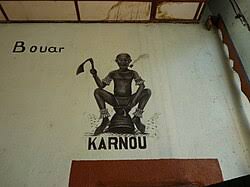
In 1924, from the Sangha River basin, a man emerged to challenge this system. His name was Barka Ngainoumbey, but to his followers, he was known as Karnou, which translates to he who can change the world.
The Rise of Karnou and the Boycott
Karnou was a Gbaya religious prophet and traditional healer. He did not initially call for armed warfare. Instead, he began preaching a gospel of non-violent resistance against both the French colonizers and their Fulani collaborators.
He urged his people to stop paying taxes, stop working for the French colonial system, and stop obeying the administration. Karnou’s movement quickly grew into a powerful campaign of civil disobedience and Black solidarity, including a widespread boycott of European merchandise.
To unite his followers, Karnou utilized traditional Gbaya spirituality. He distributed small, hooked sticks that resembled miniature hoe handles, known as koŋgo wara. Karnou taught that this sacred object, combined with traditional medicine and spiritual preparation, would grant the people invulnerability and allow them to peacefully overthrow their oppressors.
Because the French administration had a limited physical presence in the dense, rural interior, Karnou’s movement grew unnoticed for three years. By 1927, an unprecedented 350,000 adherents had joined the movement, including roughly 60,000 warriors, a staggering display of unity in a region historically known for its political fragmentation.
The War of the Hoe Handle Begins
The peaceful boycott could not last in the face of continued colonial aggression. In mid-1928, the movement shifted from civil disobedience to armed insurgency. The Kongo-Wara Rebellion officially began.
The conflict was ignited by a clash between Karnou’s followers and a group of Fula pastoralists between the towns of Baboua and Bouar. This was quickly followed by attacks on a French agricultural agent and his police escort. Violence spread rapidly. Insurgents targeted French traders, colonial government outposts, and local chiefs who collaborated with the French. The rebels successfully captured and burned down the town of Bouar.
The fighters were deeply motivated by Karnou's mysticism. Many believed the sacred koŋgo wara rendered them immune to European weapons, encouraging them to fight with incredible, sometimes reckless, bravery. In one recorded instance, a Gbaya man danced before a French commander, threatening him with a spear and chanting, Fire, big gorilla; your gun will only shoot water.
The rebellion spread unevenly, reaching deep into the Mbéré and Vina valleys of French Cameroon, southern Chad, and the French Congo. However, it is important to note that the rebellion was not entirely pan-ethnic. Some Gbaya clans, whose leaders had cultivated diplomatic ties with the French and Fulani to secure official chieftainships, actively sided with the colonial administration.
The French Retaliation and the Death of Karnou
Stunned by the scale of the uprising, the French military launched a massive, heavily armed counter-offensive in late 1928. They deployed reinforced troops to crush the movement.
Tragically, on December 11, 1928, Karnou was killed by a French military patrol. The French hoped that the death of the prophet would extinguish the rebellion, but they were mistaken.
The movement fragmented, but the resistance continued fiercely under Karnou's lieutenants, Bissi and Yandjere. To quell the ongoing dissent, the French resorted to brutal scorched-earth tactics. They imprisoned movement followers and forcibly relocated entire native populations from the forests into designated, easily supervised villages. They also attempted to forcibly conscript natives to fight against the rebels, though many groups, like the Ngando people, simply abandoned their villages and hid deep in the forest.
The final, desperate stage of the conflict, known as the war of the caves, continued until the rebellion was finally suppressed in 1931.
The Legacy of Karnou
The Kongo-Wara Rebellion was the largest interwar insurrection in both French Equatorial Africa and French Cameroon, yet it was deliberately relegated to relative obscurity by the French public and politicians.
However, the rebellion was not a failure. The negative press generated by the conflict in Europe forced the French administration to introduce reforms. The French agreed not to renew the leases of the brutal concessionary companies and slightly reduced the worst forms of oppression to stabilize the region.
Decades later, during the 1940s and 50s, Barthélemy Boganda, the vanguard Central African nationalist and first Prime Minister of the autonomous territory, invoked the legacy of Karnou. Boganda equated himself to the fallen prophet, using the memory of the rebellion to mobilize nationalistic sentiments and push for independence.
Today, the story of Karnou and the Kongo-Wara Rebellion is passed down through Gbaya folktales and songs. It serves as a powerful reminder that Central Africa did not passively accept colonization. When faced with unimaginable brutality, the people of the Sangha River basin united, stood their ground, and fought a war for their humanity.