Long before the United States declared its independence, before the Haitian Revolution shook the world, and before Mexico broke away from the Spanish Crown, a group of formerly enslaved Africans forced the mighty Spanish Empire to surrender.
They were led by a man named Gaspar Yanga, a brilliant tactician, a spiritual leader, and a man who would become known as the First Liberator of the Americas.
While the history books often center the story of the Americas around European conquerors and indigenous populations, the profound impact of African resistance is frequently erased. Between the mid-16th and mid-17th centuries, the number of enslaved Africans brought to New Spain (colonial Mexico) exceeded the indigenous population. They were brought to work the brutal sugarcane plantations and silver mines, replacing the indigenous populations decimated by European diseases.
But these Africans did not submit quietly. The story of Yanga is a testament to the unyielding African spirit and the lengths to which people will go to reclaim their freedom.
From African Royalty to Maroon Leader
Born in 1545, Gaspar Yanga is widely believed to have been a member of a royal family from West or Central Africa. Some accounts trace his lineage to Gabon, while others suggest he belonged to the Brong (or Abron) people, an Akan-speaking group from modern-day Ghana. The name Yanga itself carries significant weight, meaning pride in several West African languages, including Yoruba.
Kidnapped, enslaved, and dragged across the Atlantic to Veracruz, Mexico, Yanga refused to accept his subjugation. Around 1570, he organized an escape. Yanga led a group of his fellow enslaved Africans away from the sugarcane plantations and deep into the rugged, nearly impenetrable highland jungles near Mount Orizaba.
There, they established a Palenque, a maroon colony of self-emancipated Africans. For over thirty years, this community grew to a population of about 500 people, remaining virtually untouched by Spanish authorities.
The Strategy of Survival
Yanga was not just a runaway; he was a governor, a military commander, and a spiritual guide. He organized his community into a structured, agricultural society that farmed cotton, sweet potatoes, and sugar cane, and raised cattle.
But survival required more than farming. The maroons, known as Cimarrones, actively resisted the colonial economy. Yanga’s warriors launched strategic raids on the caravans transporting valuable goods along the Camino Real (Royal Road) between Veracruz and Mexico City. They destroyed plantation property, secured provisions, and, most importantly, freed other enslaved Africans who then joined their ranks.
For decades, the Spanish Empire sent armies to destroy the Palenque, and for decades, Yanga’s people fought them off. To the Spanish, Yanga was a dangerous bandit; to the enslaved, he was a beacon of hope. The colonial authorities realized that Yanga's continued success was a direct threat to the entire system of racial slavery. If Yanga could live free, so could others.
The Spanish Attack of 1609
By 1609, the Viceroy of New Spain, Luis de Velasco, decided that the Palenque had to be annihilated. He dispatched a heavily armed force of about 550 troops, including 100 Spanish regulars, from Puebla.
They were met by an irregular maroon force of about 500 fighters. Only 100 of Yanga's men had firearms; the rest were armed with stones, machetes, and bows and arrows. The maroon troops were commanded by Francisco de la Matosa, an Angolan. Yanga, who was quite old by this time, chose to use his people's superior knowledge of the treacherous mountain terrain to their advantage.
Before the battle commenced, Yanga sent terms of peace via a captured Spaniard. He demanded an area of self-rule and the freedom of his people. In a calculated political concession meant to soothe the anxieties of local slave owners, Yanga agreed that his proposed district would return any future runaway slaves.
The Spanish arrogantly refused the terms and attacked. They managed to advance into the settlement and burn it, but they were entirely unprepared for the ferocious guerrilla warfare waged by the maroons. The Spanish suffered heavy losses and failed to secure a conclusive victory. The conflict degenerated into a bloody stalemate that lasted for years.
The First Free Town in the Americas
Unable to defeat Yanga militarily, the Spanish Empire was forced to do something extraordinary: they surrendered their absolute authority and came to the negotiating table.
By 1618, a treaty was signed. The Spanish formally recognized the freedom of the maroon community and granted them the right to establish an independent settlement. Yanga's terms were met, with the stipulations that only Franciscan priests would tend to the people, and that Yanga and his descendants would retain the right to govern.
In 1630, the town of San Lorenzo de los Negros was officially established near Córdoba. It became the very first legally recognized free Black settlement in the Americas. The inhabitants proudly proclaimed their loyalty to the Catholic Church and the King of Spain, but they steadfastly refused to pay tribute to the Spanish government.
The Enduring Legacy of Gaspar Yanga
Gaspar Yanga died sometime after 1618, having spent his life defending the freedom he had so boldly taken. For centuries, his story was largely buried, omitted from the mainstream historical narratives that preferred to focus on European conquerors.
However, his legacy could not be erased. In 1871, five decades after Mexican independence, historian Vicente Riva Palacio (the grandson of Mexico's first Black president, Vicente Guerrero) published accounts of Yanga’s rebellion, officially designating him as a national hero of Mexico and El Primer Libertador de las Americas.
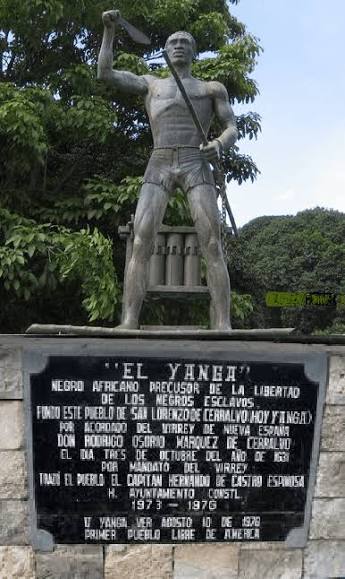
In 1932, the town of San Lorenzo de los Negros was officially renamed Yanga Veracruz in honor of its founder. Today, the town hosts the Carnival of Negritude every August 10th to celebrate his legacy, and a statue of Yanga stands proudly in the town square.
The Gaspar Yanga Biografia is not just a story of a slave rebellion; it is the story of a founder. Before America was America, Gaspar Yanga proved that enslaved people could win, build a free town, and force Europe's most powerful empire to negotiate. He broke the grip of colonial slavery and laid the foundation for Afro-Mexican identity.
It is time we say his name.