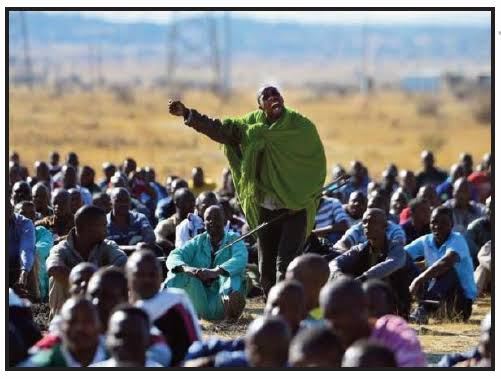
On August 16, 2012, under the blinding winter sun of South Africa's North West province, the soil of a rocky outcrop near Rustenburg drank the blood of thirty-four African mineworkers. They were armed mostly with wooden walking sticks, knobkerries, and traditional blankets wrapped around their shoulders. They had gathered on a public hill, a koppie, asking for nothing more than a living wage from Lonmin, one of the wealthiest multinational platinum mining corporations in the world.
In response, the democratic state unleashed the full, militarized force of the South African Police Service (SAPS). Armed with R5 assault rifles, tactical shotguns, and combat helicopters, police discharged hundreds of live rounds into the crowd. When the dust settled, thirty-four men lay dead, seventy-eight were maimed and bleeding, and nearly three hundred were thrown into police vans.
The Marikana massacre became the single most lethal use of state violence against civilians in South Africa since the 1976 Soweto uprising. For a continent that had celebrated the end of apartheid less than two decades earlier, the Marikana massacre of 2012 was a devastating, traumatic revelation: the skin color of the rulers had changed, but the brutal machinery of extractive capitalism remained completely intact.
How the Mines Built Inequality
To understand why the Marikana strike of 2012 happened, one must trace the century-old bloodline of the South African mining industry. Following the discovery of diamonds in Kimberley and gold on the Witwatersrand in the late nineteenth century, the colonial and apartheid regimes engineered an economic system built entirely on the hyper-exploitation of cheap, Black migrant labor.
Through draconian laws like the 1913 Natives' Land Act, millions of Africans were stripped of their ancestral lands and herded into barren native reserves and Bantustans. Denied the ability to farm their own land, African men were forced to leave their families in places like the Eastern Cape, Lesotho, and Mozambique to spend their youth deep underground in the bellies of the earth. They were housed in desolate, single-sex concrete compounds, deliberately divided along ethnic lines to prevent worker solidarity, and paid starvation wages.
When workers dared to demand dignity, such as the massive 1946 African Mineworkers' Strike where 100,000 miners stood up against mining conglomerates, the colonial state responded with batons, bullets, and bans.
When democracy arrived in 1994, African workers believed the days of sacrificial labor were over. Instead, post-apartheid economic frameworks embraced neoliberal policies that prioritized corporate profits and created a narrow tier of ultra-wealthy Black elites through Black Economic Empowerment (BEE) programs, leaving the actual miners trapped in the same squalid, dehumanizing conditions their grandfathers had endured.
The Lonmin Mines
South Africa holds more than eighty percent of the world’s platinum reserves, a precious metal essential for modern automotive manufacturing, technology, and luxury jewelry. The Marikana mines, operated by British-owned Lonmin, yielded astronomical profits during the 2000s mineral boom.
Yet, in the settlements of Wonderkop and Nkaneng surrounding the shafts, the people who chiseled that wealth from the earth lived in absolute squalor. Their homes were one-room shacks hammered together from rusting corrugated iron and salvaged timber. Raw sewage ran along dirt tracks, clean drinking water was a luxury shared at broken communal taps, and high-voltage power lines marched right over their roofs to electrify the industrial smelters while leaving their homes in the dark.
At the center of this exploitation were the rock drill operators. Working kilometers beneath the surface in stifling heat exceeding 40°C, rock drillers operated heavy, vibrating pneumatic drills directly against the rock face, breathing in toxic silica dust and risking sudden roof collapses on every shift. For this life-threatening labor, Lonmin paid them an average take-home pay of approximately R4,000 (roughly $480 USD at the time) per month.
From this pittance, miners had to pay rent, feed themselves, and send remittances home to support extended families in rural villages. Many fell into the clutches of predatory loan sharks charging interest rates of up to 50 percent. Meanwhile, Lonmin executive directors and board members took home millions in salaries, bonuses, and dividends.
The spark of the 2012 strike lay in a catastrophic breakdown of representation. Historically, the National Union of Mineworkers (NUM) had been the proud vanguard of the anti-apartheid labor movement. But over the years, as NUM became deeply entwined with the ruling African National Congress (ANC) and corporate mining management, the union's leadership grew increasingly alienated from the rank-and-file workers. Shop stewards were promoted to comfortable administrative positions, given luxury perks, and seen as protective shields for management rather than fighters for the working class.
Frustrated by NUM's refusal to back their demands, Lonmin's rock drill operators bypassed the formal bargaining channels. On August 9, 2012, thousands of workers gathered at the Wonderkop stadium and resolved to demand a basic net wage of R12,500 per month, a modest, calculated living wage.
When Lonmin management flatly refused to meet with the unrepresented workers, an unprotected, wildcat strike began on August 10.
Tensions escalated rapidly into bloodshed. On Saturday, August 11, when striking workers marched peacefully toward the local NUM office to demand that the union support their wage claim, NUM officials emerged and opened fire with live ammunition, wounding two miners.
Horrified by their own union shooting at them, the miners abandoned the stadium and assembled on a rocky hill, the koppie, vowing to remain there until Lonmin management came to speak with them.
Over the next few days, chaos erupted across the mining belt:
- August 12: Clashes between strikers and Lonmin private security guards resulted in the deaths of two security officers and several workers.
- August 13: A group of miners walking back to the koppie was intercepted by a heavy police contingent. Despite the miners pleading for a peaceful path, police fired tear gas and stun grenades. In the ensuing melee, two police officers and three mineworkers were killed.
- August 14–15: The state and corporate machinery began coordinating behind closed doors. Lonmin executives met with North West Provincial Police Commissioner Zukiswa Mbombo, agreeing that the strike had to be ended.
Behind the scenes, political pressure mounted. Cyril Ramaphosa, a founding leader of the NUM, an ANC heavyweight, and a major shareholder and non-executive director at Lonmin, sent urgent emails to government ministers and company executives, characterizing the strike not as a labor dispute, but as plainly dastardly criminal and demanding concomitant action from the state.
August 16, 2012: The Day of the Slaughter
By Thursday morning, August 16, the police operational command declared D-Day. Over 700 police officers, including specialized tactical response teams and elite paramilitary units, encircled the koppie. They pre-ordered 4,000 rounds of live ammunition and requested four mortuary vans to be placed on standby.
Leading the workers on the hill was a 30-year-old rock drill operator named Mgcineni Mambush Noki, universally recognized by the bright green blanket draped across his shoulders. Mambush stood at the front lines, speaking through a megaphone, tirelessly pleading for Lonmin management to come and negotiate. Joseph Mathunjwa, president of the rival union AMCU, arrived at the hill and dropped to his knees, weeping as he begged the workers to disperse because he knew the police intended to kill them. But the workers, believing in the justice of their cause and trusting in traditional protective rites, refused to leave without an agreement to talk.
The Cattle Kraal
At approximately 3:40 p.m., police began unrolling razor-sharp barbed wire to herd and encircle the miners. A large group of workers, led by Mambush Noki, began walking peacefully toward the neighboring Nkaneng settlement to avoid entrapment. As they passed a small cattle kraal, police fired tear gas, water cannons, and stun grenades, disorienting the column.
Within seconds, a line of Tactical Response Team officers leveled their R5 assault rifles and unleashed a relentless 12-second barrage of 328 live bullets into the men. Seventeen miners were slaughtered on camera in a cloud of dust and blood. Mambush Noki fell with fourteen bullets tearing through his body.
The Killing at the Small Koppie
What the television cameras did not capture was the second, even more sinister massacre that took place fifteen minutes later at a smaller, bush-covered hill 500 meters away. Scores of terrified, fleeing miners had hidden inside crevices and behind boulders.
Police units converged from all sides, methodically hunting down the hiding workers and firing 295 bullets into the rocks. Another seventeen miners were killed at Scene Two. Post-mortem reports revealed that many of these men were shot at point-blank range, through the back of the head, or while attempting to surrender. To conceal the brutality, police subsequently tampered with the scene, placing weapons beside the corpses of dead workers.
The Mask of Justice: Blaming the Victims
In the immediate aftermath, the state attempted to criminalize the victims. The National Prosecuting Authority arrested 270 surviving mineworkers and, invoking an infamous apartheid-era legal concept known as the common purpose doctrine, charged the miners themselves with the murder of their thirty-four slain colleagues. The move provoked massive public fury across Africa and the world, forcing the state to hastily drop the murder charges.
President Jacob Zuma appointed the official Farlam Commission of Inquiry to investigate the tragedy. While the commission's 2015 report heavily criticized the police's tactical planning and highlighted systemic corporate neglect by Lonmin, it largely shielded political elites from direct criminal responsibility.
The Legacy: A Flame That Will Not Die
Despite the terror of the massacre, the workers never surrendered their dignity. The Lonmin strike continued for another month. On September 18, 2012, Lonmin was forced to sign a wage agreement granting pay increases of up to 22 percent and a return-to-work bonus, proving that the R12,500 wage had been affordable all along.
The sacrifice of the Marikana martyrs triggered a seismic wave across the continent:
- The Death of Old Loyalties: Thousands of miners tore up their NUM membership cards, establishing AMCU as the dominant, fighting union on the platinum belt.
- Political Upheaval: Outrage over the massacre accelerated the founding of the Economic Freedom Fighters (EFF), altering South Africa's political landscape forever.
- The Living Symbol: The green blanket of Mambush Noki became a sacred continental symbol of working-class defiance against state terror and corporate greed.
The Marikana massacre tore the veil away from modern African politics. It proved that national liberation is meaningless if it merely replaces white colonial masters with Black corporate executives while leaving the masses in chains. As long as the wealth of Africa's soil is extracted through the blood of its children, the spirit of the Marikana martyrs will continue to rise from the koppie, demanding true economic freedom in our lifetime.