If you have ever witnessed a friendly but fiercely passionate internet war over who cooks the best Jollof rice, you already know a small piece of this history. West Africans and the global diaspora treat this legendary, smoky, reddish one-pot dish as a matter of supreme cultural pride. But what many food lovers do not realize is that every single grain of that rice carries the soul, the ambition, and the name of a magnificent medieval superpower: the Jolof Empire.
Centuries ago, along the fertile banks of the Senegal River, the Wolof tribe did not just create a culinary masterpiece originally known as benachin; they engineered one of the most sophisticated political confederacies in West African history.
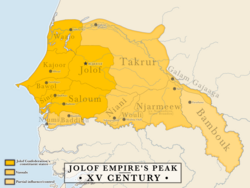
From the mid-14th century until its dramatic fracturing in 1549, the Great Jolof Empire ruled over vast swaths of modern-day Senegal, Gambia, and Mauritania. It was a realm where magic and monarchy walked hand in hand, where fierce military strategies met dazzling wealth, and where a landlocked royal court tried to outmaneuver the rising tide of European maritime trade. To understand the modern, regal-looking, and artistic Wolof people of today, we have to travel back to the smoke, the cavalry charges, and the high-stakes royal betrayals that shook ancient Senegambia.
The Mysterious Prince of the River
Every great empire requires a foundation myth that blurs the line between the earthly and the divine, and the Jolof Empire has one of the most enchanting. Long before a unified state existed, the region of central Senegal was a fragmented landscape divided into separate villages ruled by local chiefs known as Lamanes. These leaders frequently bickered over land, wood, and water.
According to rich Wolof oral traditions, a massive dispute broke out near a prominent lake, threatening to turn into a bloodbath. Suddenly, a mysterious stranger emerged from the waters. This enigmatic figure calmly and fairly divided the disputed resources among the villages and then vanished back into the lake. Astounded by his wisdom and supernatural aura, the villagers feigned a second dispute, waiting for the stranger to return. When he did, they kidnapped him and offered him the kingship of their land.
This stranger was Ndiadiane Ndiaye, the legendary founder of the Wolof state. Traditional narratives drape Ndiaye in an extraordinary lineage, linking him to an Almoravid Islamic preacher on his father’s side and the ancient state of Takrur on his mother’s side. Yet, in a poetic twist of cultural confluence, when Ndiaye first spoke, he uttered his words not in the Wolof language but in Pulaar, signaling his noble status as an enlightened outsider.
When the neighboring magician-king of the Sine Kingdom heard of this man’s fair judgments, he cried out "Ndiadiane Ndiaye!" in amazement. He then suggested that all traditional rulers between the Senegal and Gambia rivers voluntarily surrender their independence to form a grand confederacy under this singular, divine leader. Whether born of peaceful consensus or strategic expansion, this union laid the groundwork for an enduring imperial tapestry.
The Anatomy of an Imperial Confederacy
At the absolute peak of its authority, the Jolof Empire was less of a centralized autocracy and more of a highly organized confederacy of tribute-paying kingdoms. The supreme ruler was known as the Buurba, a sovereign who held both absolute political power and an elevated spiritual status. However, the Buurba did not inherit the throne through simple father-to-son succession; he was carefully selected by an elite electoral college composed of the rulers of the empire's core constituent states.
This grand wollof alliance was composed of five crucial coastal and inland kingdoms:
- Waalo: The northern gateway along the Senegal River.
- Cayor: The wealthy, strategic coastal powerhouse.
- Baol: A central economic hub famous for its close ties to royal maternal lineages.
- Sine and Saloum: The proud Serer-populated kingdoms to the south.
Each of these vassal states retained a high degree of local autonomy and was governed by its own nobly elected ruler. They agreed to cooperate with the Buurba on major geopolitical matters, defend the collective borders, and send regular, lavish tribute to the landlocked imperial capital.
When a new Buurba was appointed, he underwent elaborate, grueling rituals designed to strip away his ordinary humanity and elevate him to a divine entity. The political expectations were immense: the emperor was expected to bring absolute prosperity, rainfall, and military victory to the land. If he failed, or if the gods seemed to unfavor of his rule, the council of nobles held the constitutional power to declare him unfit and depose him.
The Golden Apex and the Dangerous Lure of the Coast
During the 15th century, the Jolof Empire found itself in a golden age of territorial and commercial dominance. As the mighty Mali Empire began to slowly lose its grip on its far-flung western provinces, the Wolof people stepped into the vacuum, rapidly expanding their sphere of influence.
The empire’s military machine was breathtaking. At its height, the Buurba could effortlessly field a colossal army consisting of 100,000 disciplined infantrymen and 10,000 devastatingly fast cavalry horsemen. This massive cavalry army allowed the empire to control the vital inland trade routes, dominating the commerce of hides, ivory, cotton textiles, and, most importantly, gold flowing from the rich inland Bambuk goldfields to the coast.
In the 1440s, a new variable entered the geopolitical equation: Portuguese ships arrived along the Atlantic coast. Initially arriving as hostile raiders, the Portuguese quickly realized it was far more profitable to trade with the mighty Buurba. The Wolof rulers began purchasing fine North African and European horses from these maritime merchants, supercharging their military dominance over the interior.
But this new wealth came with a toxic catch. The capital of the empire was located far inland, isolated from direct maritime access. In the 1480s, an ambitious prince named Bemoi, ruling in the name of his brother, attempted to shift the seat of government closer to the Atlantic coast to monopolize this lucrative European trade. This radical departure from tradition horrified conservative nobles and traditionalist princes. In 1489, a violent revolt erupted, resulting in the murder of the emperor.
Prince Bemoi fled to Lisbon, where he was received with royal splendor by King John II, baptized as a Christian, and given a fleet of twenty Portuguese caravels to reclaim his throne. However, deep in the West African waters, a bitter argument broke out between Bemoi and his Portuguese military commander, leading to the prince’s tragic execution. The European attempt to install a puppet king failed, but the structural damage to the empire was already done.
The Great Social Fabric
The internal world of the Wolof tribe was defined by a rigid, highly sophisticated social hierarchy that structured every aspect of daily life. At the absolute apex sat the royal families and the kangaame (the territorial nobility). Directly below them were the freeborn citizens, who were further stratified into highly respected occupational castes.
The Blacksmiths and Artisans
In Jolof society, master blacksmiths and jewelers were not mere laborers; they were viewed with immense spiritual reverence. Because they could transform raw earth into deadly weapons of war and breathtaking gold filigree jewelry, they held a trusted status and frequently served as neutral, fair mediators in volatile political disputes.
The Griots
The griots were the living archives, musicians, and counselors of the empire. Attached to every noble household, these epic storytellers memorized centuries of genealogies, battles, and treaties. Without their poetic verbal tapestries, the magnificent history of the Wolof people would have been entirely erased by time.
The Warriors and the Ceddo
At the bottom of the social pyramid were the enslaved populations, though they too were divided into distinct classes. The most fascinating of these were the ceddo, an elite class of military slaves owned directly by the crown. The ceddo acted as the emperor's personal enforcement arm, policing agricultural laborers and collecting taxes from stubborn nobles.
The Sovereign Power of Women
While the social hierarchy was unyielding, women held an incredibly unique and formidable position in the governance of the Jolof Empire. The most powerful woman in the realm was the Lingeer, a title typically held by the king’s mother or sister.
The Lingeer was not a mere ornamental figurehead; she was a major political player who managed the royal household and influenced succession choices. She personally owned several wealthy agricultural villages that cultivated crops and paid tribute directly to her treasury. Furthermore, the empire featured specialized female chiefs who presided as judges over legal cases involving women, ensuring their rights were protected under traditional customary law. In the northern constituent state of Waalo, this female empowerment reached its absolute zenith, where women could legally ascend to the office of Bur and rule the state with total sovereign authority.
The Battle of Danki and the Path of the Rump State
The very trade that had enriched the Jolof Empire ultimately became the engine of its destruction. Because the coastal vassal kingdoms, specifically Cayor and Baol, sat directly on the Atlantic coastline, they reaped the lion's share of the benefits from trading with European merchants. They accumulated staggering wealth, access to manufactured goods, and firearms, completely eclipsing the economic power of the landlocked imperial center.
The breaking point arrived in 1549. Fed up with sending tribute to an inland capital that no longer matched their economic might, the Kingdom of Cayor declared open rebellion. Under the brilliant leadership of Crown Prince Amari Ngoone Sobel Fall, the forces of Cayor clashed with the imperial army at the historic Battle of Danki.
The results were catastrophic for the old order. The last emperor of a united Jolof, Leele Fuli Fak, was killed on the battlefield. The defeat triggered a massive, unstoppable ripple effect across the region. Waalo and Baol immediately seized the moment, breaking away from the confederacy to claim their absolute independence. By 1600, the great imperial experiment was over.
Jolof was violently reduced to a landlocked rump state, completely cut off from the maritime Atlantic trade. For the next three centuries, the Kingdom of Jolof survived as a proud but isolated shadow of its former self, plagued by devastating civil wars and constant slave-raiding incursions from neighboring Moorish groups.
Yet, even in its reduced state, the cultural prestige of the Buurba title never truly faded. Until the final independent king, Alboury Ndiaye, was forced into exile by an aggressive French colonial column in 1890, the neighboring kingdoms still looked toward the ancient heartland of Jolof with a deep, lingering ancestral respect.
The Enduring Echoes of Greatness
Though the empires and kingdoms have dissolved into the pages of text, the vibrant legacy of the Jolof Empire remains completely unbroken. Today, the majestic Wolof language has triumphed over time, serving as the dominant national language of Senegal and remaining widely spoken across Gambia and Mauritania.
The regal poise, the breathtaking textile embroidery, the world-renowned gold filigree artistry, and the intricate storytelling traditions of the modern Wolof people are direct inheritance pieces from that golden medieval confederacy.
And, of course, there is the food. Every time a spicy, smoky, beautifully rich pot of Jollof rice is brought to a family gathering or celebrated at a party, it serves as a delicious, living monument to the creative spirits along the Senegal River. It is a reminder that while political borders fade and armies fall, the cultural genius of an emancipated African people can conquer the entire world, one single pot at a time.