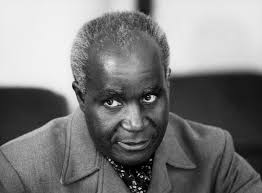
In the pantheon of African liberation leaders, few figures possess the profound historical footprint of Kenneth Kaunda. Affectionately known by his initials, "KK," Kaunda was the driving force behind the campaign to dismantle British colonial rule in Northern Rhodesia, successfully leading the nation to independence in 1964. Serving as the first president of Zambia, he held office for 27 years until 1991.
The life of Kenneth Kaunda of Zambia is a complex narrative. He was a deeply principled anti-colonial champion who housed liberation movements from across Southern Africa, yet he also oversaw a highly centralized one-party state and a devastating national economic collapse. From his early days as a rural teacher to his graceful, historic concession of power, this is the definitive history of President Kenneth Kaunda.
Early Life and Origins at Lubwa Mission
Kenneth David Kaunda was born on April 28, 1924, at the Lubwa Mission in Chinsali, which was then located in the British colony of Northern Rhodesia. He was the youngest of eight children. His parentage would later become a point of political contention: his father, Reverend David Kaunda, was an ordained Church of Scotland missionary and teacher who had migrated from Nyasaland (now Malawi) in 1904. His mother, Helen Nyirenda Kaunda, made history in her own right as the very first African woman to teach in colonial Northern Rhodesia. Both of his parents taught among the Bemba ethnic group in the northern reaches of the territory.
Growing up in this educational and deeply religious environment, young Kaunda attended the Munali Training Centre in Lusaka between 1941 and 1943. Following in his parents' footsteps, he initially pursued a career in education. He served as a boarding master and headmaster at the Lubwa Mission from 1943 to 1945, and later worked as a teacher in Tanganyika (modern Tanzania) and Southern Rhodesia (modern Zimbabwe). In 1948, he moved to Mufulira to teach for the United Missions to the Copperbelt.
During these formative years, Kaunda read the writings of Mahatma Gandhi, whose philosophy of non-violent resistance profoundly moved him and shaped his future political strategies. In 1946, he married Betty Banda, with whom he would eventually have eight children.
The Struggle Against Colonial Rule
Kaunda Kenneth officially entered the political arena in 1949, returning to his homeland to become an interpreter and adviser on African affairs to Sir Stewart Gore-Browne, a liberal white settler. That same year, he became a founding member of the Northern Rhodesian African National Congress (ANC), the colony's first major anti-colonial organization. By 1953, he had relocated to Lusaka to serve as the ANC's Secretary-General under the presidency of Harry Nkumbula.
The primary objective of the ANC was to mobilize indigenous Africans against the European-dominated Federation of Rhodesia and Nyasaland. African leaders fiercely opposed this federation, fearing it was designed to permanently consolidate power in the hands of a white settler minority. The colonial authorities cracked down on this dissent, and in 1955, both Kaunda and Nkumbula were sentenced to two months of imprisonment with hard labor for distributing "subversive" literature.
Over time, ideological rifts emerged. Dissatisfied with Nkumbula's increasingly moderate stance and his perceived failure to adequately defend indigenous Africans, Kaunda led a dissident faction away from the ANC in October 1958. He founded the Zambian African National Congress (ZANC) and became its president. Kaunda utilized ZANC to execute a policy he called "positive nonviolent action," relying on civil disobedience against the federation. The colonial government swiftly banned ZANC in March 1959, and Kaunda was sentenced to nine months in prison, serving time in Lusaka and Salisbury.
While he was incarcerated, his political allies, including Mainza Chona, formed the United National Independence Party (UNIP). Upon his release in January 1960, Kaunda was immediately elected president of UNIP. Under his leadership, the party experienced spectacular growth, claiming 300,000 members by June 1960. In July 1961, he organized the "Cha-cha-cha campaign" in the Northern Province, an aggressive civil disobedience initiative that involved arson and the obstruction of significant roadways.
The pressure succeeded. In the October 1962 elections, despite a constitutional framework designed to disproportionately favor European settlers, UNIP and the ANC captured a majority of the votes. UNIP won 15 of the 37 seats, leading to a UNIP-ANC coalition government with Kaunda serving as Minister of Local Government and Social Welfare. In January 1964, UNIP won a decisive electoral victory, and Kenneth Kaunda became the prime minister.
The First President of Zambia
On October 24, 1964, the British protectorate was officially dissolved, and the independent republic of Zambia was born. Kenneth Kaunda was inaugurated as the nation's first president.
Upon taking office, President Kenneth Kaunda faced the monumental task of developing a nation that had been systematically neglected. At independence, Zambia possessed just one hundred university graduates and roughly 6,000 indigenous inhabitants with two or more years of secondary education. To rectify this, Kaunda implemented a policy providing free exercise books and pens to all children, requiring parents to pay only a token school fee and supply uniforms. In 1966, he oversaw the opening of the University of Zambia in Lusaka, serving as its first Chancellor.
Economically, the new government inherited a vibrant economy resting on vast, rich copper deposits, though these resources were almost entirely controlled by foreign multinational corporations like the British South Africa Company (BSAC). In April 1968, Kaunda initiated the Mulungushi Reforms, a massive nationalization program aimed at bringing foreign-owned corporations under the control of the state's Industrial Development Corporation. By 1974, the government had fully nationalized the copper mining industry.
However, his economic management ultimately proved disastrous. Kaunda modeled the agricultural sector on socialist policies similar to Tanzania's, neglecting agrarian development while simultaneously subsidizing food for the urban poor. When the 1973 oil crisis hit and global copper prices plummeted, the Zambian state lost its primary source of income. The nation fell heavily into debt with the International Monetary Fund (IMF), and long-term planning was abandoned in favor of constant crisis management. Over the 1970s and 1980s, unemployment surged, living standards decayed, and Zambia suffered severe economic impoverishment.
Zambian Humanism and the One-Party State
Politically, Kenneth Kaunda's Zambia evolved into an increasingly authoritarian environment. Shortly before independence in 1964, violent clashes erupted between the government and supporters of the Lumpa Church, led by Alice Lenshina; Kaunda temporarily banned the church and ordered her arrest.
Following inter-party political violence during the 1968 elections, and threatened by the emergence of the rival United Progressive Party founded by his former ally Simon Kapwepwe in 1972, Kaunda moved to consolidate absolute power. He signed the Choma Declaration on June 27, 1973, and promulgated a new constitution that legally transformed Zambia into a one-party state, banning all political parties except UNIP.
Under this system, Kaunda promoted a left-nationalist ideology known as "Zambian Humanism". This philosophy combined mid-20th-century central planning with what he described as traditional African principles of mutual aid, trust, and community loyalty. Operating as the sole legal candidate, he was re-elected in 1978, 1983, and 1988, consistently claiming over 80 percent of the official vote.
A Pillar of Southern African Liberation
Despite his domestic economic failures, Kenneth Kaunda of Zambia earned immense international respect for his foreign policy. He was a fiercely outspoken opponent of apartheid and white minority rule throughout Southern Africa.
Zambia became a critical "Frontline State," serving as a haven and operational base for numerous liberation movements, including the African National Congress (ANC) of South Africa, ZAPU and ZANU of Rhodesia (Zimbabwe), and SWAPO of Namibia. ANC leader Oliver Tambo spent a significant portion of his 30-year exile living and working in Zambia.
This logistical and diplomatic support placed a massive burden on the Zambian economy, as the white-minority governments were previously the country's primary trading partners. Zambia also suffered direct military retaliation, being bombed by both Rhodesian and Portuguese jets in the 1960s and 1970s. To bypass white-dominated trade routes, Kaunda established close ties with the People's Republic of China, which funded and constructed the TAZARA Railway linking the Zambian Copperbelt to the Tanzanian port of Dar es Salaam in 1975.
Kaunda served as the chairman of the Organization of African Unity (OAU) twice and chaired the Non-Aligned Movement from 1970 to 1973. He functioned as a crucial diplomatic mediator, hosting figures like Henry Kissinger and working extensively with Western and African leaders to facilitate majority rule across the continent.
Fall from Power and the Return to Democracy
By 1990, the deteriorating economy, characterized by soaring food prices and crumbling infrastructure, reached a breaking point. In July, three days of violent rioting erupted in Lusaka, followed by a brief, unsuccessful military coup attempt. Realizing the deep public dissatisfaction, Kaunda was forced to reverse his long-standing defense of the one-party system.
In December 1990, he signed constitutional amendments that dismantled UNIP's monopoly on power, legalizing opposition parties and paving the way for multiparty elections. In the elections held in late 1991, the Movement for Multiparty Democracy (MMD), led by trade unionist Frederick Chiluba, defeated UNIP in a landslide. Kaunda captured only 24 percent of the vote compared to Chiluba's 75 percent.
On November 2, 1991, Kenneth Kaunda peacefully handed over power. He became only the second mainland African head of state to allow free multiparty elections and voluntarily relinquish office after an electoral defeat.
Post-Presidency and Final Years
After leaving office, Kaunda continued to clash with Chiluba's MMD government. Intending to run for the presidency again in 1996, he was barred after the government passed constitutional amendments specifically designed to make citizens of foreign parentage ineligible, a direct attack on his Malawian heritage. In 1997, he was arrested by paramilitary police on charges of inciting an attempted coup, though he was released under house arrest and the charges were subsequently dropped in 1998.
In 1999, a high court temporarily declared him stateless, attempting to formally strip his Zambian citizenship, but the Supreme Court of Zambia successfully overturned the ruling in 2000. Kaunda officially resigned as UNIP's president and retired from active politics in 2000.
In his retirement, Kaunda devoted his formidable energy to humanitarian efforts, primarily fighting the catastrophic spread of the HIV/AIDS pandemic across Africa, a disease that had tragically claimed the life of one of his own children in the 1980s. He founded the Kenneth Kaunda Peace Foundation and served as an African President-in-Residence at Boston University from 2002 to 2004.
On June 14, 2021, the 97-year-old former president was admitted to the Maina Soko Military Hospital in Lusaka. Having been a strict lacto-vegetarian for much of his life, who gave up alcohol and tea in the 1950s, his health eventually failed him due to a recurring battle with pneumonia. Kenneth Kaunda passed away on June 17, 2021.
He was survived by 30 grandchildren and eleven great-grandchildren. His death triggered an outpouring of grief across the continent; Zambia observed 21 days of national mourning, while nations such as Zimbabwe, South Africa, Botswana, Malawi, Namibia, and Tanzania declared their own extended periods of state mourning to honor the fallen patriarch of African independence.