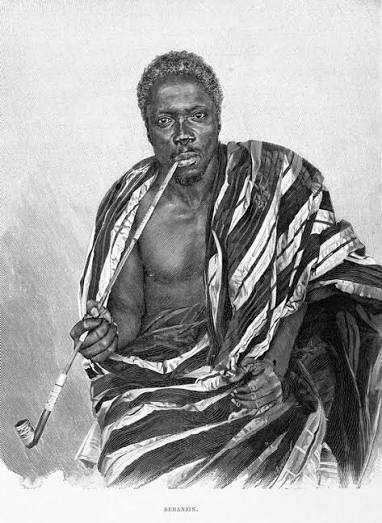
There is a profound difference between a ruler who clings to a throne at any cost and a hero who surrenders everything to save his people. When the history of the African continent is told, the narrative too often dwells solely on colonial conquest. But that is a tremendous disservice to the genius and valor of Béhanzin, the eleventh monarch of the formidable Fon kingdom in modern-day Benin. He was not just any king; he was the ruler of the land of the rising sun and whispering winds, where the trees danced, and the ocean sang. He had a heart as big as his kingdom and a will as strong as the ancient baobab trees.
To truly understand the legacy of the man known as the King Shark, we must look beyond his eventual exile. We must look at how he brilliantly modernized his nation, how he forced a European superpower to its knees through tactical economic warfare, and how he ultimately chose his people's survival over his own freedom.
The Architect of a Modern Empire
Long before the French colonial army set foot on the royal soil of Abomey, a prince was born whose name would become synonymous with anti-colonial defiance across West Africa. He entered the world in 1845 on the Abomey plateau as Ahokponou Nyakaja Honsinyenli, the son of King Glèlè and Queen Nan Akossou Mandjanou. Designated as the royal heir in 1875 under the name Kondo, he grew up watching European powers gradually slice away at the coastlines of the African continent. When his father passed away in December 1889, Kondo ascended the throne in January 1890 as the eleventh king of the Fon kingdom of Dahomey, located in present-day Benin.
Upon taking the crown, he assumed the royal title of king Béhanzin Aïdjéré. In the rich tradition of Dahomey, a new monarch selected personal symbols and proverbs that embodied the ethos of his reign. Béhanzin chose the egg, two coconut palm trees, and above all, the shark. His name translated to “the egg of the world or the son of the shark,” earning him the legendary moniker “King Shark”. His royal motto reverberated through his court and across the ocean: “the angry shark comes to disturb the helm,” or as oral history proudly echoes, “the angry shark will terrorize his enemy”. He was an intelligent, courageous, and fiercely independent leader who saw European encroachment for what it truly was: an existential threat to his ancestral homeland.
He assumed the royal symbol of the shark, a powerful metaphor signifying that he would fiercely guard the coast of the kingdom of Dahomey just as the mighty shark guards the ocean's treasures. His people loved him, recognizing him as an intelligent, courageous, fair, and just ruler who saw the creeping threat of European encroachment along the West African coast.
King Behanzin knew that defending his sovereignty required more than just ancestral courage; it required absolute modernization. He aggressively grew and upgraded his military infrastructure, completely transforming the Dahomean army into one of the most powerful and best-organized forces in West Africa. Through the port of Whydah, he strategically purchased between 4,000 and 6,000 modern rifles, including advanced Winchester and Mannlicher carbines, from German merchants.
He commanded a massive, disciplined force of 15,000 male soldiers alongside his elite vanguard of 5,000 female warriors. The Fon people lovingly referred to these women as Minon, meaning “our mothers,” though the terrified French called them Dahomey Amazons because of their fierce, unparalleled combat skills. Together, this highly trained military machine stood as an iron wall against foreign invaders.
The Economic Masterstroke and the First Victory
The brilliance of King Behanzin was not just in his military might, but in his strategic mind. In 1890, the French attempted to assert control over the coastal port of Cotonou and the tributary kingdom of Porto-Novo. When hostilities broke out in the First Franco-Dahomean War, the French relied on their superior weaponry and fortified log stockades to hold off the Dahomean charges.
Instead of continuing to throw his warriors against heavily fortified French infantry squares and gunboats, Béhanzin pivoted to a brilliant tactical alternative: economic warfare. Knowing that the French colonial enterprise was driven by profit, he ordered his forces to destroy the lucrative palm plantations at Porto-Novo systematically.
This calculated economic devastation completely paralyzed the French commercial ambitions and precipitated an early end to the hostilities. France was forced to the negotiating table. On October 3, 1890, a treaty was signed where the French had to concede to paying King Béhanzin a handsome annual annuity of 20,000 francs just for the right to use the port of Cotonou. By outsmarting them economically, Béhanzin secured a massive diplomatic and financial victory that funded the further growth of his kingdom.
The Magic Sticks and the Second War
The peace lasted for two years, during which Béhanzin continued to stockpile weapons and prepare his nation for the inevitable return of the colonizers. In 1892, a massive French expeditionary force led by Colonel Alfred-Amédée Dodds invaded, bringing with them foreign troops and devastating new technology. The invaders arrived with ships as big as castles and weapons that spat fire.
The king led his army with the wisdom of the owl at night, and they fought many fierce battles. Rather than fighting predictable set-piece battles, Béhanzin adapted. He utilized guerrilla warfare, ordering his troops to dig trenches and foxholes to aggressively slow the French march toward the capital. The Minon warriors fought with the courage of lions, launching relentless bayonet charges and targeting French officers. In one legendary account, a trusted wife of Béhanzin ran out of ammunition at the peak of battle and fiercely killed the head of French military intelligence by ripping out his throat with her sharpened teeth, avenging family members who had been corrupted by French bribes.
Despite the legitimacy of their cause and their breathtaking courage, the Dahomean army faced insurmountable odds. The invaders possessed “magic sticks” that made loud noises and could fatally hurt people from far away. The French Lebel rifles and heavy artillery began to decimate the Dahomean ranks, inflicting thousands of casualties.
The Scorched Earth and the Ultimate Sacrifice
By November 1892, the French forces were closing in on the royal capital of Abomey. It was here that King Behanzin made his most agonizing and profound sacrifice. Rather than allowing his sacred ancestral capital to be captured, looted, and desecrated by the enemy, the king ordered the evacuation of his people and personally burned the magnificent city of Abomey to the ground. He chose to destroy the physical heart of his empire so that the spiritual dignity of Dahomey would remain untouched by colonial hands.
He and his surviving warriors fled north to Atcheribé to regroup. However, after many moons of continued resistance, the king looked at the devastation raining down upon his homeland. He knew that if he continued the guerrilla war, the French would systematically massacre every last man, woman, and child in his kingdom.
To save his people from complete annihilation, the King Shark made the ultimate personal sacrifice. He chose to give up his throne, his power, and his freedom. On January 15, 1894, he voluntarily surrendered his person to the French. When he prepared to leave his beloved land, his people wept and cried out, begging him not to leave them.
With tears in his eyes, Béhanzin delivered a message of enduring hope. He told them that sometimes we must face the storms to see the sunrise again. He promised his people that he would always be with them in the stories they told and the songs they sang.
A Spirit That Could Not Be Exiled
The French, terrified of his continued influence, betrayed their promise to let him negotiate in Paris and instead banished him across the sea to the island of Martinique, and later to Algeria. But while King Béhanzin sailed far away from his kingdom, his spirit never left. It stayed in the hearts of his people, in the rustling leaves, and in the waves that kissed the shores of modern-day Benin.
Years passed, and the children of Dahomey grew up with the tales of their brave king, learning that no matter how big the challenge, one must always stand up for what is right. King Béhanzin died in exile in Algeria in 1906, but his remains were eventually returned to Abomey in 1928, where he was laid to rest with the eternal honor he deserved.
He is remembered today not just as a king who fought a war, but as a brilliant visionary who grew his nation's wealth, outmaneuvered his enemies, and ultimately offered his own life as a shield for his subjects. He was a hero who loved his people more than anything in the world, and his courage continues to shine brighter than the stars in the night sky.