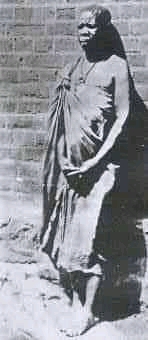
The Unyielding Spirit of Mbuya Nehanda
In the pantheon of African anti-colonial heroes, few figures command as much reverence and absolute spiritual authority as Mbuya Nehanda. Born as Charwe Nyakasikana, she evolved into a central, monumental figure during the First Chimurenga, a fierce and desperate uprising against British colonial rule in the late 19th century. Operating as a svikiro, or spirit medium, of the Zezuru Shona people, Nehanda Nyakasikana provided not only brilliant strategic leadership but also the deep spiritual fortitude that united her people against overwhelming and heavily armed odds.
The Origins of the Sacred Spirit
To truly understand the sweeping power of Mbuya Nehanda, one must first look deep into the rich spiritual traditions of the Shona people. The term “Nehanda” refers specifically to a mhondoro, which is a powerful and highly respected royal ancestral spirit, frequently referred to as a "lion spirit". These sacred spirits communicate through chosen women, who are then granted the esteemed title Nehanda or Mbuya Nehanda, with "mbuya" translating to grandmother.
The original Nehanda was a woman named Nyamhita, the daughter of Ishe Mutota, the 15th-century founder of the vast Mutapa state. According to traditional lore, Mutota ordered his son Matope to commit incest with his older half-sister Nyamhita as a ritualistic means to consolidate his royal power and expand the empire. Following this event, Nyamhita was granted a territory called Handa to rule over, and her legendary spiritual power became so immense that it lived on by occupying the bodies of designated mediums for nearly five hundred years.
The Life of Charwe Nyakasikana
The woman who would become the most famous and impactful incarnation of this ancestral spirit was born around 1840 in the Chishawasha district of central Mashonaland. Charwe Nyakasikana was the daughter of Chitaura, a man belonging to the Hwata dynasty, which had been founded in the upper Mazowe valley in the late eighteenth century. She lived a relatively traditional early life, marrying and raising a family consisting of two daughters and a son, though the specific name of her husband has unfortunately been lost to history.
By the year 1884, Charwe became possessed by the Nehanda spirit. Living in the rocky Mazoe hills, she became a highly respected oracle. She routinely performed traditional ceremonies thought to ensure essential rain and good crops, holding significant and unquestioned authority in the religious hierarchy of Mashonaland long before the drums of war ever began to beat.
The Gathering Storm and The First Chimurenga
When British settlers, operating under the aggressive leadership of Cecil John Rhodes and the British South Africa Company (BSAC), arrived in 1890, Charwe initially counseled peace and diplomacy. She advised her followers to treat the new European settlers as guests, specifically instructing them to bring the colonizers a black cow as a traditional sign of greeting and goodwill. However, the BSAC soon revealed its true intentions by seizing ancestral land and livestock, imposing forced labor camps, and instituting a heavily punitive “hut tax” against the native populations.
This suffocating oppression sparked the First Chimurenga, or War of Liberation, in 1896. The rebellion was uniquely and powerfully driven by traditional spiritual leaders. Mukwati led the initial resistance in Matabeleland starting in May 1896, and by October, the Shona people joined the fierce fight, guided primarily by Mbuya Nehanda and Sekuru Kaguvi. Sekuru Kaguvi was the medium for the spirit Kaguvi, also known as Murenga, who was considered the spiritual husband of Nehanda. Together, this powerful alliance preached that Mwari, the supreme deity, had decreed that the white settlers were the root cause of the region's recent suffering, which included severe drought and a devastating rinderpest outbreak among cattle. Nehanda famously assured her warriors that they had nothing to fear, promising that Mwari would turn the settlers' bullets into water, a prophecy that galvanized widespread, fearless resistance across the territory.
Capture, Trial, and Mbuya Nehanda's Death
Despite their fierce and incredibly brave resistance, the indigenous forces eventually ran out of supplies and were systematically defeated by the superior, modernized firepower of the British. By late 1897, Mbuya Nehanda was captured by the colonial regime and put on trial. She was specifically charged with the murder of Henry Hawkins Pollard, a notoriously cruel Native Commissioner. Pollard had recently severely beaten Chief Chiweshe for failing to report a cattle disease, and eyewitnesses claimed Nehanda had ordered her people to execute Pollard and dispose of his body in a river so he would not “stink”.
In April 1898, she was found guilty of murder and sentenced to death by Judge John Watermeyer, a man widely known as the “Hanging Judge”. While she was awaiting execution, a Catholic Jesuit priest named Father Francis Richartz desperately attempted to convert the condemned prisoners to Christianity. While Sekuru Kaguvi eventually accepted conversion and was baptized under the name “Dismas,” Nehanda fiercely and unequivocally rejected the priest's efforts. According to Father Richartz’s own historical accounts, Nehanda completely refused to cooperate, demanded to return to her own country in Mazoe to die, and began to dance, laugh, and yell wildly in her cell.
On April 27, 1898, Mbuya Nehanda was taken to the scaffold. Local mythology and oral histories claim that the executioners initially struggled to hang her due to her immense spiritual power, succeeding only after an African prisoner traitorously suggested removing a traditional tobacco pouch from her belt.
The Enduring Legacy
Right before the trapdoor opened, Mbuya Nehanda uttered a prophetic, deeply defiant final statement to her captors: “Mapfupa angu achamuka,” which translates to “My bones will surely rise!” This legendary proclamation became a powerful, undying rallying cry that would echo across generations of Zimbabweans.
Her profound prophecy was ultimately fulfilled in the 1960s and 1970s during the Second Chimurenga, the armed guerrilla struggle that successfully dismantled colonial rule and led to the total independence of Zimbabwe in 1980. Nationalist leaders heavily invoked her name and spirit, cementing her status as the absolute grandmother of the newly liberated nation.
Today, the death of Mbuya Nehanda is not viewed as a defeat, but as the ultimate sacrifice for freedom. She is immortalized throughout Zimbabwean culture. The maternity ward at Parirenyatwa Hospital in Harare proudly bears her name, and her legal judgment dockets are meticulously preserved in the National Archives of Zimbabwe, officially recognized by UNESCO's Memory of the World register. In May 2021, a monumental ten-foot-tall bronze statue of Mbuya Nehanda was unveiled in central Harare at the busy intersection of Samora Machel Avenue and Julius Nyerere Way, permanently honoring her as a towering symbol of African sovereignty, cultural pride, and unyielding courage.