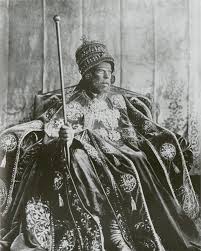
Imagine a continent carved up like a prize cake at a European dinner table. By the late 19th century, the relentless machine of Western imperialism had swallowed almost every kingdom, valley, and coast in Africa. Yet, tucked away in the rugged, misty highlands of the Horn of Africa, one ancient empire refused to bow. This was not a stroke of historical luck; it was the destiny of a man who spent his childhood in a mountain prison and grew up to become the architect of modern Ethiopia: Emperor Menelik II.
Born as Sahle Maryam on August 17, 1844, in the historic town of Ankober, he was the son of Prince Haile Melekot, the ruler of the Shewa province. His grandfather, King Sahle Selassie, looked upon the newborn prince and claimed he saw the reincarnation of the legendary Menelik I, the biblical son of King Solomon and the Queen of Sheba. Delightedly, he named the child Menelik, prophesying that he would one day rise to reconstitute the fractured Ethiopian Empire to its ancient, sprawling glory.
But long before the prince could touch the throne, the fire of internal warfare engulfed his home. In 1855, the centralizing Emperor Tewodros II marched south and invaded Shewa. Menelik’s father died during the chaos of the campaign, the province was forcibly annexed, and the eleven-year-old prince was captured and dragged away as a political hostage to the towering mountain fortress of Magdala.
The Golden Cage of Magdala
For ten long years, Magdala was both Menelik's prison and his premier training ground. Emperor Tewodros II, recognizing the immense nobility and razor-sharp intelligence of the young prince, treated him with remarkable warmth, practically raising him alongside his own children. At court, Menelik was given a classical education by the Ethiopian Orthodox Church, alongside intense training in military strategy, statecraft, and horsemanship.
Living at the epicenter of imperial power, the young prince observed the critical errors that eventually doomed Tewodros II, most notably the emperor’s brutal, alienating domestic massacres and his volatile relationship with foreign powers. Menelik bided his time, collecting lifelong alliances with other noble captives.
By 1865, as Tewodros II’s absolute authority began to crumble from widespread internal rebellions, a twenty-one-year-old Menelik saw his window. Under the absolute cover of darkness, he slipped past the prison wardens, scaled the treacherous ravines of Magdala, and made a daring escape back to his homeland of Shewa. The jubilant population received him with open arms, and he was quickly acclaimed as the rightful Negus, or King, of Shewa.
The Art of the Waiting Game
Now firmly in command of Shewa, Menelik proved to be a master of calculated patience and supreme diplomatic foresight. When Emperor Yohannes IV took the imperial crown in 1872, Menelik chose to bide his time rather than plunge the country into a bloody, exhausting civil war. He paid his taxes, sent soldiers to assist Yohannes IV against regional uprisings, and outwardly performed the tasks of a loyal vassal while quietly constructing an unstoppable power base of his own.
Menelik recognized early on that protecting African sovereignty in the modern age required Western technology. He circumvented the imperial court to establish direct European diplomacy, opening trade routes to secure massive stockpiles of modern firearms from France, Russia, and Italy. He brought in brilliant foreign advisors, most notably the Swiss engineer Alfred Ilg, who became a deeply trusted counselor in technical and international affairs.
To fund this massive military build-up, Menelik aggressively expanded his territories to the south and east, incorporating the Oromo, Gurage, and Wolayta lands into his realm. The strategic conquest of the historic trade hub of Harar in 1887 filled his royal exchequer with sweeping revenues from ivory, gold, coffee, and the regional slave trade.
When Emperor Yohannes IV was tragically killed on March 10, 1889, fighting invading Mahdist forces from Sudan, Menelik was ready. Boasting the most modern, well-equipped army on the continent, he swept northward and obtained the immediate allegiance of the Ethiopian nobility. On November 3, 1889, on the slopes of Mount Entoto, he was formally consecrated and crowned as the Negus Negast, the King of Kings and Emperor of Ethiopia.
The Trap at Wuchale
Just as Menelik assumed the imperial throne, Italy began aggressively expanding its presence along the Red Sea coast, establishing a colonial foothold in Eritrea. Looking to secure his northern border and formalize diplomatic relations, Menelik signed the Treaty of Wuchale with the Italian envoy, Count Pietro Antonelli, on May 2, 1889.
The treaty was celebrated as a masterstroke of friendship, but it contained a sinister, calculated deception. The document was written in two languages, and Article XVII was intentionally altered in the translation.
- The Amharic Version: Stated that Ethiopia could choose to utilize Italy's diplomatic channels for foreign affairs if it wished.
- The Italian Version: Explicitly stated that Ethiopia must conduct all foreign relations through Rome, effectively rendering the country an Italian protectorate.
When Menelik’s brilliant wife, Empress Taytu Betul, discovered the alteration, she was furious, famously warning the emperor of the colonial plot. Menelik flatly rejected the treaty in 1891, asserting: “My kingdom is an independent kingdom and I seek no one's protection.” The Italians tried to bribe the emperor with two million rounds of ammunition to accept the clause, but he threw the offer back in their faces. Realizing they could not trick the Amharic monarch, Rome prepared to enforce its protectorate by the sword, launching a full-scale invasion of Ethiopia in 1895.
The Thunder of Adwa
The Italians marched inland with supreme racial arrogance, utterly convinced that a modernized European army would effortlessly rout what they dismissed as a fragmented host of African barbarians. It was a fatal, catastrophic miscalculation. On September 17, 1895, Menelik issued a thunderous national proclamation, calling upon every capable citizen to defend their faith and fatherland.
The call resonated across every ethnic divide. Menelik mobilized a towering, unified army of over 100,000 warriors. Crucially, the Ethiopians were not fighting with primitive spears; they were armed with thousands of top-tier modern rifles and rapid-fire Hotchkiss artillery pieces that Menelik had brilliantly stockpiled for years, ironically, much of it purchased directly from the Italians under the guise of friendship.
On March 1, 1896, the two forces collided in the mountainous, unforgiving terrain of Adwa. Empress Taytu herself marched to the battlefield at the head of 5,000 elite troops, strategically capturing and cutting off the enemy's water sources.
The battle was a swift, crushing masterpiece of African military supremacy. Within six hours, the disorganized and completely outnumbered Italian forces were entirely routed. More than 4,000 Italian soldiers lay dead or missing on the battlefield, and another 2,000 were captured as prisoners of war. It was the most humiliating and bloody defeat ever experienced by a European colonial power on African soil since the days of the Pharaohs.
The shockwaves of Adwa electrified the global landscape. Riots broke out in the streets of Rome, and the Italian government collapsed within two weeks. On October 26, 1896, Italy signed the Treaty of Addis Ababa, unconditionally repealing the Treaty of Wuchale and formally recognizing the absolute, unyielding independence of Ethiopia.
Building the Modern State
With the empire safely secured from foreign appetites, Menelik turned his towering focus toward absolute modernization, permanently shifting the national capital to a plain he named Addis Ababa, meaning “new flower”. He connected the mountainous country with telegraph and telephone lines and oversaw the construction of the massive Franco-Ethiopian Railway linking Addis Ababa directly to the Red Sea coast.
His sweeping reforms reshaped the national identity. He instituted a unified public school system to train future statesmen, established a central state bank, and reorganized the national taxation structure to stabilize the exchequer. He created Ethiopia's first centralized Cabinet of Ministers and launched universal smallpox vaccination campaigns across rural communities.
Yet, his legacy remains a complex, deeply contested element of history. While celebrated globally as an immortal icon of Black resistance and anti-colonial sovereignty, critics among the incorporated southern ethnic groups point to the brutal land expropriations, cultural suppressions, and forced military assimilations committed by his armies during his expansion campaigns.
In mid-1906, the aging lion suffered a massive, debilitating stroke. By 1909, he was left completely paralyzed and unable to speak, leaving the government to a tumultuous regency led by Empress Taytu and his grandson, Lij Iyasu. During the quiet night of December 12, 1913, Menelik II passed away at the age of 69. He was laid to rest in a grand mausoleum in Addis Ababa, leaving behind a proud, unified nation that had successfully looked into the jaws of Western imperialism and declared itself forever free.