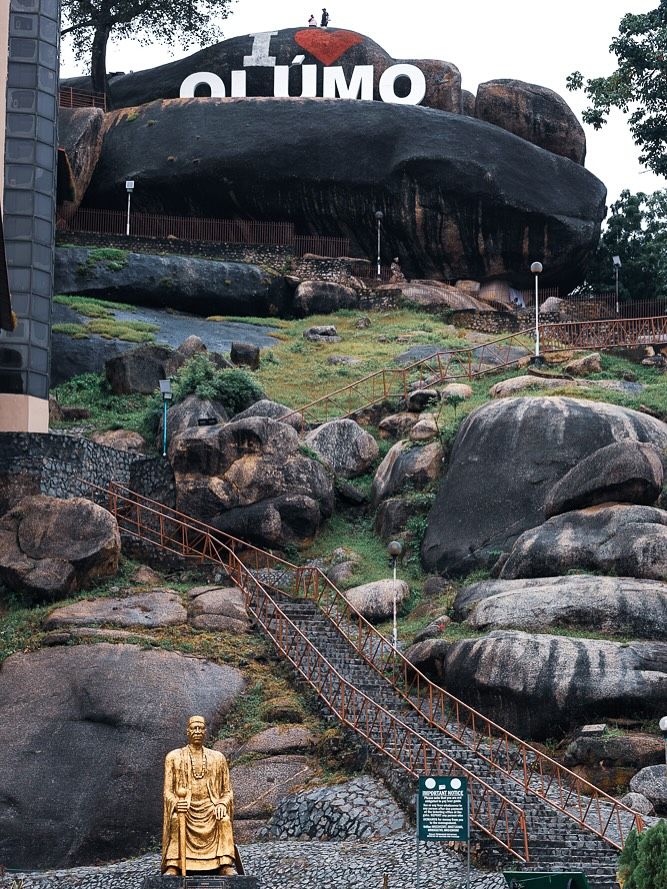
In the heart of Abeokuta, Ogun State, stands a colossal monument not made by human hands but carved by the slow, deliberate forces of nature. Rising 137 meters (449 feet) above sea level, Olumo Rock is more than just a striking geological formation or a popular tourist destination. It is a living, breathing chronicle of survival, a spiritual sanctuary, and the very foundation upon which an entire city was built.
To understand the Yoruba people of Egbaland, one must understand this rock. Its silence holds the memory of brutal 19th-century wars, the desperate prayers for deliverance, and the ultimate triumph of a people who refused to be erased.
This is the story of Olumo Rock.
The Geological and Paleontological Marvel
Long before it became a refuge for human beings, Olumo Rock was a silent witness to prehistoric eras. It is an immensely important paleontological and archaeological site. Excavations around the rock have yielded an outstanding collection of stone tools, including hand axes, pick-like tools, hammer rocks, and artificially shaped spherical rocks, that date back approximately 1.5 million years.
But it was during the turbulent 19th century that this massive outcrop of granite earned its name and its place in history. The name Olumo is derived from two Yoruba words: “Olu” (meaning God or deity) and “mo” (meaning molded). Together, they translate to God has molded it, or more profoundly for the Egba people, This is where God ended our struggles.
The Era of Bloodshed: A Fortress in the Stone
The 19th century was a period of intense and bloody inter-tribal warfare across Yorubaland. The Egba people, fleeing the oppressive forces of the Old Oyo Empire, desperately sought a place of safety.
According to local history, the caves within the rock were first discovered by Adagba, a brave farmer and hunter. Recognizing the strategic value of the massive granite outcrop, Adagba invited the fleeing Egba people to take refuge there.
From 1830 to 1833, as a vicious war raged between the Egba and the invading forces of the Dahomey Kingdom (now the Republic of Benin), Olumo Rock served as an impenetrable natural fortress. It provided a supreme strategic advantage; from the peak of the rock, Egba warriors had a sweeping, panoramic view of the surrounding landscape, allowing them to monitor the advance of enemy troops long before they reached the settlement.
The rock was not just a military lookout; it was a home. Inside the dark, cool caves, the Egba people built five rooms (though only one remains today). They used the natural hollows and holes in the cave floors to grind pepper, pound yam, and prepare meals while the war raged outside. Entire families lived, prayed, and survived within the crevices of the stone.
The Birth of Abeokuta
When the wars finally subsided, the Egba leaders consulted the Ifa oracle to ask whether they should return to their ancestral homes or remain at the rock. The oracle instructed them to stay.
As the Egba people emerged from their hiding place, neighboring tribes wondered how they had survived the brutal conflict. When asked, Where did you hide during the war? the Egba proudly replied, “A sasi Abe Okuta”, “We sought refuge under the rock”.
Thus, the city that grew outwards from the base of the mountain was named Abeokuta, which literally translates to Under the rock.
The Climb: A Journey Through Time
Today, climbing Olumo Rock is a pilgrimage for historians, tourists, and the Egba people alike. While modern additions like heavy-duty glass elevators and man-made stairs have made the 137-meter ascent easier, the traditional path still demands that visitors use natural rock footholds and ladders.
The journey to the top is lined with history:
- The Warrior Sculptures: Along the ancient route to the peak stand sculptures of Egba warriors adorned with Owo Eyo (cowries). The statues with standing heads represent the warriors who survived the wars, while those with buried heads honor those who died.
- The Cave Hideouts: Visitors can still explore the very caves where women and children hid, complete with the hollowed-out floors used for grinding food.
- The Grave of Chief Sonni: Just outside the cave lies the grave of Chief Sonni Osi Itoko, whose final rest dates to January 3, 1956. As the Osi (a chief who sits at the left hand of the king), Yoruba tradition dictated that he be buried near his home, which was located at Olumo.
- The Sacred Shrines: The rock remains deeply spiritual. Its patron deity is still venerated in the Yoruba religion as an orisha. A specific shrine on the rock is opened only once a year, typically on August 8th, for the Olumo Festival, during which the Alake of Egbaland (the paramount king) performs sacred rites.
- The Miracle Trees: At the very peak of the rock, growing straight out of the granite with no visible roots, is a flourishing Iroko tree, a true mystery of nature. Beside it grows a Baobab tree, a plant typically found in the savannah, miraculously thriving in the rocky terrain.
The View from the Summit
Reaching the summit offers a breathtaking, 360-degree view of the city that the rock birthed. From the top, one can trace the meandering path of the Ogun River (from which Ogun State derives its name), spot the majestic palace of the Alake of Egbaland, the family house of the late M.K.O. Abiola, the first mosque built in Egbaland, and the first Christian church in Nigeria.
To the Egba people, the rock is an enduring symbol of unity and divine protection. They celebrate it in their official anthem, chanting “Maa yo l’ori Olumo”, “I will rejoice on top of Olumo”.
Olumo Rock is not merely a tourist attraction. It is a monument of faith, a sanctuary of stone, and a quiet reminder that even in the face of absolute chaos and war, survival is possible. You do not just visit Olumo Rock; you encounter it. And if you listen closely to the wind sweeping over the granite, you can still hear the heartbeat of the Egba people.