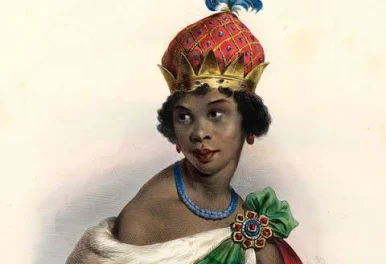
In the annals of 17th-century global history, few figures cast a shadow as long, formidable, and brilliantly complex as Nzinga Ana de Sousa Mbande, widely celebrated today as Queen Nzinga.
Operating in an era defined by the brutal expansion of European imperialism and the devastating acceleration of the transatlantic slave trade, Nzinga of Angola did not merely survive; she thrived. She was a master diplomat, a brilliant military tactician, and a paramount ruler who governed the Ambundu Kingdoms of Ndongo (1624–1663) and Matamba (1631–1663), located in what is today present-day northern Angola.
For four decades, she held the heavily armed forces of the Portuguese Empire at bay, forging international alliances and fundamentally altering the geopolitical landscape of Central West Africa. This is the exhaustive history of Nzinga Mbande, the woman who became the ultimate symbol of African resistance.
The Gathering Storm: Early Life and Political Education
To understand the extraordinary trajectory of Queen Nzinga, one must first understand the volatile world into which she was born. Born around 1583, she was a direct descendant of the ruling family of Ndongo. Her grandfather, Ngola Kilombo Kia Kasenda, had ruled as the king of Ndongo and was successfully succeeded by her father.
Her upbringing was far from conventional. While many royal women of the era were relegated to the shadows of the royal court, the young Nzinga received intensive, specialized military and political training directly as a child. This rigorous education prepared her to navigate the complex, rapidly shifting alliances of regional African politics.
During this period, the Portuguese Empire was aggressively encroaching upon South West Africa, driven by the highly lucrative and morally catastrophic expansion of the African slave trade. The Portuguese sought to destabilize local kingdoms to capture human beings for the brutal sugar plantations in Brazil. Early on, Nzinga proved her immense value to her kingdom by demonstrating an astonishing aptitude for defusing these intense political crises as an official ambassador to the Portuguese Empire.
The Weight of the Crown: Ascension and Immediate Conflict
The geopolitical landscape fractured completely in 1624 when her brother, Mbandi, died. In the wake of his death, Nzinga the Queen assumed absolute power over the kingdom of Ndongo.
Her ascension could not have come at a more perilous moment. She took the throne during a period marked by the rapid, violent growth of the slave trade and the relentless military encroachment by the Portuguese into her sovereign territory. Realizing that she would not be a submissive or easily manipulated client ruler, the Portuguese quickly turned against her. After initial discussions ended in failure because she steadfastly refused to submit to their authority, the Portuguese ousted her from Kidonga. In an ultimate act of royal defiance that same year, she famously declared herself the "Rainha de Andongo" (Queen of Ndongo).
Refusing to accept a negotiated surrender, the Portuguese officially declared war on Ndongo in 1626. The conflict was incredibly destructive. Operating from exile, Nzinga continued her fierce resistance, fleeing to the east but miraculously managing to reclaim the island in 1627.
However, the relentless European military machine took a heavy toll. By 1628, her army had been severely depleted, and she was forced into exile once more. The following year, 1629, brought further tragedy when she was again driven out by the Portuguese, a devastating event during which her sister was captured by enemy military forces.
The Imbangala Alliance and the Conquest of Matamba
Facing absolute defeat and possessing a shattered army, Queen Nzinga of Ndongo and Matamba realized she needed a radical new military strategy. In desperate search of powerful allies, she made a highly pragmatic, deeply controversial decision: she married the fearsome Imbangala warlord Kasanje.
The Imbangala were a formidable, heavily militarized society known for their highly effective, often ruthless martial traditions. By forging this new alliance, Nzinga successfully rebuilt her armed forces.
With her newly revitalized military apparatus, she pivoted her attention inland. From 1631 to 1635, she launched a brilliant campaign and successfully conquered the Kingdom of Matamba. This pre-colonial African kingdom was strategically located in what is now the Baixa de Cassange region of the Malanje Province of modern-day Angola. By securing Matamba, she established an impenetrable, resource-rich stronghold deep in the interior, far away from the coastal artillery of the Portuguese navy.
The Global Proxy War: The Dutch Alliance
The 1640s brought a massive geopolitical shift to the Atlantic world, and Nzinga Mbande was perfectly positioned to exploit it. In 1641, the Dutch West India Company successfully attacked the Portuguese and captured the vital coastal city of Luanda.
Seeing a golden opportunity to crush her Portuguese enemies, she quickly entered into negotiations with the Dutch. By 1641, she had firmly established what is recognized as among the earliest African-European alliances specifically designed to combat another European imperial nation.
This strategic partnership yielded immediate results. With the Dutch pressuring the coast and Nzinga attacking from the interior, she was able to reclaim large swaths of her ancestral homeland of Ndongo between 1641 and 1644. Fighting alongside her new Dutch allies, her combined forces defeated the Portuguese in multiple engagements, although they were ultimately unable to capture the heavily fortified Fortress of Massangano.
The war raged on with devastating intensity. In 1646, her army achieved a spectacular victory by defeating the Portuguese at Davanga, though the triumph was bittersweet as her other sister was captured during the conflict. The following year, in 1647, the alliance with the Dutch proved incredibly fruitful when their combined forces successfully seized Masangano from Portuguese control.
However, the window of Dutch supremacy was brief. In 1648, a massive Portuguese fleet arrived from Brazil, recapturing Luanda and forcing the Dutch to abandon their African positions. Left without her European ally, Nzinga executed a masterful tactical withdrawal, retreating her army safely back to the deep interior strongholds of Matamba.
The Final Years: Peace and Legacy
For the next decade, Queen Nzinga waged a relentless, grinding guerrilla war from Matamba. She fundamentally understood the brutal calculus of 17th-century survival. In a famous speech delivered to her army in 1657, she frankly stated that her long-standing alliance with the Imbangala was a "necessary evil" in the overarching military war against the Portuguese.
By 1657, both sides were utterly exhausted by decades of perpetual bloodshed. Recognizing that she had successfully secured the borders of Matamba and prevented the total subjugation of her people, she officially signed a peace treaty with the Portuguese that same year. She had fought courageously against their colonial ambitions and relentless slave-raiding attacks for decades.
Nzinga Ana de Sousa Mbande passed away peacefully on December 17, 1663, at the advanced age of 80.
Her death marked the end of an era. Without her brilliant strategic mind and unifying, indomitable will to hold the imperialists at bay, the region became highly vulnerable. Unfortunately, her death rapidly accelerated both the Portuguese colonial occupation of the region and the devastating expansion of their Atlantic slave trade activities across central West Africa.
The Immortal Spirit of Angola
Today, Queen Nzinga of Angola is remembered not as a victim of European imperialism, but as one of its most terrifying and capable adversaries. She was a woman who navigated a male-dominated political landscape, weaponized rival European powers against one another, and forged a powerful kingdom in the fires of a brutal century.
She remains an unparalleled icon of African liberation and female leadership. Long after the fortresses of the colonizers have crumbled into dust, the legendary name of Nzinga continues to echo across Angola and the world as the ultimate symbol of sovereign defiance.