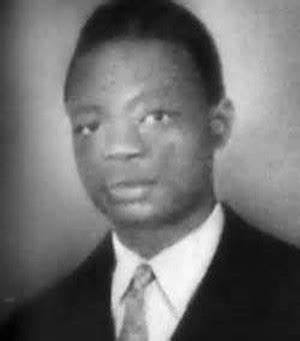
In the annals of African anti-colonial history, certain names ring out like thunder: Patrice Lumumba, Kwame Nkrumah, Thomas Sankara. Yet, one of the most brilliant and tragic architects of African emancipation has been systematically erased from the global narrative. His name was Ruben Um Nyobè.
Decades before Cameroon achieved its independence, Um Nyobè demanded it. He was the first African political leader to stand before the United Nations General Assembly and claim full independence for his country. He was a visionary who preached a revolution of the mind, a pacifist who sought to dismantle the oppressive French colonial system through non-violent resistance, and a martyr who was hunted down and assassinated by the French army in 1958.
This is the story of Ruben Um Nyobè, the forgotten father of Cameroon.
Early Life Under Colonial Rule
Um Nyobè was born on April 10, 1913, in the village of Song Mpeck, located in the agricultural Bassa region of southern Cameroon. At the time of his birth, Cameroon (then Kamerun) was a German colony. Following Germany’s defeat in World War I, the territory was arbitrarily partitioned between France and the United Kingdom by the League of Nations, a division that would profoundly shape Um Nyobè's life and political mission.
He was raised in a traditional animist family; his father was a local priest. Young Ruben acquired his Christian name after being baptized in a Presbyterian school. He proved to be an exceptional student, mastering French alongside indigenous languages like Bassa, Bulu, and Do. However, his rebellious spirit emerged early. While training to be a teacher in Fulassi, he was expelled in his final year for protesting against the colonial education system.
Despite this setback, he earned his degree and eventually joined the colonial civil service in 1935, later serving as a court registrar in Edea. It was within the colonial legal system that Um Nyobè witnessed firsthand the brutal inequities of French rule, including the strict segregation and exploitation of indigenous Cameroonians.
The Birth of a Unionist and the Mpodol
Following World War II, a wave of political consciousness swept across colonized Africa. Um Nyobè initially joined the Jeunesse camerounaise Française (JeuCaFra), an organization originally set up by the French to counter Nazi propaganda, but he soon gravitated toward more radical anti-colonial groups.
In 1945, he helped found the Union of Confederated Trade Unions, backed by the French General Confederation of Workers (CGT). As the union’s general secretary by 1947, he fought tirelessly for better conditions for Cameroonian laborers, arguing that true social and economic justice was impossible without political independence.
His charisma, legal acumen, and unwavering dedication earned him the title Mpodol, meaning Spokesman or Prophet in his native Bassa language. He became the voice of the voiceless.
Founding the UPC and Taking the Fight to the UN
On April 10, 1948, trade unionists in Douala founded the Union des populations du Cameroun (UPC), the first political party in French sub-Saharan Africa whose sole, explicit demand was complete independence from France and the reunification of the divided Cameroonian territories. Though not present on its founding night, Um Nyobè was quickly propelled to the head of the party as its general secretary.
Under his leadership, the UPC became a massive, highly organized political machine. Um Nyobè's political philosophy, often called Umism, was deeply anti-tribalist. He viewed tribalism as a tool engineered by the French to divide and conquer the African populace. He insisted on peaceful actions, strikes, boycotts, and demonstrations, often ending UPC meetings by singing both the Cameroonian national anthem and the French Marseillaise to prove his quarrel was with the colonial system, not the French people.
In 1952, 1953, and 1954, Um Nyobè traveled to New York City to address the United Nations General Assembly. Standing before the world, he denounced French colonial rule, demanded a fixed deadline for independence, and called for the creation of a Cameroonian Legislative Assembly.
The French Crackdown and the Maquis
France viewed Um Nyobè as an existential threat to its imperial ambitions. The French administration labeled the UPC a communist movement, a potent slur during the Cold War, and enlisted the Catholic Church to denounce it as the anti-god party.
On July 13, 1955, the French government officially banned the UPC by decree. The colonial authorities launched a massive, violent crackdown. They arrested UPC followers, murdered its members, and exiled its leaders.
Ruben Um Nyobè refused to abandon his country or his people. He retreated into the equatorial forests of the Bassa region, establishing a maquis (resistance movement). For three years, he led a resistance from the jungle, continually demanding independence, organizing his followers, and writing extensively about his vision for a free Cameroon.
Assassination and the Damnatio Memoriae
The French military ruthlessly hunted the Mpodol. On the morning of September 13, 1958, French soldiers, aided by local informants who had been tortured, tracked Um Nyobè’s footprints through the forest to his camp near Boumnyebel.
As he attempted to flee, a soldier shot him from behind. When Um Nyobè fell, he dropped his briefcase. Inside were notebooks containing his meticulous dreams and plans for an independent Cameroon. He died with a groan in the dirt of his own country. He was 45 years old.
France’s brutality did not end with his death. To ensure he could not become a martyr or a symbol of resistance, his executioners dragged his body through the mud, publicly displayed it, and severely disfigured his corpse. Before burying him, they encased his body in a concrete block so that his grave could never become a site of pilgrimage.
France then attempted to erase him from history. When Cameroon officially achieved independence on January 1, 1960, less than two years after his assassination, it was handed over to a French-backed puppet government led by Ahmadou Ahidjo.
The new government instituted a damnatio memoriae (condemnation of memory). For decades, it was strictly forbidden to speak Ruben Um Nyobè's name in public. His writings were destroyed, his name was scrubbed from school history books, and anyone who mentioned the true heroes of independence was considered a subversive and risked imprisonment.
The Resurrection of a Legacy
France gave Cameroon its independence, but it kept the economic and political chains firmly attached, a system of neo-colonialism that Um Nyobè had prophesied and died trying to prevent.
However, you cannot encase an idea in concrete. In 1991, following immense public pressure, the Cameroonian government finally passed a law rehabilitating the nation's true independence fighters, legally allowing Um Nyobè's name to be spoken again. In 2007, 49 years after his execution, a monument was finally erected in the town of Éséka in his honor.
Today, a new generation of Cameroonians and Africans are rediscovering the legacy of the Mpodol. Ruben Um Nyobè was a man who stood against the machinery of an empire with nothing but the force of his intellect and his unyielding demand for freedom. He died in a forest, carrying a briefcase of dreams. It is time the world remembers his name.