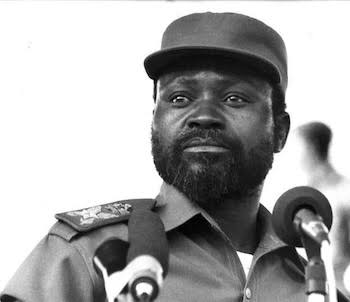
The landscape of 20th-century African decolonization was populated by leaders of deep conviction, but few possessed the visceral charisma, military genius, and revolutionary fire of Samora Moisés Machel. Known to his people as “President Samora,” he was the commander who drove the Portuguese out of Southeast Africa and stood as the founding father of independent Mozambique.
Machel was an uncompromising Marxist-Leninist who viewed the anti-colonial struggle not merely as a change of flags, but as a total social revolution designed to forge a “New Man” (Homem Novo) free from the structural exploitation of tribalism, capitalism, and racism. His unyielding stance toward outside paternalism is perfectly captured in his famous warning to his people, visible in the archival image
“If one day you hear the Europeans praise me, know that I have betrayed you.”
From the grueling guerrilla campaigns in the forests of Niassa to his tragic and deeply controversial death in a remote mountainside plane crash, this is the sweeping history of Samora Machel.
The Crucible of Colonial Gaza: Early Life and Radicalization
Samora Moises Machel was born on September 29, 1933, in the rural farming village of Madragoa (known today as Chilembene), located in the Gaza Province of southern Mozambique. He belonged to the Shangana ethnic group, and his lineage carried a proud tradition of anti-colonial resistance; his ancestors had fought valiantly against Portuguese conquest at the turn of the century.
Despite his father’s relative agricultural success, owning four plows and 400 head of cattle by 1940, the Machel family was systematically squeezed by the structural racism of the Portuguese colonial apparatus. Under colonial law, Machel's father was classified as an indígena (native). This status meant he was legally forced to accept lower prices for his crops than white farmers, compelled to cultivate labor-intensive cotton at the expense of food crops for his family, and barred from branding his own cattle to prevent theft.
Machel received his primary education through Catholic missionary schools, which focused heavily on integrating African children into the Portuguese language and culture. He completed the fourth grade but was unable to pursue formal secondary schooling. However, possessing a basic qualification certificate, he moved to the capital city of Lourenço Marques (modern-day Maputo) in 1954 to study nursing.
While working as a medical aide at the Miguel Bombarda Hospital and attending night classes, the stark realities of racial segregation crystallized Machel's political awareness. He witnessed fertile ancestral lands along the Limpopo River being arbitrarily appropriated by the colonial government for white settlers, while his own family members were forced to seek hazardous employment in South African mines to avoid starvation.
The systemic injustice became intensely personal when one of his brothers was killed in a South African mining accident. At the hospital, Machel began organizing his first protests, challenging the discriminatory reality that Black nurses were paid significantly less than their white counterparts for performing identical duties.
The Guerrilla Commander: The Rise of FRELIMO
By the early 1960s, Machel was firmly under the surveillance of the PIDE, the notorious Portuguese political police. Warned by an anti-fascist white pharmaceutical representative named João Ferreira that his arrest was imminent, Machel abandoned his nursing career and slipped across the border. He traversed Swaziland, South Africa, and Botswana, eventually hitching a ride to Dar es Salaam, Tanzania, on a plane transporting recruits for South Africa's African National Congress (ANC).
In Tanzania, Machel immediately volunteered for the armed wing of the newly formed Mozambique Liberation Front (FRELIMO), established under the leadership of the intellectual scholar Eduardo Mondlane. Machel was sent to Algeria for intensive military training, returning to run FRELIMO's central training camp at Kongwa.
THE REVOLUTIONARY ASCENT
1962: Joins FRELIMO in Dar es Salaam, Tanzania
1963: Sent to Algeria for specialized military training
1964: Leads FRELIMO's first guerrilla incursions into Niassa
1966: Appointed Commander-in-Chief of the FPLM army
1970: Assumes the Presidency of FRELIMO following Mondlane's murder
When FRELIMO officially launched its armed war of independence on September 25, 1964, Machel emerged as a brilliant military tactician. He made his reputation leading guerrilla columns through the grueling, isolated terrain of the northern Niassa and Cabo Delgado provinces. Following the death of FRELIMO's first military commander, Filipe Samuel Magaia, in October 1966, Machel was elevated to head the guerrilla army, the FPLM.
The Ideological Transformation
On February 3, 1969, FRELIMO was shaken by the assassination of Eduardo Mondlane, who was killed by a parcel bomb in Dar es Salaam. The tragedy triggered a severe internal leadership crisis. While the moderate Vice President, Uria Simango, expected to assume the presidency, the Executive Committee instead created a political triumvirate consisting of Simango, Machel, and the socialist poet Marcelino dos Santos.
Simango soon broke ranks, publishing a scathing pamphlet titled “Gloomy Situation in Frelimo”. Machel and dos Santos outmaneuvered the moderate faction, resulting in Simango’s expulsion. In May 1970, Machel officially assumed the presidency of FRELIMO. Under his guidance, the front transformed from a broad nationalist coalition into a vanguard Marxist-Leninist party, explicitly linking national liberation with the elimination of the domestic petty bourgeoisie.
Smashing the Gordian Knot: The Path to Independence
In 1970, the newly appointed commander of the Portuguese colonial forces, General Kaúlza de Arriaga, launched Operation Gordian Knot, the largest and most aggressive conventional offensive of Portugal's colonial wars. Arriaga boasted that he would eliminate FRELIMO within a matter of months by deploying overwhelming firepower against their northern strongholds.
Machel responded with an adaptable guerrilla strategy. Instead of fighting static defensive battles, he allowed the Portuguese to overrun empty bush camps and shifted the focus of the war entirely. FRELIMO columns struck south into the western province of Tete, threatening the massive Cahora Bassa dam project on the Zambezi River. The maneuver forced the Portuguese to tie up thousands of troops in concentric defensive rings around the dam, completely stripping the rest of the province.
By 1973, FRELIMO units had crossed the Zambezi, pushing deep into Manica and Sofala provinces, sabotaging the vital railway line linking landlocked Rhodesia to the port of Beira. The sudden incursions spread panic among the white settler population, exposing the structural vulnerability of the colonial state.
THE GEOPOLITICAL TRANSITION (1974–1975)
April 25, 1974: The Carnation Revolution overthrows the Lisbon regime
September 7, 1974: Lusaka Accords map out the transfer of power
June 25, 1975: Samora Machel proclaims independent Mozambique
The collapse of the colonial empire came abruptly from within. On April 25, 1974, Portuguese military officers, exhausted by fighting three unwinnable wars in Africa, executed the bloodless Carnation Revolution in Lisbon, overthrowing the dictatorial Caetano government.
The incoming post-coup President, General António de Spínola, attempted to preserve a Lusophone commonwealth tied to Lisbon through a referendum. Machel flatly rejected the proposal with characteristic wit:
"You don't ask a slave if he wants to be free, particularly when he is already in revolt, and much less if you happen to be a slave-owner."
Machel refused to declare a ceasefire, intensifying military operations in Zambezia province until the new Portuguese government conceded. On September 7, 1974, the historic Lusaka Accords were signed, establishing a transitional government led by FRELIMO's Joaquim Chissano as prime minister. Machel executed a triumphant promotional journey from the Rovuma River in the north to the Maputo River in the south, mobilizing the population.
On June 25, 1975, before an ecstatic crowd at the Machava Stadium, Samora Machel officially proclaimed the birth of the People's Republic of Mozambique.
The Socialist State: Forging the Homem Novo
President Samora moved with radical speed to dismantle the structural remnants of colonial capitalism. Within a month of independence, on July 24, 1975, his government nationalized all land, health, and educational institutions. Private clinics and Catholic parochial schools were completely abolished, stripping the Church of its historical privileges.
On February 3, 1976, Machel announced the total nationalization of all rented urban housing. While citizens were legally permitted to own a primary home for personal use, renting property for private profit was outlawed. This policy fundamentally altered the demographic map of Mozambican cities, as thousands of Black citizens moved from squalid peripheral shantytowns into the modern apartment blocks abandoned by the exiting Portuguese population.
The Iron Fist of Reeducation
At FRELIMO's Third Congress in February 1977, Marxism-Leninism was officially proclaimed as the vanguard state ideology. In his quest for absolute social and moral purity, Machel introduced highly controversial reeducation centers. Petty criminals, political dissidents, and individuals deemed "anti-social elements", including prostitutes and drug users, were rounded up and detained without trial.
The structural conditions within these isolated camps were incredibly harsh, with research indicating that over a thousand inmates perished due to starvation, disease, and summary executions. In 1983, the regime launched “Operation Production,” forcefully displacing thousands of "unproductive" urban residents to remote rural provinces to labor in agricultural projects.
Machel was equally unapologetic regarding the permanent elimination of internal political rivals. Former FRELIMO leaders who had broken ranks, including Uria Simango, his wife Celina, and Paulo Gumane, were subjected to massive show trials before being secretly executed, allegedly burned alive by a military convoy in 1977.
Frontline Geopolitics and the Scourge of Civil War
Machel’s domestic socialist vision was systematically undermined by a hostile regional environment. Committed to the liberation of Southern Africa, Machel implemented strict UN sanctions against Ian Smith’s white-minority regime in Rhodesia, closing the border and sacrificing over $550 million in vital transit revenues. He provided rear military bases and embedded Mozambican troops to fight alongside Robert Mugabe’s ZANLA guerrillas.
In direct retaliation, the Rhodesian Central Intelligence Organisation (CIO) recruited disgruntled Mozambican exiles and former colonial settlers to establish a proxy rebel movement: the Mozambique National Resistance (RENAMO). Following Zimbabwe’s independence in 1980, the sponsorship of RENAMO was rapidly assumed by the apartheid regime of South Africa.
The South African Defence Force (SADF) used heavy airdrops to build RENAMO into a formidable destabilizing force. RENAMO guerrillas targeted the nation's infrastructure, blowing up railway lines, destroying rural health clinics, and attacking collective villages to structurally paralyze the Marxist state.
The conflict rapidly escalated into a full-scale civil war, complicated by a catastrophic exodus of over 200,000 Portuguese technicians, managers, and agrarian professionals. Deprived of technical expertise, agricultural and industrial productivity dropped by 50 percent, leaving millions of citizens stranded in economic ruin, inflation, and severe food shortages.
The Nkomati Accord: A Pragmatic Trap
By 1983, with the economy in shambles, Machel embarked on a diplomatic offensive to the West, visiting European capitals and meeting with US President Ronald Reagan to solicit private investment. The culmination of this pragmatic shift occurred on March 16, 1984, when Machel and South African President P.W. Botha signed the Nkomati Accord.
Dressed in a colorful field marshal's outfit, Machel signed the non-aggression pact, subsequently forcing nearly one thousand ANC members to leave Maputo. However, the agreement proved to be a strategic disaster. While Machel honored his commitments, the duplicitous apartheid regime flagrantly disregarded the pact, secretly expanding massive arms shipments to RENAMO's central headquarters at Casa Banana in Gorongosa.
The Mbuzini Disaster: The Samora Machel Plane Crash
By late 1986, the regional security crisis had reached a volatile climax. RENAMO was operating with total impunity out of Malawi, utilizing the territory of the conservative pro-Western President Hastings Banda. Enraged, Machel publicly threatened to place defensive missiles along the Malawian border and halt all trade transit from the landlocked country.
On October 19, 1986, President Samora attended an urgent regional summit in Mbala, Zambia, aimed at coordinating a unified strategy to pressure the region's hostile regimes. Although his security team strongly advised against flying at night, Machel insisted on returning to Maputo immediately to execute a planned reshuffle of his military command the following morning.
The presidential aircraft, a Soviet-built Tupolev Tu-134, never reached its destination. Cruising through the night sky, the aircraft veered sharply off course and crashed violently into a hillside at Mbuzini, located just inside South African territory near the convergence of the borders with Swaziland and Mozambique. The catastrophic Samora Machel plane crash killed the president and 33 senior officials, advisors, and flight crew members instantly.
The Contested Investigations
The immediate aftermath of Samora Machel's death triggered a furious diplomatic battle over the cause of the disaster. The South African government appointed the Margo Commission, which included international aviation experts, and officially concluded that the crash was entirely due to pilot error and negligence by the Soviet flight crew.
However, the Mozambican and Soviet governments flatly rejected the findings, submitting an alternative minority report. They argued that the apartheid military had deployed a highly sophisticated, mobile decoy radio beacon (VOR) to intentionally mislead the aircraft's navigation system, luring the plane off its path and into the jagged mountains.
Decades later, the mystery remains unresolved, sustained by conflicting declassified accounts. While declassified 2016 French intelligence files support the thesis of pilot oversight regarding out-of-date aircraft instruments, alternative internal testimonies, such as memoirs from FRELIMO general Jacinto Veloso, allege a dark conspiracy between South African intelligence and the Soviet secret service, sparked after a furious Machel had reportedly told the Soviet ambassador to “go to hell”.
Crypts and Continuity: An Enduring Legacy
On October 28, 1986, a massive state funeral was held in Maputo, attended by a global gathering of revolutionary leaders, including Julius Nyerere, Kenneth Kaunda, Robert Mugabe, and ANC leader Oliver Tambo. Samora Machel was laid to rest in a star-shaped crypt at Mozambican Heroes' Square in Maputo, cementing his status as an immortal national icon.
His death marked the definitive structural end of the First Mozambican Republic. His successor, Joaquim Chissano, rapidly abandoned the unworkable socialist economic models. By 1987, the FRELIMO elite opened the country to international financial institutions, embracing market liberalization and structural adjustment programs.
Though this capitalistic transition brought an end to the one-party monopoly and ushered in civil liberties under the 1990 constitution, it also dismantled the egalitarian welfare state that Machel had fought to build. In the decades that followed, systemic corruption spread through state institutions, transforming the revolutionary vanguard into a wealthy political elite.
Despite his radical mistakes, his forced collectivism, and the harsh record of his reeducation centers, Samora Machel remains a revered figure of African dignity. He is remembered as the leader who forged a unified national identity out of diverse ethnic groups, holding the iconic, enduring rallying cry of the liberation war:
“A Luta Continua” (The Struggle Continues)