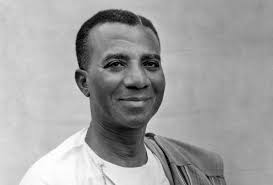
The Midnight Cry in Lome
Imagine waking up in the dead of night to the terrifying sound of heavy boots splintering your front door. It is January 13, 1963. You are not just an ordinary citizen; you are the architect of your nation's freedom, a brilliant economist, and the first president of a newly independent republic. Barefoot, wearing only a pair of beige shorts and a shirt, you slip out a window, scramble over a garden wall, and hide in a vehicle parked in a diplomatic compound next door. You think you are safe. You think the international laws of sovereignty will shield you. But by sunrise, three gunshots ring out, and African history is permanently altered.
This is the tragic, true story of Sylvanus Olympio, the first president of Togo, who became the first post-colonial African head of state to be assassinated in a military coup. The assassination of Sylvanus Olympio was the original sin of post-colonial African politics, setting a terrifying precedent that would haunt the continent for decades. To understand how this global intellectual ended up bleeding out on the gravel of an embassy yard, we must look at the intricate tapestry of his life, his radical vision for Togo, and the global forces that conspired against him.
An Aristocratic Beginning and The Roots of a Polyglot
To truly understand the man, one must first understand the complex, transnational world into which he was born. Sylvanus Épiphanio Olympio entered the world on September 6, 1902, in Kpandu, located in what was then the German protectorate of Togoland and is now the Volta Region of Ghana.
The Olympio family was legendary. They belonged to an elite, aristocratic community of mixed Brazilian and African descent. His grandfather, Francisco Olympio Sylvio, was a prominent Brazilian trader who had emigrated to West Africa. His father, Ephiphanio Olympio, ran a highly successful trading house for the Miller Brothers in Agoué. His uncle, Octaviano Olympio, moved his operations to Lomé and quickly became one of the wealthiest men in the colony. This family network was deeply tied to both the Tabom people of Ghana and the Amaro people of Nigeria, making them cosmopolitan, educated, and fiercely independent.
Young Sylvanus was a product of this rich cultural synthesis. He began his education at a German Catholic school in Lomé, which his uncle Octaviano had built. Showing immense intellectual promise, he later traveled to the United Kingdom to study at the prestigious London School of Economics. There, he studied economics under the socialist theorist Harold Laski. By the time he returned to Africa, he was a brilliant polyglot, fluent in German, English, French, Portuguese, and Yoruba.
The Corporate Giant and Sparks of Rebellion
Before he was a revolutionary politician, Sylvanus Olympio was a corporate titan. Following his graduation, he joined Unilever, working first in Nigeria and then in the Gold Coast. He climbed the corporate ladder with astonishing speed. By 1929, he was appointed the head of Unilever operations in Togoland. In 1938, he remained in Lomé but was promoted to general manager of the United Africa Company's operations throughout Africa.
During this time, he married Dina Grunitzky, a woman of mixed Ghanaian and German-Polish heritage who belonged to the Amegashie royal family. Together, they had five children: Bonito, Rosita, Gilchrist, Sylvana, and Elpidio.
But history has a way of interrupting private success. When World War II broke out, the colony fell under the control of the pro-Nazi Vichy France government. The Vichy authorities looked at the wealthy, British-educated Olympio family with intense suspicion. In 1942, they arrested Sylvanus and placed him under constant surveillance in the remote city of Djougou in French Dahomey. This imprisonment was a profound turning point that permanently changed his view toward the French, transforming the corporate executive into a fierce, uncompromising nationalist who pushed for independence at the war's end.
The Fight for Independence
Sylvanus Olympio realized that Togo held a unique legal status. It was not a formal French colony, but rather a UN Trust Territory. Olympio weaponized this loophole. Domestically, he founded the Comité de l'unité togolaise, which became the major party opposing French control. Internationally, he took his fight straight to the global stage. In 1947, he petitioned the United Nations Trusteeship Council, marking the first time a petition for the resolution of grievances was taken to the UN.
The French colonial apparatus fought back with heavy interference in local elections throughout the 1950s. In 1954, the French arrested Olympio and entirely suspended his right to vote and run for office.
But you cannot cage a vision whose time has come. Olympio’s relentless international lobbying led to the 1958 elections where French control was limited. His party won every elected position in the national council, forcing the French to restore his rights. Sylvanus Olympio became the Prime Minister of the Togo colony, successfully leading the country to complete independence and eventually becoming its first president after winning the 1961 election with over 90% of the vote.
A Visionary Caught in a Geopolitical Vice
He inherited a small nation, but his ambitions were towering. He wanted absolute sovereignty, which put him on a collision course with massive geopolitical forces.
The Wrath of Paris and the Franc Zone
Unlike other francophone leaders, Olympio kept Paris at arm's length. He adopted a unique position for early independent African leaders of former French territories, choosing not to join alliances like the African and Malagasy Union. Instead, he fostered connections with former British colonies, relied on German aid rather than French aid, and pursued connections with the United States. In 1962, he even visited the US and had a friendly meeting with President John F. Kennedy. Furthermore, Olympio was considering leaving the CFA franc zone to create a Togolese currency backed by the Deutsche Mark. For the French empire, a fully sovereign Togo was an unforgivable risk that could inspire other nations to emancipate themselves.
The Clash with Kwame Nkrumah
Geopolitics closer to home were equally volatile. A defining dynamic during his presidency was his bitter border rivalry with Kwame Nkrumah’s Ghana. The colonial borders had arbitrarily sliced through the homeland of the Ewe people, dividing them. While Nkrumah proposed dissolving the borders to unite the countries, Olympio sought to have the eastern part of the German colony returned to Togo. The relationship deteriorated into toxic hostility, with Olympio publicly referring to Nkrumah as a "black imperialist". Tensions soared after 1961, leading to mutual assassination accusations and political exiles organizing in each other's countries.
The Internal Powder Keg
Domestically, Olympio practiced strict financial austerity to develop his country without relying on outside support. This economic prudence proved fatal when applied to the military. Olympio originally wanted Togo to have no standing army at all upon independence, but eventually agreed to a tiny force of about 250 soldiers.
Meanwhile, Togolese veterans who had fought for the French colonial army in Indochina and Algeria were returning home and demanding to be integrated into the Togolese military. Military leaders Emmanuel Bodjollé and Kléber Dadjo repeatedly pleaded with Olympio for increased funding and enlistment, but they were unsuccessful. On September 24, 1962, a young sergeant named Étienne Eyadéma personally asked Olympio to join the military and was rejected. On January 7, 1963, when Dadjo presented another request, Olympio reportedly tore it up. Following a 1961 assassination attempt, Olympio had also outlawed opposition parties, transforming Togo into a one-party state and alienating many political figures who were subsequently exiled or imprisoned.
Death at the Gates
By early 1963, the air in Lomé was thick with tension. Shortly after midnight on January 13, 1963, military members broke into the presidential house. Olympio escaped the initial assault and sought refuge by climbing over a wall into the US Embassy compound, hiding in a parked Buick.
US Ambassador Leon B. Poullada was alerted to the situation and arrived at the embassy to find Olympio hiding in the car. Olympio explained the situation, but Poullada advised him to wait while he returned home to find the keys to open the building. In a chilling tragedy of diplomatic failure, Olympio was left exposed.
At 7:15 AM, three gunshots rang out. Sylvanus Olympio's body was discovered by Ambassador Poullada just three feet from the door to the US Embassy. Étienne Eyadéma, the young sergeant whose enlistment Olympio had rejected, boasted to international media that he had personally fired the shot while the president tried to escape.
The Legacy of a Fallen Giant
The assassination sent shockwaves across a fragile continent. Radical leaders in Guinea, Liberia, the Ivory Coast, and Tanganyika denounced the coup, and the new government of Togo was excluded from the Addis Ababa Conference that formed the Organisation of African Unity.
Étienne Eyadéma would later claim power in 1967, ruling the country with an iron fist until his death in 2005. The Olympio family was forced into a long exile, with Sylvanus's son, Gilchrist Olympio, later returning to lead the main political opposition against the Eyadéma regime.
Sylvanus Olympio was a brilliant light snuffed out too soon by a toxic cocktail of colonial resentment, Cold War geopolitics, regional rivalries, and domestic austerity. He dreamed of an Africa that was self-reliant, highly educated, and economically sovereign. His story is a poignant, unforgettable reminder of the immense sacrifices made by the pioneer generation of African independence, and a testament to an enduring vision of liberty that refuses to be forgotten.