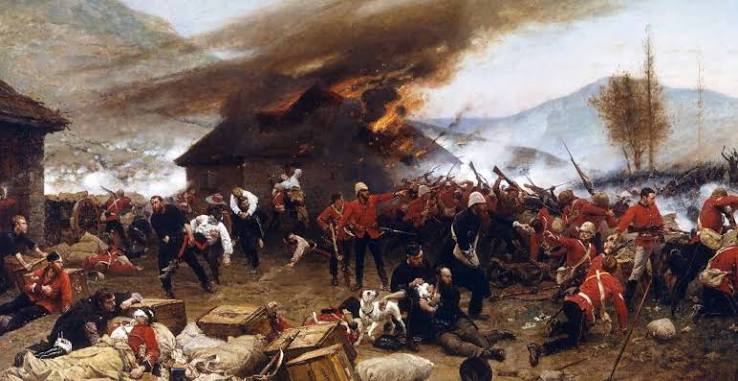
The story of the Anglo-Zulu War is rarely told with the honesty it deserves. For over a century, Western historians and Hollywood filmmakers have painted this conflict as a heroic defense of civilization against a savage horde. They focus obsessively on a handful of British soldiers barricaded behind biscuit boxes, conveniently ignoring the colossal greed, political deceit, and unprovoked aggression that birthed the war in the first place.
To understand the 1879 Zulu War, we must strip away the colonial mythology. This was not a war of self-defense for the British; it was a calculated, imperialistic land grab. The discovery of diamonds in South Africa in 1867 had fundamentally altered the region's destiny. The British Empire, driven by Lord Carnarvon’s grand design for a unified South African confederation, needed to consolidate power, secure cheap African labor for the mines, and crush any indigenous sovereignty that stood in its way.
The greatest obstacle to this colonial ambition was the independent Zulu Kingdom, ruled by the shrewd and powerful King Cetshwayo kaMpande.
The Manufactured Crisis and the Impossible Ultimatum
King Cetshwayo had no desire to fight the British. He was a deeply pragmatic leader who maintained a strictly defensive posture, understanding that drawing the ire of the world's foremost military superpower would spell disaster for his people. Yet, the British High Commissioner, Sir Bartle Frere, and the manipulative Secretary for Native Affairs, Theophilus Shepstone, were determined to manufacture a casus belli.
Using minor border disputes as a pretext, Frere issued an outrageous ultimatum to Cetshwayo in December 1878. The demands were designed to be impossible to accept: Cetshwayo was ordered to completely dismantle the Zulu military system, abandon the cultural amabutho (age-grade regiment) system, and allow a British resident to oversee his kingdom, all within thirty days. To accept would mean the end of the Zulu nation. Frere knew the King would refuse, giving the British the exact excuse they needed to launch the British Zulu War.
When the deadline expired in January 1879, Lieutenant-General Lord Chelmsford spearheaded an unprovoked invasion, marching over 16,000 troops across the Buffalo River into Zululand in three heavily armed columns.
The War Machine of the Amabutho
The British marched in with supreme arrogance, thoroughly underestimating the African intellect and military capability awaiting them. They assumed the Zulu warriors would scatter at the first sound of artillery. They were catastrophically wrong.
The Zulu military was a marvel of discipline and strategic organization. While they had acquired some outdated firearms through trade, their true power lay in close-quarters combat and extreme mobility. Warriors were armed with the iklwa (a devastating short-handled stabbing spear), throwing spears (izijula), and large cowhide shields (ishlangu).
Their battlefield tactic was the legendary izimpondo zenkomo, the horns of the beast. The chest of the army would engage the enemy head-on, pinning them down, while the swift horns would sprint out to flank and completely encircle the opposing force. The loins remained seated with their backs to the battle, acting as a rested reserve to be deployed for the final crushing blow. Driven by fierce loyalty to their king and ritually prepared by izinyanga (traditional doctors), the Zulu army was an unstoppable force of nature.
The 1879 Battle of Isandlwana: An Empire Humiliated
On January 22, 1879, the British arrogance met its ultimate reckoning. Lord Chelmsford had split his forces, taking half his men out of his camp at Isandlwana to chase what he believed was the main Zulu army. He ignored standing orders to entrench his camp or form a defensive wagon laager.
Meanwhile, a massive Zulu force of 20,000 men, commanded by Ntshingwayo kaMahole Khoza, had brilliantly outmaneuvered Chelmsford. Discovered hiding in a nearby valley, the Zulu impi rose as one and launched a spontaneous, devastating assault on the exposed British camp.
The Battle of Isandlwana remains one of the most comprehensive defeats ever inflicted on a modern European army by an indigenous force. As the terrifying Zulu war chants of uSuthu! echoed across the plains, the warriors absorbed punishing artillery fire and closed the distance. The British infantry, though armed with the modern breech-loading Martini-Henry, found their firing lines stretched too thin.
At the climax of the battle, a solar eclipse cast an eerie shadow over the carnage, a moment remembered in Zulu oral history as the day the sun turned black. The Zulu forces shattered the British lines, engaging in fierce hand-to-hand combat. Over 1,300 British and colonial troops were wiped out. It was a monumental, undeniable African victory that shattered the myth of European invincibility.
The Propaganda of Rorke’s Drift
The global shockwaves of the 1879 Battle of Isandlwana panicked the British establishment. To cover up the embarrassment of their decimated field army, the British propaganda machine immediately amplified a minor skirmish that occurred later that same day: the Battle of Rorke’s Drift.
A reserve force of 4,000 Zulus, acting entirely against King Cetshwayo’s strict orders not to cross the border into Natal, attacked a small British mission station. The 150 British defenders fought behind hastily constructed barricades for twelve hours, eventually repelling the attack. The British government awarded an unprecedented eleven Victoria Crosses for this single action. It was a calculated political move to distract the Victorian public from the crushing humiliation they had suffered just hours earlier.
The Coastal Campaign and the Siege of Eshowe
While the world fixated on Isandlwana, an equally brutal theater of the 1879 war was unfolding along the coast. The British Right Column, under Colonel Charles Pearson, marched toward the old royal homestead of Eshowe. On the same day as Isandlwana, Pearson’s forces clashed with a 6,000-strong Zulu coastal impi at the Battle of Inyezane. Though the Zulus fought with breathtaking bravery, the British utilized rockets, Gatling guns, and concentrated fire to force a Zulu withdrawal.
Pearson reached Eshowe but soon realized he was entirely cut off. The Zulus employed a brilliant blockade strategy, surrounding the fort and besieging the British for over two months. The psychological warfare was intense; Zulu scouts would taunt the starving British soldiers from the tree lines, daring them to come out of their holes in the ground. It was not until April, at the Battle of Gingindlovu, that a heavily reinforced British relief column finally broke the siege.
The Turning Point and the Fall of Ulundi
The Zulu strategy was brilliant but fundamentally constrained by their agricultural economy. The amabutho could not remain mobilized indefinitely; they needed to return home to harvest crops and tend to their families. The British, however, possessed the bottomless resources of a global empire.
Furious and seeking revenge, Britain flooded South Africa with thousands of fresh troops. In late March, the tide turned decisively. At the Battle of Hlobane on March 28, the Zulus secured another stunning victory, annihilating British mounted units. But the very next day, at the Battle of Kambula, the Zulu army charged a heavily fortified British position. Facing concentrated artillery, canister shot, and relentless volleys from the Martini-Henry rifle, the Zulu suffered catastrophic casualties. Kambula broke the offensive power of the Zulu nation.
Desperate to restore his ruined reputation before he was replaced by Sir Garnet Wolseley, Lord Chelmsford pushed his massive new army toward the royal capital. On July 4, 1879, the final, tragic Zulu battle took place at Ulundi.
Having learned their lesson, the British did not fight in thin lines. They formed a massive, impenetrable infantry square on the open plain. Despite knowing the odds, the Zulu warriors charged the square with unwavering courage. They were mowed down by Gatling guns and artillery. The royal capital of Ulundi was torched, burning for days.
The Scars of a Broken Kingdom
King Cetshwayo was hunted down and captured in August 1879, exiled first to Cape Town and later paraded in London.
But the British did not simply annex the land; they executed a masterclass in malicious colonial statecraft. Sir Garnet Wolseley divided the once-unified Zulu Kingdom into thirteen separate, rival chiefdoms, deliberately installing leaders who had opposed Cetshwayo, including the white trader John Dunn, who had betrayed his former friend to fight for the British. This cynical settlement plunged the Zulu people into a devastating, bloody civil war that claimed more lives than the Anglo-Zulu War itself. By 1887, a fractured, bleeding Zululand was formally annexed by the British Empire.
Today, the legacy of this Zulu battle of 1879 remains immortal. It stands as a testament to an African nation that chose to die on its feet rather than live on its knees. From international academic archives where the conflict is studied globally, even translated as the Isandlwana battle in foreign texts, to digital spaces where modern youth simulate the Zulu wars in Roblox experiences, the tactical genius and unyielding bravery of the Zulu warriors continue to command absolute reverence.
They fought not for conquest, but for the sacred right to exist on their own land. And for one terrifying, glorious day at Isandlwana, they made the most powerful empire on earth tremble.