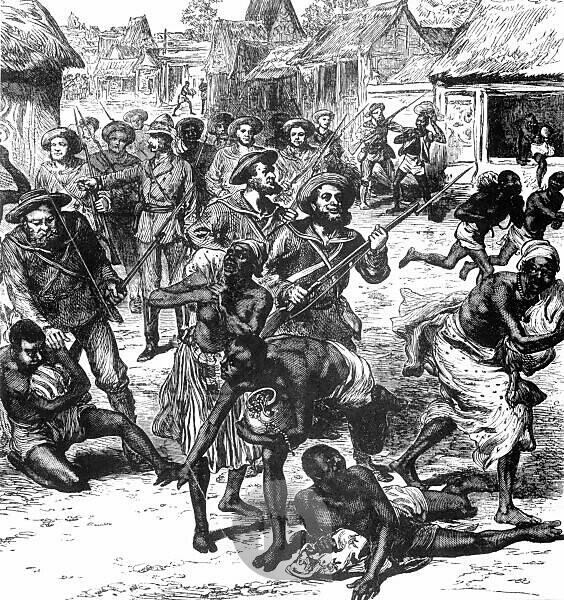
The history of the Anglo-Ashanti Wars is not a story of swift European conquest. It is the epic narrative of an African superpower that fought the British Empire to a standstill for nearly a century. Between 1823 and 1900, the Ashanti (Asante) Empire, located in the interior of modern-day Ghana, engaged in a series of five brutal wars against the British and their coastal allies.
To understand the Ashanti wars, one must look beyond the British imperial propaganda of bringing civilization and acknowledge the profound military sophistication, political complexity, and unwavering resilience of the Ashanti people.
The Rise of the Ashanti Military Machine
Long before the British attempted to conquer them, the Ashanti had forged one of the most centralized and militarily advanced states in sub-Saharan Africa. Formed in 1701 under the leadership of Asantehene (King) Osei Tutu and his advisor Okomfo Anokye, the empire was unified by the sacred Golden Stool, which housed the soul of the Ashanti nation.
The Ashanti military was a highly disciplined fighting machine. Capable of mobilizing tens of thousands of warriors, the army was structured into specialized divisions: scouts (akwansrafo), an advance guard (twafo), a main body (adonten), a personal bodyguard (gyase), a rearguard (kyidom), and two maneuvering wings (benkum and nifa). They were pioneers in logistics and battlefield medicine, deploying specialized medical units to care for the wounded, a feature rarely seen in armies of that era.
By the 19th century, the Ashanti had acquired firearms, primarily trade muskets known as Long Danes. While often technologically inferior to the breech-loading rifles eventually used by the British, the Ashanti compensated with brilliant tactical maneuvering in the dense West African rainforest. They utilized a hammer and anvil strategy, drawing enemies into heavy frontal fire while flanking wings encircled and crushed them.
The Early Clashes: Protecting the Coastal Monopoly
The root of the conflict with the British lay in economics and sovereignty. The Ashanti economy was robust, built on the trade of gold, kola nuts, and, significantly, enslaved people. The Ashanti sought direct access to the coastal trade routes on the Gulf of Guinea, putting them in direct conflict with the Fante confederacy, a coastal people who acted as middlemen.
The British, seeking to abolish the slave trade and monopolize legitimate commerce, allied with the Fante. The British refused to acknowledge the Ashanti claim to be the overlords of the coast and refused to pay notes (rent) for the coastal forts they occupied. The tension was palpable.
The First Anglo-Ashanti War (1823–1831): An Empire Humiliated
The First Anglo-Ashanti War erupted when the British Governor, Sir Charles MacCarthy, arrogantly dismissed Ashanti territorial claims. Believing the Ashanti would crumble before a European force, MacCarthy led an expedition inland in 1824.
At the Battle of Nsamankow, MacCarthy’s forces walked into a brilliant Ashanti trap. The British found themselves facing 10,000 disciplined Ashanti warriors. The Ashanti advance was flawless; as one American anthropologist noted, they “marched in perfect order... before they turned toward the enemy and fired volleys on command”. MacCarthy's supply lines failed, boxes meant to contain ammunition were found to hold only macaroni, and his force was annihilated. MacCarthy was killed, and the Ashanti transformed his gold-rimmed skull into a royal drinking cup.
The Ashanti swept to the coast, proving they could crush a British army. It wasn't until 1826 at the Battle of Dodowa that a combined British and allied force halted the Ashanti advance, largely due to the terrifying novelty of British Congreve rockets. A treaty in 1831 established the Pra River as a border, ushering in decades of uneasy peace.
Stalemate and the Sack of Kumasi (1863–1874)
The peace shattered with the Second Anglo-Ashanti War (1863–1864). When an Ashanti fugitive fled across the Pra River, Ashanti forces pursued him into British-protected territory. The resulting conflict was a grueling stalemate, with tropical diseases claiming more lives on both sides than actual combat.
The Third Anglo-Ashanti War (1873–1874) marked a shift in British strategy; for the first time, they aimed to completely destroy the Ashanti Empire. The conflict was triggered when Britain purchased the Dutch Gold Coast, including the port of Elmina, which the Ashanti historically claimed. Asantehene Kofi Karikari launched an invasion to protect Ashanti sovereignty.
Britain dispatched Major General Sir Garnet Wolseley with 2,500 heavily armed British troops and thousands of African and West Indian soldiers. Wolseley built a military road through the jungle and deployed Gatling guns and modern artillery.
At the Battle of Amoaful (January 1874), the Ashanti fought with staggering ferocity. The British commander noted the admirable skill and generalship of the Ashanti commander, Amankwatia, who directed a punishing series of flank attacks. Ultimately, superior British firepower prevailed. The British advanced into the capital, Kumasi, looted its artistic treasures, and blew up the royal palace. The resulting Treaty of Fomena forced the Ashanti to pay a massive gold indemnity and renounce their coastal claims.
The War of the Golden Stool (1900)
Following the Fourth Anglo-Ashanti War (1895–1896), a brief campaign where the British, fearing French and German encroachment, arrested Asantehene Agyeman Prempeh I and exiled him to the Seychelles without a shot being fired, the British believed the Ashanti were finally broken.
They were wrong.
In March 1900, the British Governor, Sir Frederick Mitchell Hodgson, committed one of the most arrogant and ignorant blunders in colonial history. He marched into Kumasi and demanded to sit on the Golden Stool (Sika Dwa Kofi). He did not understand that the Stool was not a throne; it was the sacred soul of the Ashanti nation. No one, not even the Asantehene, was allowed to sit on it.
The Ashanti chiefs were stunned into silence, but they returned home to prepare for war. When the male chiefs hesitated, it was a 60-year-old woman who galvanized the nation. Queen Mother Yaa Asantewaa of Ejisu delivered a blistering, legendary speech:
“If it were in the brave days... chiefs would not sit down to see their king taken away without firing a shot... I must say this, if you, the men of Ashanti, will not go forward, then we will. We, the women, will. I shall call upon my fellow women. We will fight!”
Yaa Asantewaa took command of a 5,000-strong army and launched the War of the Golden Stool (the Fifth Anglo-Ashanti War). The Ashanti besieged the British fort in Kumasi for months, cutting telegraph lines, barricading roads, and utilizing devastating guerrilla tactics.
It took a massive relief force of 1,000 men and heavy artillery to finally break the siege in July 1900. The Ashanti suffered approximately 2,000 casualties, and the British and their allies lost over 1,000, making it one of the bloodiest conflicts in the region. Yaa Asantewaa was captured and exiled to the Seychelles, and the Ashanti Empire was formally annexed into the British Gold Coast colony in 1902.
The Undefeated Soul of the Ashanti
The British may have annexed the land, but the Ashanti claimed the ultimate victory: the British never captured the Golden Stool. It remained safely hidden in the forests, preserving the spiritual integrity of the Ashanti nation.
The Ashanti Wars were a masterclass in African resistance. For nearly a century, the Ashanti Empire stood toe-to-toe with the most powerful military force on earth, defending their sovereignty, their economy, and their sacred soul. Their fierce determination laid the foundational spirit of resistance that would eventually lead Ghana to become the first sub-Saharan African nation to achieve independence in 1957.