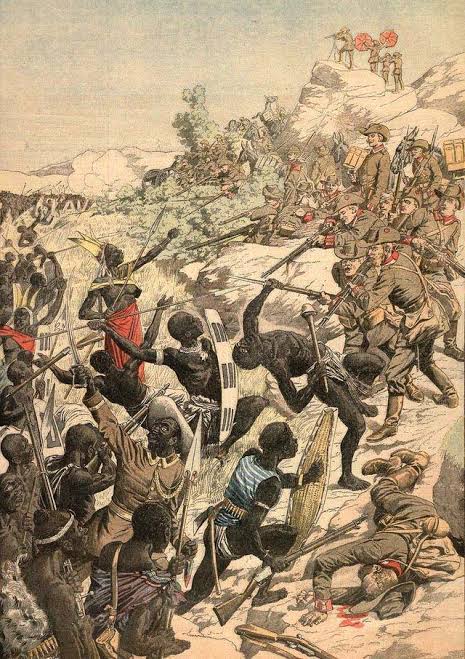
The history of German South-West Africa, modern-day Namibia, is rarely told with the brutal honesty it requires. For over a century, European historical records have framed the events of 1904 as a colonial rebellion or a pacification campaign. The reality is far more sinister. The Battle of Waterberg and the ensuing Omaheke Desert blockade were not standard military engagements; they were the calculated mechanisms of the 20th century’s first state-sponsored genocide, a horrific blueprint that would later be replicated in Nazi Germany.
To understand the Battle of Waterberg, one must first confront exactly why the Herero and Nama people were forced to take up arms. This was not a random act of hostility, but a desperate fight for survival against an empire determined to erase them.
The Architect of Theft: Why the War Began
German colonization of Namibia began in 1884, when Chancellor Otto von Bismarck claimed the territory to counter British expansion. Initially, the German military presence was incredibly weak, relying entirely on manipulation. Governor Theodor Leutwein, who commanded the territory from 1894 to 1904, utilized a pragmatic but ruthless divide-and-rule strategy, forcing indigenous tribes to sign protection treaties against one another. When these treaties inevitably fractured, the colonial army would destroy the rebellious group and auction off their land and cattle to arriving white European settlers.
By 1903, the Herero people had been systematically stripped of over 50,000 square miles of their ancestral land. But the theft of land was only the beginning of their torment.
The structural condition that made war inevitable was the deeply racist, two-tiered German judicial and economic system. German settlers and soldiers operated with absolute impunity. African lives were legally and socially deemed worthless; European colonizers could murder and rape indigenous people without fear of genuine legal consequence, while Africans were routinely executed for minor infractions or alleged cattle theft. Furthermore, German colonial law explicitly permitted white employers to brutally beat and flog their indigenous workers.
Economically, the Herero were strangled. A devastating rinderpest epidemic in 1897 killed the vast majority of their cattle, collapsing their traditional pastoral economy and forcing many into starvation or indentured servitude. Predatory German traders exploited this desperation, selling goods and alcohol on credit, and then violently confiscating whatever remaining cattle or land the Herero possessed to settle the manufactured debts.
The Herero were being squeezed out of existence. The 1904 uprising was not a riot; it was a highly organized, desperate war for political independence, land retrieval, and human dignity.
The Uprising and the Humiliation of an Empire
On January 12, 1904, under the command of Paramount Chief Samuel Maharero, the Herero nation launched a brilliant surprise offensive. The uprising caught the arrogant colonial administration completely off guard. Herero fighters strategically dismantled the colonial infrastructure, destroying railway bridges and reclaiming stolen territory.
In a stark display of moral superiority over their colonizers, the Herero fighters operated under strict rules of engagement. They exclusively targeted German military installations and male colonizers, killing between 123 and 160 German men, while intentionally sparing women, children, missionaries, and non-German Europeans.
The success of this African resistance sent shockwaves through Berlin. The defeat of a European imperial power by an African population they deemed biologically inferior was an unbearable humiliation for Kaiser Wilhelm II and the German General Staff. In a furious response, Governor Leutwein was dismissed. The Kaiser dispatched Lieutenant General Lothar von Trotha, a man notorious for his ruthless suppression of rebellions in East Africa and China, with a fleet of reinforcements and a singular, chilling mandate: crush the Herero by all means necessary.
The Battle of Waterberg (August 11, 1904)
By the spring of 1904, Chief Samuel Maharero had consolidated his forces. Between 60,000 and 80,000 Herero, the vast majority of whom were women, children, and the elderly, accompanied by their remaining cattle, gathered at the Waterberg Plateau (Ohamakari). They concentrated at this location because it offered the last major waterholes and abundant grazing land before the desolate Omaheke Desert. Crucially, the Herero leadership expected that the mass gathering would force the Germans back to the negotiating table to establish a lasting peace treaty.
Von Trotha had no intention of negotiating. He spent nearly three months laboriously transporting heavy artillery, machine guns, and supplies via ox-drawn carts to the Waterberg. His plan was complete annihilation.
On August 11, 1904, von Trotha executed his battle plan, deploying roughly 1,500 heavily armed troops organized into six columns. The German forces possessed 1,625 modern breech-loading rifles, 30 artillery pieces, and 14 Maxim belt-fed machine guns. The Herero forces, numbering between 3,500 and 6,000 fighting men, defended their families using traditional throwing clubs (kirri) alongside whatever firearms they had captured.
Von Trotha’s strategy was to surround the plateau in a semicircle, intentionally leaving only one exit open: the waterless expanse of the Omaheke Desert to the east. However, the German execution was flawed. The commander of the southeastern column failed to move into position on time, creating a massive, unclosed gap in the German lines.
Despite enduring point-blank artillery and machine-gun fire for nearly a day, the Herero fighters held their ground long enough for their people to escape. Facing ammunition shortages, Chief Samuel Maharero led a massive, coordinated breakthrough through the gap in the German lines, guiding the bulk of his people and their cattle eastward into the desert. The combat casualties of the battle itself were relatively low: 26 German soldiers died, while Herero combat deaths were estimated at 120 to 150.
Von Trotha declared a victory, but his officers knew the truth: the Herero had outmaneuvered the encirclement. The true horror, however, was just beginning.
The Vernichtungsbefehl and the Desert Blockade
Furious that the Herero had survived, von Trotha weaponized the geography of Namibia. He ordered his troops to pursue the refugees into the Kalahari and constructed a 200-mile military cordon along the western edge of the desert to seal them inside. German patrols systematically poisoned the few existing waterholes and guarded the rest, operating under explicit orders to shoot anyone attempting to return.
On October 2, 1904, von Trotha formalized this genocide by issuing the Vernichtungsbefehl (Extermination Order). The decree was unprecedented in its chilling clarity:
"Within the German boundaries, every Herero, with or without firearms, with or without cattle, will be shot. I won't accommodate women and children anymore. I shall drive them back to their people, or I shall give the order to be shot at them."
Tens of thousands of Herero men, women, and children died agonizing deaths from dehydration, starvation, and exhaustion in the baking sands of the Omaheke. German patrols later found skeletons clustered around futile, 50-foot-deep holes dug by bare hands in a desperate search for water.
The genocide did not stop with the Herero. In late 1904, witnessing the atrocities, the Nama people revolted under the leadership of Hendrik Witbooi and, later, Simon Kooper. Operating as highly effective guerrilla fighters, 2,000 Nama warriors managed to tie down 14,000 German soldiers for years. In response, von Trotha issued a second extermination order against the Nama on April 22, 1905.
Shark Island: The Blueprint for the Holocaust
By late 1905, growing public backlash in Germany regarding the financial cost of the war, and protests from colonial farmers who realized von Trotha was destroying their future forced labor pool, prompted the Kaiser to rescind the extermination orders. The military pivoted from outright slaughter to incarceration and slavery.
Surviving Herero and Nama were rounded up and transported hundreds of kilometers to concentration camps in Swakopmund, Windhoek, and Lüderitz. The most infamous of these was the Shark Island concentration camp, heavily documented in history as Death Island.
Conditions at Shark Island were designed for extermination through labor. Inmates were provided with handfuls of uncooked rice; they had no means to boil, resulting in rampant dysentery, scurvy, and typhoid. Prisoners were beaten with whips (sjamboks) and forced into backbreaking slave labor to build the railways and the Lüderitz harbor. Women were subjected to systemic rape by German soldiers and colonial guards.
It was at Shark Island that the gruesome foundation of Nazi racial pseudoscience was poured. German race scientists, most notably Dr. Eugen Fischer, arrived at the camps to conduct medical experiments on living and dead prisoners to prove African biological inferiority. In an act of unparalleled psychological torture, captured Herero and Nama women were forced to boil the severed heads of dead inmates, often their own family members, and scrape the skin and eyes off the bone with glass shards so the pristine skulls could be shipped to German universities for study.
Eugen Fischer would later return to Germany and become a leading figure in Nazi eugenics. Similarly, General Franz Ritter von Epp, a company commander during the Herero genocide, would go on to mentor a young Adolf Hitler. The methodologies of the Holocaust, concentration camps, racial science, death marches, and extermination orders- were perfected in the deserts of Namibia.
The Scars of an Unfinished Fight
By the time the concentration camps were officially closed in 1908, the demographics of Namibia had been violently altered forever. The Herero population plummeted by 80%, from 80,000 to fewer than 16,000. The Nama population was halved, reduced from 20,000 to just 10,000. Chief Samuel Maharero and a fractured group of about 1,000 survivors managed to cross the desert into the British Bechuanaland Protectorate (modern-day Botswana), where they remained in exile. Furthermore, the indigenous San (Bushmen) were subsequently hunted and pushed into generations of severe servitude by the colonizers.
After the war, the German administration confiscated all Herero and Nama land, distributing it to white settlers. This racialized land distribution was largely maintained through the subsequent decades of South African apartheid rule and remains deeply unequal in Namibia today.
For over a century, the descendants of the victims fought for global recognition. Finally, in May 2021, the German government officially acknowledged the atrocities as a genocide. However, the agreement was highly controversial. Germany offered €1.1 billion (approx. $1.3 billion) in development aid to be paid over 30 years, but strictly refused to use the legal term reparations to avoid admitting legal liability.
The OvaHerero Traditional Authority and the Nama Traditional Leaders Association swiftly rejected the deal, pointing out that they were excluded from the bilateral negotiations between the German and Namibian governments. Their ancestral land remains in the hands of the descendants of the colonizers, and their sacred sites are still under threat; in 2024, plans to expand the Lüderitz port to produce green hydrogen sparked outrage, as the construction threatens to desecrate the unmarked, underwater graves surrounding Shark Island.
The Battle of Waterberg was not the end of the Herero and Nama nations; it was the crucible that proved their unbreakable endurance.