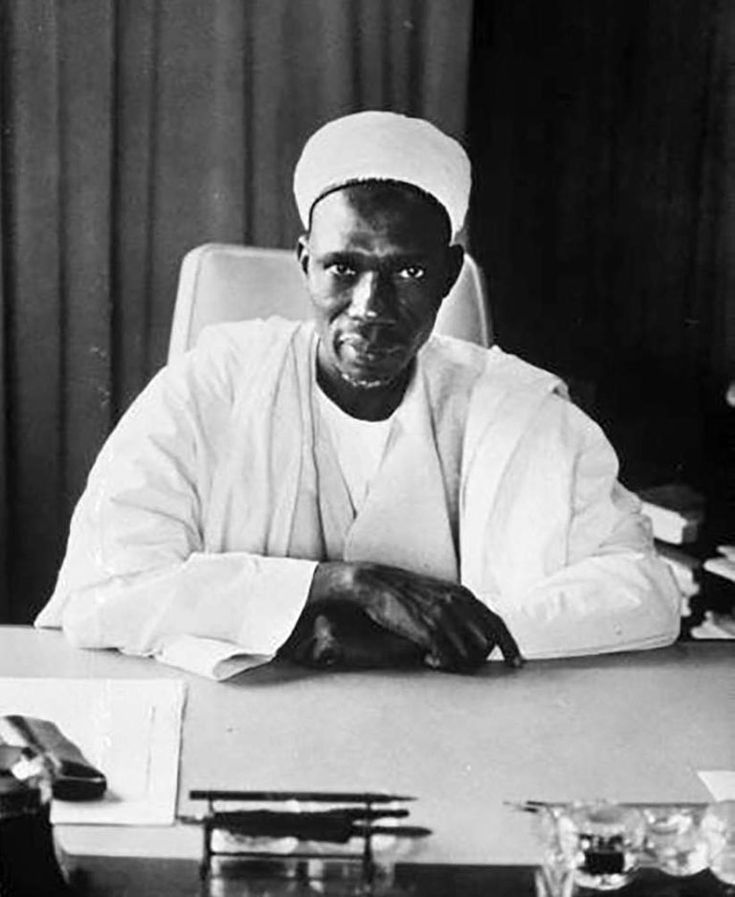
Before he stood on the world stage as the leader of Africa’s most populous nation, Abubakar Tafawa Balewa was a boy from a humble family in Northern Nigeria. Born in December 1912 in the village of Tafawa Balewa, Bauchi province, his origins were rooted in the Gerawa and Fulani people. His father, Yakubu Dan Zalla, was a former slave who eventually rose to become a district head. His village's name derived from two corrupted Fulani words: “Tafari” meaning rock, and “Baleri” meaning black, earning him the early moniker Black Rock.
The history of Tafawa Balewa is one of an accidental intellectual. As a child, he attended a Koranic school in Bauchi before proceeding to Katsina Teachers Training College (later Barewa College), where he graduated with a teaching certificate in 1933. Initially, he was not considered the best student, but he possessed an exceptional mastery of the English language. He returned to Bauchi Middle School as an English teacher, rising to the rank of headmaster in 1944. It was during this period that he wrote Shaihu Umar, a poignant 1934 novella exploring themes of the trans-Saharan slave trade, family, and Islamic submission.
His trajectory shifted entirely due to a friendly challenge. To prove to a friend that a Northerner could pass the rigorous senior teacher's certificate exam, Balewa took the test and succeeded. This landmark achievement earned him a scholarship to the University of London's Institute of Education in 1945. Upon his return, he served as an Inspector of Schools, completely uninterested in politics until circumstances and peers pushed him into the arena.
The Reluctant Politician and the Birth of a Prime Minister
Entering the political landscape in 1946, Balewa was elected to the Northern House of Assembly and subsequently the Central Legislative Council in 1947. He quickly became a fierce, vocal advocate for the rights of Northern Nigeria, delivering an impassioned speech that demanded radical changes to the British Native Administration. Alongside Ahmadu Bello, the Sardauna of Sokoto, he co-founded the Northern People's Congress (NPC) to represent the Muslim majority in the North. Although Balewa was a commoner, an unusual trait for an NPC leader, he became the party's deputy leader under Bello.
Balewa’s rise through the federal ranks was meteoric. Moving to Lagos in 1952, he served as Minister of Works, and by 1954, as Minister of Transport. Recognizing his steady hand, Britain's Colonial Governor appointed him Nigeria's first Chief Minister in 1957.
Determined to forge a unified front ahead of independence, Balewa formed a national coalition government involving the country’s three major factions: the NPC, the Action Group (AG) led by Obafemi Awolowo, and the National Council of Nigeria and the Cameroons (NCNC) led by Nnamdi Azikiwe. In his first prime ministerial broadcast in 1957, a quintessential Tafawa Balewa speech, he declared the era a national emergency, urging political leaders to bury their differences and control their party extremists to achieve independence.
On October 1, 1960, sir Abubakar Tafawa Balewa officially became the first Prime Minister of an independent Nigeria. In a gesture of national unity, he personally advocated for Nnamdi Azikiwe, an Igbo Southerner, to become the nation's ceremonial President. Queen Elizabeth II knighted Balewa that same year, cementing his status as a distinguished Commonwealth leader.
The Golden Voice on the Global Stage
Balewa was an orator of profound dignity, earning the nickname the Golden Voice of Africa for his resonant, measured delivery. Doubling as his own Foreign Minister in the early years of his administration, he built Nigeria’s foreign policy brick by brick.
He was a staunch pan-Africanist who recognized the dangers of a fragmented continent. At the 1963 summit in Addis Ababa, which birthed the Organisation of African Unity (OAU), Balewa delivered a pragmatic and defining address. He explicitly rejected the ideological division of the continent into the Monrovia and Casablanca Blocs, emphasizing that true African unity required the absolute equality of all states and the strict recognition of existing colonial borders to prevent continental chaos. He warned fiercely against the neocolonial threat of economic domination and proposed the creation of an African Common Market.
On the world stage, Balewa's influence was vast:
- He became the first Nigerian leader to address a joint session of the United States Congress in 1961.
- He developed a warm relationship with U.S. President John F. Kennedy, executing the first live two-way satellite call between heads of government via the SYNCOM satellite in August 1963.
- He led a vocal, unrelenting protest against the Sharpeville Massacre in South Africa, pushing the British Commonwealth to expel South Africa over its apartheid policies.
- He successfully mediated negotiations during the brutal Congo Crisis of 1960–1964.
Despite his international prominence, the Prime Minister remained deeply modest. He rejected lavish living, keeping a 50-acre farm outside Bauchi where he vacationed and often conducted state business in quiet reflection.
The Wild West and the Fall of the First Republic
While Balewa excelled internationally, his domestic administration was besieged by the intense regional factionalism built into Nigeria's federal structure. The country was split into the North (NPC), the East (NCNC), and the West (AG), with each region paralyzed by the fear of being dominated by the others.
The breaking point arrived in the Western Region. A bitter power struggle erupted between Action Group leader Obafemi Awolowo and his successor as Premier, Ladoke Akintola. Awolowo wanted the West to remain fiercely independent of the federal government, while Akintola sought an alliance with the center.
The resulting violence forced Tafawa Balewa to declare a state of emergency in the Western Region. Awolowo was subsequently charged with a treasonable felony and imprisoned, an act that alienated many Southern supporters and deepened ethnic distrust. By the time of the October 1965 regional elections, the West had devolved into total anarchy, marred by intimidation, ballot rigging, and horrific violence dubbed Operation Wetie. The Prime Minister was unable to stem the chaos in what became known as the Wild West.
Abduction, Assassination, and Unresolved Mysteries
The unrest culminated in Nigeria's first military coup on January 15, 1966. Disgruntled army officers, led by Majors Kaduna Nzeogwu and Emmanuel Ifeajuna, moved to overthrow the civilian government. During the violent putsch, Major Ifeajuna abducted the Prime Minister from his official residence in Lagos.
For days, the nation was paralyzed by the disappearance of its leader. Six days later, Balewa’s body was discovered by a roadside in Ifo, along the Abeokuta Road, alongside the remains of his Finance Minister, Festus Okotie-Eboh.
The exact circumstances of Balewa's death generated decades of fierce controversy. Matthew T. Mbu, a young minister in Balewa’s cabinet, later claimed that Major Ifeajuna told Christopher Okigbo that the Prime Minister had not been shot, but had collapsed and died from an asthma attack. This was vehemently debunked by those close to Balewa, who maintained he had no history of asthma. Veteran journalist Olusegun Osoba, who discovered the body, noted that Balewa's corpse was remarkably fresh and undecomposed compared to Okotie-Eboh's, leading to further speculation. However, Balewa's official biographer, Trevor Clark, concluded decisively that Major Ifeajuna had shot the Prime Minister and dumped his body. Because Ifeajuna was executed for treason in 1967 before he could publicly testify to the events of that night, the ultimate truth of those final hours died with him.
The assassination of Sir Abubakar Tafawa Balewa, along with Ahmadu Bello and other prominent leaders, shattered the First Republic and triggered a devastating chain reaction. News of his murder ignited violent riots across Northern Nigeria, eventually culminating in the bloody counter-coup of July 1966 and the descent into the Nigerian Civil War.
Balewa was buried in his hometown of Bauchi, where his tomb remains a national monument. Today, his portrait graces the ₦5 note, a quiet reminder of a self-effacing teacher who tried to hold a fractured nation together with the power of his voice.