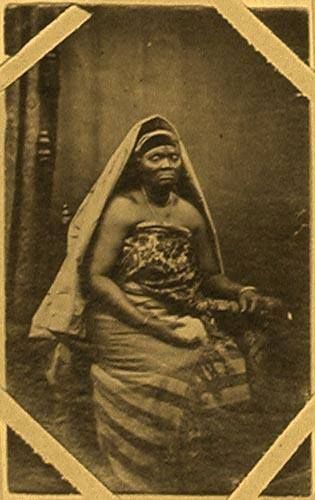
In the bustling commercial heart of Lagos Island lies Tinubu Square, a famous landmark that serves as a monument to one of the most powerful, brilliant, and polarizing figures in 19th-century West African history: Madam Efunroye Tinubu.
To some, she is celebrated as a fierce Yoruba nationalist, a defender of African autonomy, and the first woman to aggressively resist British colonial rule. To others, she was a ruthless, opportunistic transatlantic slave trader who built a massive fortune by selling her own people and defending an abhorrent institution long after it had been outlawed.
The truth is that she was both. History is rarely black and white, and Madam Tinubu dwelt comfortably in its stormy grays. To understand the woman whose name is permanently etched into the geography of Lagos and Abeokuta, we must look at her story without sanitizing her crimes or erasing her triumphs.
The Rise of a Merchant Queen
She was born Efunporoye Osuntinubu around 1805 in the Ojokodo Forest area of Egbaland, which is now part of Ogun State, Nigeria. The name Osuntinubu means “Osun has come within the deep waters,” reflecting her family's adherence to indigenous Yoruba spiritual traditions, specifically the worship of the creator god Obatala and the river goddess Osun.
Tinubu came of age during a period of profound instability fueled by the Yoruba wars, which fed the transatlantic slave trade. After her first husband died, leaving her a young widow with two sons, she turned to the market to survive. She had learned the trade of selling herbs, tree bark, leaves, and roots from her grandmother, Osunsola, and inherited the sharp business acumen of her mother, Nijeede, a food seller.
Her life changed dramatically in 1833 when she met and married Adele Ajosun, an exiled Oba (king) of Lagos who was taking refuge in Abeokuta. When Adele moved to the coastal town of Badagry, a major hub for the slave trade, Tinubu moved with him. She shrewdly leveraged her new royal connections to build a formidable business empire, trading salt and tobacco from Europeans for slaves captured during the Yoruba wars.
When Oba Adele was reinstated to the Lagos throne in 1835, Tinubu accompanied him as a royal wife. Though Adele died just two years later, Tinubu’s grip on the political and economic landscape of Lagos was already secured. She married Yesufu Bada (Obadina), a prominent Muslim soldier and war captain, merging military might with her immense economic influence.
The Kingmaker of Colonial Lagos
Madam Efunroye Tinubu quickly proved that she was a master of political maneuvering. When the throne of Lagos became vacant, she wielded her wealth and connections to back her stepson, Oluwole, successfully installing him as Oba over his rival, Kosoko. When Oluwole died in an accidental gunpowder explosion at the palace in 1841, Tinubu threw her immense weight behind her brother-in-law, Akitoye, making him the next king.
As a reward for her kingmaking, Oba Akitoye granted Tinubu ownership of valuable stores in downtown Lagos and highly favorable commercial concessions. She became the undisputed economic powerhouse of the region, acting as the major conduit between European merchants on the coast and local traders in the Nigerian interior.
However, her power made her enemies. The rival she had sidelined, Kosoko, eventually mustered an army, ousted Akitoye in 1845, and forced Tinubu to flee back to Badagry. From exile, she continued to expand her commercial empire, importing firearms and ammunition from Europeans to fund a formidable army that kept the transatlantic slave trade booming.
The British Agenda and the Conflict Over Slavery
The 1850s marked a turning point in West African history. The British Empire, having abolished the slave trade decades earlier, began blockading ports and pressuring local leaders to sign abolition treaties.
It is crucial to understand that the British intervention was not purely humanitarian. While the abolition of slavery was the moral justification, the British were equally focused on expanding their imperial control and establishing a monopoly on legitimate commerce, such as palm oil and cotton, to feed the Industrial Revolution.
In December 1851, under the pretext of ending the slave trade, the British Navy bombarded Lagos, removed Kosoko, and reinstalled Akitoye to the throne. In January 1852, Akitoye signed a treaty with Great Britain abolishing the transatlantic slave trade in Lagos.
Tinubu, however, saw the British interference as a direct threat to her business and to African autonomy. Believing the British had no right to dictate the commerce of Lagos, she covertly subverted the treaty, continuing to secretly trade slaves for guns with Portuguese and Brazilian merchants. Because of her immense wealth and power, she reportedly commanded a private security force of 360 personal slaves, Oba Akitoye turned a blind eye to her activities.
Her unapologetic stance on slavery remains her most controversial legacy. According to Nigerian historian Oladipo Yemitan, when Tinubu was arraigned before a judge for trading a young boy in Abeokuta, she bluntly stated: I have a large household, and I must feed them well. I need money to do that; that's why. In another notorious incident known as the Amadie-Ojo Affair, she reportedly told a Brazilian slave trader that she would rather drown twenty slaves than sell them at a discount.
Banishment and Rebirth in Abeokuta
Tinubu's economic hegemony and her secret slave-trading inevitably led to a massive collision with Benjamin Campbell, the British Consul in Lagos. Campbell publicly denounced her influence, while Tinubu openly challenged his authority, asserting that the British had no right to infringe upon Lagosian sovereignty.
When Oba Akitoye died and his son Dosunmu ascended the throne in 1853, Tinubu’s power reached its zenith. She executed orders on the king's behalf and orchestrated violent campaigns against Brazilian and Sierra Leonean immigrants whom she believed the British were using to dominate legitimate trade.
Fearing her growing military and political might, Consul Campbell confronted Tinubu with British gunboats in May 1856. Under extreme British pressure, Oba Dosunmu was forced to exile her from Lagos.
Banishment to Abeokuta would have ruined an ordinary person, but Madam Efunroye Tinubu reinvented herself. She adapted her business to the changing economic climate, heavily engaging in the booming trade of palm oil, cotton, and arms.
When the powerful Kingdom of Dahomey (from modern-day Benin) launched devastating invasions against Abeokuta in the 1860s, Tinubu proved her fierce loyalty to her homeland. She used her vast wealth to supply the Egba warriors with massive amounts of ammunition and firearms, effectively turning the tide of the war and securing victory for Abeokuta.
In deep gratitude for her financial and military support, the people of Abeokuta bestowed upon her the prestigious chieftaincy title of Iyalode (First Lady/Queen of Women) of Egbaland in 1864, making her the first woman to ever hold the title. She remained a powerful kingmaker in Abeokuta politics until she passed away in 1887. Because none of her children survived her, her vast properties and lands were inherited by her slaves.
A Legacy Set in Stone
Today, Madam Tinubu's legacy defies simple categorization. To the British colonizers, she was a barbaric relic of the slave trade who stood in the way of their imperial ambitions. To her critics, she was an opportunistic merchant who fed the poor with one hand while shackling children with the other. But to the people of Abeokuta and early Lagos, she was a nationalist heroine who fiercely defended Yoruba land against foreign domination and successfully outsmarted European empires.
She was a woman who shattered the gender limitations of her time, dominating the political and economic landscape of 19th-century Nigeria. Her name lives on through the iconic Tinubu Square on Lagos Island (formerly Independence Square) and a memorial statue in Ita Iyalode, Abeokuta.
Madam Efunroye Tinubu was a woman of her time, complex, unapologetic, and powerful. She remains an enduring symbol of resistance and commerce, forever woven into the complicated, colorful history of Nigeria.