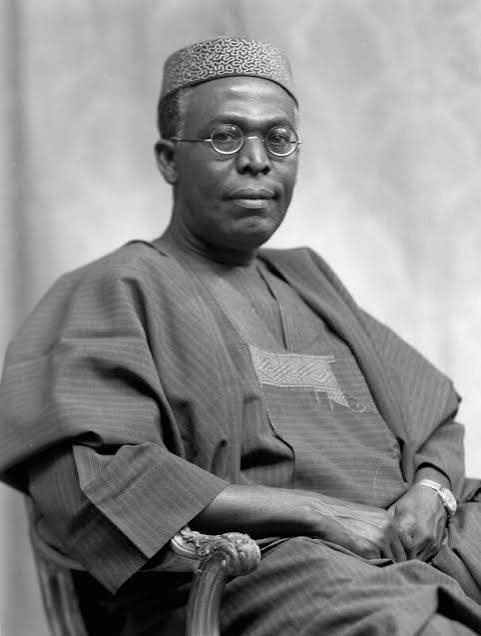
In the pantheon of African liberation and statecraft, few names evoke as much awe, intellectual reverence, and fierce debate as Chief Obafemi Awolowo. To some, he was the undisputed sage of modern Nigerian governance. This disciplined administrative genius proved that an African government could build world-class institutions, educate millions for free, and run an industrial economy without borrowing a dime from foreign powers. To others, particularly in the eastern heartlands, his name is inextricably linked to the agonizing memories of the Nigerian Civil War, where his fiscal policies and economic blockade became instruments of devastating military strategy.
To study the biography of Obafemi Awolowo is to look into the mirror of Nigeria itself: a land of staggering potential, boundless intellectual brilliance, deep ethnic suspicion, and unfinished nation-building. He was neither a simple hero nor a caricature; he was a political colossus whose policies lifted millions out of poverty even as his wartime decisions left wounds that have yet to fully heal.
Humble Beginnings: The Crucible of Ikenne
Born Jeremiah Obafemi Oyeniyi Awolowo on 6 March 1909, in the Remo town of Ikenne (in modern-day Ogun State), young Obafemi entered a world suspended between ancient African tradition and colonial intrusion. His father, David Shopolu Awolowo, was a respected farmer, sawyer, and early Christian convert, while his grandmother remained deeply rooted in traditional Ifá spiritual systems.
Tragedy struck early. When Awolowo was only eleven years old, his father died of smallpox in 1920. The family's financial stability collapsed overnight. Forced to abandon his formal schooling, young Awolowo worked menial jobs, fetching and selling firewood, working as a houseboy, and laboring across towns, just to pay for basic school fees.
This early experience with destitution forged in him a lifelong obsession with self-discipline and an unyielding conviction: poverty was not an inherent African condition, but a systemic failure that education alone could eradicate.
Awolowo clawed his way through Wesley College in Ibadan, qualifying as a teacher and shorthand typist. Working as a clerk, money-lender, and newspaper correspondent for the Nigerian Times, he saved relentlessly while studying through correspondence. He earned a Bachelor of Commerce degree from the University of London as an external student, and in 1944, sailed for the United Kingdom to study law at the Inner Temple.
In London, while mastering British jurisprudence, Awolowo never lost sight of his ancestral homeland. In 1945, he attended the historic Fifth Pan-African Congress in Manchester alongside Kwame Nkrumah and Jomo Kenyatta. That same year, he founded the Egbe Omo Oduduwa, a cultural pan-Yoruba movement designed to foster solidarity and pride, and authored Path to Nigerian Freedom (1947), the first systematic intellectual manifesto demanding true federalism based on ethno-linguistic self-determination.
The Western Region: A Golden Age of African Governance
Returning to Nigeria as a barrister, Obafemi Awolowo founded the Action Group (AG) in 1951 and was elected the first Premier of the Western Region in 1954. What followed over the next five years remains one of the most astonishing developmental sprints in African history.
Rejecting colonial dependency, Awolowo mobilized the region's agricultural revenue, primarily from the cocoa boom, to fund an aggressive social-democratic welfare state under the slogan "Freedom for all, life more abundant".
- Universal Free Primary Education (1955): In a historic move that critics called impossible, Awolowo introduced free, compulsory primary education across the Western Region. Literacy skyrocketed, creating an entire generation of African professionals, doctors, engineers, and teachers.
- Free Healthcare: He instituted free medical care for all children under the age of eighteen, drastically reducing infant mortality.
- First in Africa Media & Sport: In 1959, his administration launched Western Nigerian Television (WNTV), the very first television broadcasting station in Africa, beating several European nations to the technology. He also constructed Liberty Stadium in Ibadan, Nigeria’s first modern sports arena.
- Economic Modernization: Awolowo built the iconic Cocoa House in Ibadan, developed the Ikeja Industrial Estate in Lagos, and established the country’s first minimum wage policy.
Awolowo demonstrated to the world that African self-governance was not a chaotic experiment, but a model of fiscal discipline, administrative rigor, and progressive vision.
Treason, Prison, and the Storm Before the War
In 1959, on the eve of independence, Awolowo stepped down as Premier to lead the Action Group into the federal parliament as the Leader of the Opposition against the conservative Northern People’s Congress (NPC) and the National Council of Nigerian Citizens (NCNC) coalition.
National politics, however, proved treacherous. A bitter ideological feud broke out between Awolowo and his successor as Premier, Chief Samuel Ladoke Akintola, who favored compromising with the federal government. The Western Region erupted into chaos, prompting the federal government to declare a state of emergency.
In 1962, Awolowo was placed under house arrest, and in 1963, he was tried and convicted of treasonable felony for allegedly conspiring to overthrow the federal government. He was sentenced to ten years in Calabar Prison. Even behind bars, his intellectual output did not cease; he wrote extensively on political philosophy, economics, and constitutional design, preparing himself for the storm that was about to engulf the young republic.
The Civil War and the Controversy Over Biafra
When the July 1966 counter-coup plunged Nigeria into ethnic massacres and political disintegration, the new military Head of State, General Yakubu Gowon, recognized that the country needed Awolowo’s stature and economic intellect. Gowon released Awolowo from prison in August 1966 and eventually appointed him Federal Commissioner for Finance and Vice Chairman of the Federal Executive Council.
This period marks the most deeply polarized chapter in any comprehensive Obafemi Awolowo biography.
Before hostilities escalated, Awolowo sought to mediate, visiting Enugu in May 1967 to meet with Eastern Region Governor, Lieutenant Colonel Chukwuemeka Odumegwu Ojukwu. When reconciliation failed and Ojukwu declared the sovereign Republic of Biafra, Awolowo threw his full political and administrative weight behind the Federal Military Government to preserve the territorial integrity of Nigeria.
The Two Sides of the Wartime Legacy
For a balanced, honest historical record, Awolowo's wartime tenure must be examined from both perspectives:
- The Feat of Fiscal Genius: As Finance Commissioner, Awolowo pulled off what global economists considered an impossibility: he funded the entire three-year federal war effort without borrowing a single dollar from foreign banks or Western institutions. He protected Nigeria from the crushing structural adjustment debts that would later cripple other post-colonial African states. He also managed the transition to Nigeria's sovereign currency, introducing the name Naira. A contribution so profound that his portrait has proudly graced the front of the Nigerian 100 Naira banknote since 1999.
- The Trauma of Blockade and Starvation: To the people of Biafra, Awolowo’s strategies were experienced as catastrophic cruelty. He openly defended the total economic and supply blockade of the enclave, arguing that starvation was a legitimate weapon of war to force a swift surrender and preserve the republic. The resulting famine claimed hundreds of thousands of innocent civilian lives, mostly children.
- The £20 Currency Policy: Following the war’s end in 1970, the federal policy allowing Biafrans to exchange their currency for only twenty Nigerian pounds, regardless of the amount they held, was widely viewed across the Eastern Region as a deliberate attempt to impoverish Igbo families and set back their economic recovery for decades.
This dual reality is why Awolowo remains a revered nation-builder to some and a symbol of generational grievance to others. Acknowledging both truths is essential to understanding the complexities of Nigeria’s historical trauma.
The Presidential Quest and the Awoist Doctrine
In 1979 and 1983, following the return to civilian democracy, Awolowo formed the Unity Party of Nigeria (UPN) to contest the presidency. His campaign promised the same progressive agenda that had transformed the West: free education at all levels, integrated rural development, free health services, and full employment.
Despite winning millions of votes across the southwest and parts of the middle belt, he was defeated in both elections by Shehu Shagari of the National Party of Nigeria (NPN). The controversial 1979 election, which hinged on the legal interpretation of what constituted two-thirds of nineteen states, went all the way to the Supreme Court, ending his dream of implementing his social-democratic vision at the federal level.
His political philosophy, known as Awoism, emphasized Spartan personal discipline, intellectual preparation, state-led welfare, and uncompromising integrity. Following his death, even his staunchest wartime adversary, Emeka Ojukwu, paid him an unforgettable tribute, describing Chief Obafemi Awolowo as the best president Nigeria never had.
Family and the Awolowo Household
Behind the fierce public battles stood an exceptionally tight-knit family. On December 26, 1937, Awolowo married Hannah Idowu Dideolu (HID) Adelana, a brilliant businesswoman and political strategist whom he immortalized as his jewel of inestimable value. Their marriage lasted fifty years until his death.
Together, they raised the Awolowo children:
- Olusegun Awolowo (1938–1963): A promising lawyer who tragically died in a car crash during his father's imprisonment.
- Omotola Oyediran (1940–2020): An accomplished educator and administrator.
- Oluwole Awolowo (1942–2013): A politician and publisher of the Nigerian Tribune.
- Ayodele Soyode (1944–2011): A lawyer and mother of former Second Lady of Nigeria, Dolapo Osinbajo.
- Dr. Tokunbo Awolowo-Dosunmu (born 1948): A physician, diplomat, and former Nigerian Ambassador to the Netherlands who oversees the Obafemi Awolowo Foundation today.
An Immortal African Legacy
Chief Obafemi Awolowo passed away peacefully at his home in Ikenne on May 9, 1987, at the age of 78. In recognition of his monumental contributions to African education, the federal government renamed the University of Ife the Obafemi Awolowo University (OAU), which remains one of the continent's most prestigious centers of learning. Furthermore, every time a Nigerian holds a 100 Naira banknote, they are looking at his face, a daily, tangible reminder of a man who literally minted the nation's modern economy.
Awolowo was an extraordinary leader who proved that African minds could design, fund, and execute transformative governance. While history must honestly reckon with the bitter pain of the civil war years, his life stands as an eternal testament to what visionary leadership, intellectual preparation, and unyielding self-reliance can accomplish for the African people.