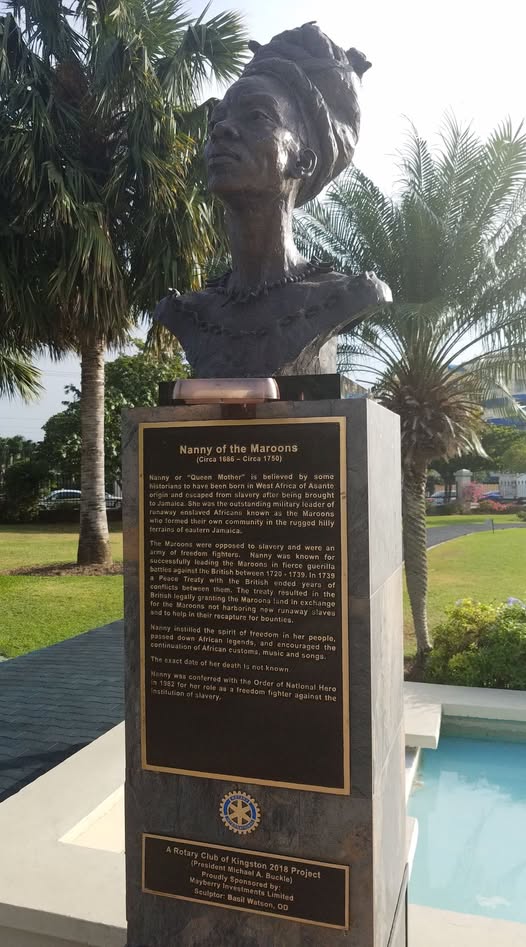
When we discuss the monumental figures who dismantled colonial supremacy, the narrative often defaults to men in suits negotiating in European capitals. Yet, the truest blueprints of Black liberation were drawn in the unforgiving mountains of the Caribbean by African women who defended their sovereignty with blood and iron.
Much like Ana Nzinga, who fiercely resisted Portuguese expansion in 17th-century Angola, Queen Nanny of the Maroons engineered a resistance so sophisticated that it forced the British Empire to surrender territory and recognize her people's autonomy. To understand the Nanny of the Maroons' history, we must strip away the colonial mythologies that sought to diminish her and look at the brilliant, uncompromising military and spiritual leader who orchestrated freedom for her people.
The Royal Roots of a Revolutionary
To fully grasp the Nanny of the Maroons' biography, we must trace her lineage back to West Africa. Born around 1686, Nanny was an Akan woman of the Asante people in modern-day Ghana. Maroon oral historians, particularly those from Accompong Town, assert that her mother was Nyankopong, connecting her to Antwiwaa Nyame, the founder of the powerful Asante Oyoko clan. This means Nanny was born of African royal blood.
Captured and forced into the horrors of the Transatlantic slave trade, she arrived in Jamaica during the brutal height of British plantation slavery. According to the foundational legend that distinguishes a Jamaican from a Maroon, Nanny and her sister, Sekesu, survived the Middle Passage together. While Sekesu remained enslaved on the plantations, symbolically becoming the mother of non-Maroon Jamaicans, Nanny escaped into the treacherous, rugged interior of the island, establishing the lineage of the free Maroons. Other oral traditions maintain that Nanny actually arrived in Jamaica as a free woman, accompanied by her brother Kojo (or Cudjoe), who would go on to lead the Leeward Maroons in western Jamaica's Cockpit Country.
The Maroons were primarily descendants of West Africans, particularly the Akan, who were known by the British as Coromantee and feared as ferocious, unyielding fighters. Joining forces with indigenous Taíno survivors and Africans who had previously escaped Spanish enslavers, Nanny and the Maroons built fortified, independent African societies right in the heart of Jamaica's Blue Mountains.
Masters of the Blue Mountains
By 1720, Nanny had emerged as the preeminent leader of the Windward Maroons in eastern Jamaica. She established Nanny Town, a matrifocal, Akan-styled community perched strategically atop a 900-foot ridge overlooking the Stony River. This geographical mastery made a surprise attack by British forces nearly impossible.
Under her command, the Windward Maroons waged a devastatingly effective guerrilla war against the British during the First Maroon War (1728–1734). Nanny was a master tactician who understood how to weaponize the Jamaican landscape. Her forces pioneered the use of the abeng, a hollowed-out cow's horn used by Akan tribes, to transmit coded, long-range communications across the mountains that the British could not decipher.
Her troops were also absolute masters of camouflage and stealth. Nanny taught her warriors to cover themselves in branches and leaves, slowing their breathing to blend seamlessly into the forest. They utilized the narrow, single-file ravines to trick British soldiers into deadly ambushes. To inflict maximum psychological terror, Nanny ordered her forces never to kill every single British soldier in an ambush; they always left a few survivors to run back to their bases and spread the terrifying tales of the forest coming alive to slaughter them.
Beyond her military genius, Nanny was a liberator. Over a span of thirty years, she is credited with orchestrating raids that freed more than 1,000 enslaved Africans from colonial plantations, bringing them into the safety of her mountain stronghold.
The Science of Obeah and the Myths of Empire
Nanny's absolute authority was not solely military; she was the spiritual epicenter of her people. She practiced Obeah, an African-derived spiritual and healing tradition. To the Maroons, Obeah represented oracular wisdom, discipline, and the synthesis of natural and supernatural sciences. Nanny utilized these practices to unite her community, maintain morale under constant siege, and protect her warriors.
Colonial records and later oral histories circulated a legendary claim: that Nanny possessed the supernatural ability to catch British bullets with her buttocks and fire them back. While this myth highlights her perceived invincibility, Caribbean scholars like Kamau Brathwaite and Carolyn Cooper have astutely deconstructed it. Brathwaite argues that this specific colonial framing was a deliberate attempt to vulgarize and denigrate Nanny's fearsome, holistic power as a leader, healer, and nurturer. Conversely, Cooper suggests this myth empowers the historical practice of Jamaican women using the self-conscious vulgarization of their bodies, specifically turning their backsides, as a profound expression of insult and defiance against oppressors.
Regardless of the colonial spin, Nanny's spiritual leadership created a shared sense of purpose that held the Windward Maroons together against the relentless machinery of the British Empire.
Treaties, Betrayal, and How Did Nanny of the Maroons Die?
After years of suffering massive casualties and failing to penetrate Maroon territory, the British Empire did something it almost never did: it admitted defeat. The British sued for peace, signing a treaty with Cudjoe and the Leeward Maroons in 1739, and a subsequent treaty with Quao and the Windward Maroons in 1740.
These treaties formally recognized Maroon autonomy and ended the direct military conflict, but they came with a poisonous caveat: the Maroons were required to stop harboring runaway slaves and instead capture and return them to the British for a bounty. They were also required to fight for the British against foreign invaders. Nanny was reportedly furious. She fiercely opposed the principle of peace with the British, recognizing that agreeing to hunt down other fleeing Africans was simply another insidious form of colonial subjugation.
Despite her opposition, a separate land patent was signed in 1740, granting 500 acres of land in Portland Parish to Nanny and the people now residing with her. This land became Moore Town (or New Nanny Town), which still stands today.
So, how did nanny of the Maroons die? British colonial journals from 1733 boast that a hired Black Shot mercenary named Captain Sambo (William Cuffee) killed Nanny, the rebels' old obeah woman, during the First Maroon War. However, historical evidence completely invalidates this British claim, as the 500-acre land grant was legally deeded to her and her people in 1740, seven years after her supposed death. While the exact date remains a mystery, it is widely accepted that Queen Nanny lived to be an old woman, dying of natural causes around 1750 or 1760. According to enduring Maroon oral history, she is buried at Bump Grave in Moore Town.
An Unforgotten Legacy
Queen Nanny’s life is a testament to the fact that African women in the Americas were not merely resisting slavery; they were actively organizing freedom and defending sovereign nations. Because of her strategic brilliance, her people were never fully re-enslaved or destroyed.
In 1975, the Jamaican government rightfully declared her a National Heroine. Today, she stands as the only woman among Jamaica's national heroes, and her fierce, unyielding portrait graces the Jamaican $500 banknote, affectionately known across the island as a Nanny.
As one of Jamaica's greatest national heroes, her story is not just Caribbean history; it is African history. Queen Nanny reminds us that the ultimate price of freedom is the willingness to fight for it, protect it, and make it absolutely impossible for the world to ignore.