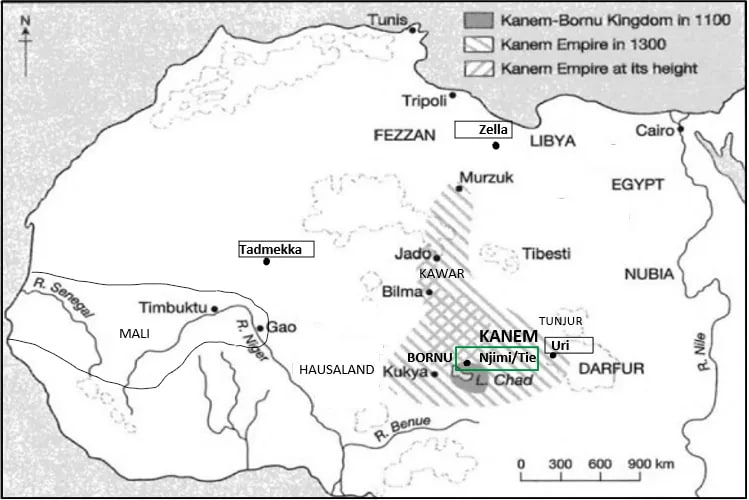
Imagine an empire so resilient and structurally profound that it held absolute power for over a millennium. Long before the modern borders of Niger, Chad, Cameroon, and Nigeria were drawn, the basin of Lake Chad gave rise to a civilization that would echo through eternity. The empire of Kanem was founded around the 8th or 9th century, emerging as a confederation of nomadic pastoralists and agriculturalists. The Zaghawa people, alongside the Tebu-speaking Kanembu, are often credited with the early foundation.
These early architects of statecraft possessed a crucial advantage. They were among the first in the central Sudan region to master iron-smelting technology and horsemanship. This technological edge enabled them to construct formidable, stratified societies, eventually giving rise to the Duguwa dynasty, which ruled from the capital Njimi. They levied taxes and established control over the lucrative trans-Saharan trade, exchanging goods with North Africa and setting the stage for what would become the colossal Bornu Empire.
The Crescent Moon and The Sayfawa Dynasty
History shifted on its axis in the 11th century. Around 1085, the political and spiritual fabric of Kanem was transformed when the Duguwa dynasty was replaced by the Sayfawa dynasty. A pivotal figure named Hummay took the throne and firmly established Islam as the religion of the court. The Sayfawa rulers, known as mais, claimed illustrious descent from the legendary Yemeni hero Sayf ibn Dī Yazan, a strategic move that amplified their prestige across the Islamic world.
The Sayfawa would go on to rule for an astonishing 771 years, marking one of the longest continuous dynastic reigns in human history. Islamization brought literacy in administration and deepened diplomatic ties with Arabia and the Mediterranean. Yet, this transformation was not without its internal friction, as many commoners clung to traditional indigenous beliefs, creating a complex, syncretic society.
Zenith of Kanem and The Golden Era
The 13th century heralded an era of unprecedented expansion under the energetic leadership of Mai Dunama II Dibalemi, who reigned from roughly 1210 to 1259. Dunama II fielded an awe-inspiring cavalry of 40,000 horsemen, extending the Kanem Empire's reach as far north as the Fezzan in modern Libya. Wealth flowed into the empire through the export of salt, ivory, and enslaved people, in exchange for North African horses, copper, and fine textiles.
Intellectual and religious life flourished. Dunama II established diplomatic channels with North African sultans and built a dedicated hostel in Cairo, Egypt, to accommodate pilgrims and students from Kanem traveling to Mecca. However, his reign also sowed the seeds of future discord. By desecrating the mune, a sacred traditional artifact, Dunama II alienated traditionalists and sparked fierce rebellions, notably from the Bulala people.
The Great Migration to Bornu
No empire is immune to the cycles of climate and conflict. By the late 14th century, a combination of prolonged droughts, overgrazing, and relentless military pressure from the Bulala warriors forced the Sayfawa dynasty to make a historic decision. Around the year 1380, Mai Umar Idrismi abandoned Njimi and led his people westward across Lake Chad into the region of Bornu.
What seemed like a catastrophic retreat was actually a brilliant reinvention. In Bornu, the Kanembu intermarried with the local populations, giving birth to the Kanuri people and language. After a turbulent century of civil wars and short-lived reigns, the empire was stabilized, and a massive, permanent fortified capital was established at Birni Ngazargamu around 1472 by Mai Ali I Gaji. From this new, agriculturally rich stronghold, the revitalized Kanem-Bornu state would eventually strike back, recapturing its ancestral homeland of Kanem in the 16th century.
Guns, Cavalry, and The Master Tactician
If the 13th century belonged to Dunama II, the late 16th century was unequivocally the era of Mai Idris Alooma, who reigned from roughly 1571 to 1603. Alooma was a visionary statesman and a brilliant military tactician who brought the Bornu Empire to its absolute zenith. Recognizing the shifting dynamics of global warfare, he reached out to the Ottoman Empire, securing Turkish muskets and military instructors to train his army.
Alooma revolutionized his military with camel corps for desert logistics, fortified camps, and a formidable fleet of boats for river crossings. Under his iron-willed, reformist rule, Islamic law was rigorously implemented, mosques were erected, and trans-Saharan trade boomed. Kanem-Bornu exported vast quantities of natron, cotton, kola nuts, and slaves, while pulling in silk, glass, and firearms from the Mediterranean.
The Fula Jihads and The Rise of The Shehus
The long, slow twilight of the Kanem-Bornu empire began in the 17th century. Shifting climatic conditions brought severe droughts that shrank Lake Chad, while the rise of transatlantic trade slowly diminished the economic dominance of the Saharan routes.
The death knell for the ancient Sayfawa dynasty sounded in the early 19th century with the explosive rise of the Sokoto Caliphate. In 1808, Fulani jihadists, inspired by Usman dan Fodio, invaded Bornu and destroyed the grand capital of Ngazargamu. The embattled mai turned in desperation to Muhammad al-Amin al-Kanemi, a brilliant Muslim scholar and warlord.
Al-Kanemi successfully repelled the Fulani forces, but the price of his salvation was the ultimate transfer of power. He built a new capital at Kukawa in 1814 and began ruling as the shehu, relegating the Sayfawa mais to mere figureheads. When the last mai attempted a doomed rebellion in 1846, he was executed, bringing an unceremonious end to a thousand-year-old dynasty.
The Warlord and The Colonial Scramble
The final chapter of this ancient civilization was written in blood and colonial ink. In 1893, the empire was violently conquered by Rabih az-Zubayr, a ruthless Sudanese warlord and slave raider. Rabih sacked Kukawa, established a brutal military autocracy from the town of Dikwa, and effectively destroyed the traditional socio-economic structures of the region.
Rabih’s reign of terror was short-lived. In 1900, he was defeated and killed by French colonial forces at the Battle of Kousséri. The ashes of the mighty Kanem-Bornu Empire were subsequently divided and swallowed up by the British, French, and German colonial empires, though the traditional title of shehu miraculously survives to this day within the modern borders of Nigeria.