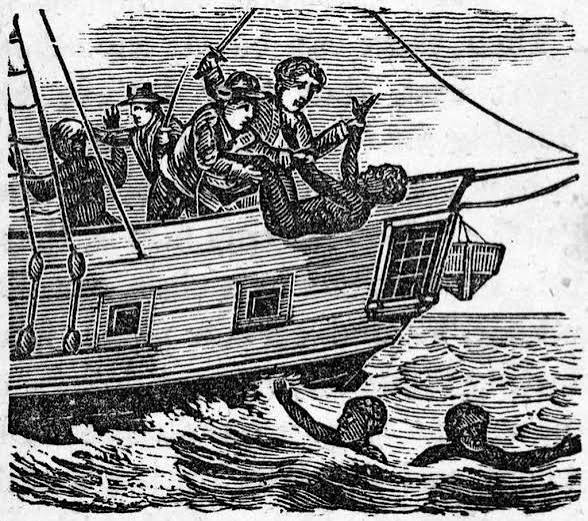
The Atlantic Ocean holds the bones of millions, but few atrocities illuminate the cold, bureaucratic evil of the transatlantic slave trade quite like the Zong massacre of 1781. This was not an act of spontaneous maritime panic or a tragedy born of unavoidable natural disaster. It was a calculated, financial decision to execute more than 130 enslaved African men, women, and children. When the perpetrators returned to England, they did not stand murder trial; they went to court to demand an insurance payout for lost cargo.
To understand the 1781 Zong massacre is to look directly into the gaping moral void of European colonial law, where human life was quantified, insured, and liquidated purely for the preservation of profit.
The Floating Tomb: Overcrowding on the Zong
The vessel that would become infamous as the Zong slave ship was originally a 110-ton Dutch ship named Zorg, captured by the British in early 1781 off the coast of modern-day Ghana. A Liverpool slave-trading syndicate, which included former Liverpool mayor William Gregson, purchased the ship, renaming it the Zong. Gregson was a seasoned slaver whose financial stakes had already seen 58,000 Africans forced into the horrors of the Americas.
When the slave ship Zong departed Accra in August 1781, it was carrying 442 enslaved Africans, packed into a hold barely fit for half that number. In an era where British ships typically carried 1.75 enslaved people per ton of ship capacity, the Zong carried an abhorrent 4.0 people per ton. It was commanded by Luke Collingwood, a man embarking on his first voyage as captain. Collingwood was formerly a ship's surgeon, a role tasked with inspecting captive Africans and discarding those deemed to have no commodity value, psychologically preparing him for the mass slaughter to come.
Alongside a dangerously undersized crew of 17 men, the grossly overloaded ship set sail across the Atlantic Ocean toward the colonial sugar plantations of Jamaica.
The Mathematics of Murder
The journey was plagued by incompetence. By late November, illness, malnutrition, and the horrific conditions of the Middle Passage had already claimed the lives of several mariners and over 60 enslaved Africans. Then, on November 27 or 28, a catastrophic navigational error occurred: the crew spotted Jamaica but misidentified it as the French colony of Saint-Domingue (modern-day Haiti), sailing 300 miles past their destination.
Faced with a prolonged journey and dwindling supplies, Captain Collingwood and his crew made a sickening financial calculation. If the enslaved Africans died a natural death from illness or thirst on board, or died onshore, the Liverpool ship-owners would suffer a total financial loss. The insurance underwriters would not pay out. However, under a maritime insurance principle known as general average, if a captain jettisoned a portion of his cargo into the sea to save the rest of the ship, the owners could legally claim compensation. The insurance policy covered the loss of enslaved people at £30 per head.
On November 29, the crew held a meeting and unanimously agreed to execute their captives to trigger the insurance clause.
Over the next several days, the crew of the Zong dragged 54 women and children to the cabin windows and hurled them into the sea. On December 1, they threw 42 male slaves overboard. In the days that followed, 36 more were cast into the freezing Atlantic waters. As the slaughter unfolded, 10 Africans, refusing to be murdered by their captors, engaged in a final, profound act of defiance and jumped into the ocean themselves.
In total, 142 Africans were killed. The crew would later claim an absolute necessity, stating the ship had run out of water. Yet, when the Zong finally arrived in Black River, Jamaica, on December 22, it still had 420 imperial gallons of fresh water aboard.
Gregson v. Gilbert: A Trial of Property, Not Murder
When news of the massacre reached Great Britain, the horror was not that human beings had been slaughtered, but that the insurance underwriters refused to pay the syndicate’s claim. The owners sued, and the case of Gregson v. Gilbert commenced at the Guildhall in London in March 1783.
The initial jury found in favor of the slave-trading syndicate, treating the massacre as a legitimate maritime business loss. The insurers, desperate to avoid the payout, appealed the decision, bringing the case before the highest court of the King's Bench, overseen by Lord Chief Justice the Earl of Mansfield in May 1783.
The transcripts of this hearing strip bare the depravity of British colonial law. The Solicitor General, John Lee, acting on behalf of the ship owners, expressed absolute bafflement that anyone would consider the incident a crime. He argued vigorously before the court:
“What is this claim that human people have been thrown overboard? This is a case of chattels or goods. Blacks are goods and property; it is madness to accuse these well-serving honourable men of murder.”
Lee insisted that the enslaved Africans perished just as a cargo of goods perished, comparing the mass execution to throwing wood into the sea.
Lord Mansfield, delivering his judgment, agreed with the fundamental legal premise, stating flatly that the Case of Slaves was the same as if Horses had been thrown overboard. However, Mansfield overturned the initial verdict and ordered a new trial, but not out of a sense of justice for the murdered Africans. He ruled in favor of the insurers because new evidence revealed that heavy rain had fallen on the ship on December 1, producing enough water for eleven days. Because the water shortage was alleviated, Mansfield concluded there was no longer an absolute necessity to jettison the cargo, thus rendering the insurance claim invalid due to the captain's mismanagement, not his inhumanity.
In the eyes of the highest court in the British Empire, the Zong massacre was merely an instance of property fraud.
The Abolitionist Awakening
While the British legal system coldly dismissed the bloodshed, the details of the massacre leaked into the public consciousness, fundamentally shifting the trajectory of global history.
Olaudah Equiano, a formerly enslaved African living in London who had purchased his own freedom, heard of the atrocity and immediately brought it to the attention of Granville Sharp, a prominent anti-slavery campaigner. Sharp was outraged. He attempted to bring criminal murder charges against the crew and owners, petitioning the Lords Commissioners of Admiralty and the Prime Minister, but he was completely ignored. The British state refused to prosecute white men for the murder of Black commodities.
Despite the legal failure, Equiano and Sharp weaponized the tragedy. They ensured the gruesome details of the zong massacre permeated British society, utilizing it as the ultimate proof of the inherent, unredeemable evil of the slave trade. The sheer scale of the cruelty galvanized religious groups, notably the Quakers, who submitted early anti-slavery petitions to Parliament.
The story of the Zong became the rallying cry that united the early abolitionist movement. In 1787, the Society for Effecting the Abolition of the Slave Trade was founded. The following year, Parliament passed the Slave Trade Act 1788 (Dolben's Act), the first piece of legislation to limit the number of captives a ship could legally carry. Eventually, this momentum, built on the outrage generated by the Zong, culminated in the Slave Trade Act of 1807, which banned British participation in the transatlantic slave trade, and the Slavery Abolition Act of 1833.
The Eternal Echoes of the Zong
The perpetrators of the massacre never faced a day of criminal justice. Captain Luke Collingwood died of illness in Jamaica mere days after the ship docked, avoiding the legal spectacle entirely. The William Gregson syndicate continued to operate as wealthy, respected merchants in Liverpool.
Yet, the legacy of the 142 Africans murdered in the mid-Atlantic refused to be erased. Their story transcended the sterile court records of Gregson v. Gilbert, deeply influencing global culture and historical memory. The atrocity inspired J.M.W. Turner’s haunting 1840 painting The Slave Ship, which depicted shackled victims consumed by the sea, and has since inspired profound works of literature, including M. NourbeSe Philip’s deconstructive poem Zong! and the British historical drama Belle. In 2007, a monument was finally erected in Black River, Jamaica, honoring the lives of those who were killed.
The history of the Zong demands that we look beyond the triumphant narratives of European abolitionism to see the grim catalyst that sparked it. It forces us to remember the 208 survivors who stood on the auction blocks of Jamaica, carrying the screams of their drowning brothers and sisters with them, and the 142 souls whose brutal sacrifice finally forced an empire to look at the blood on its hands.