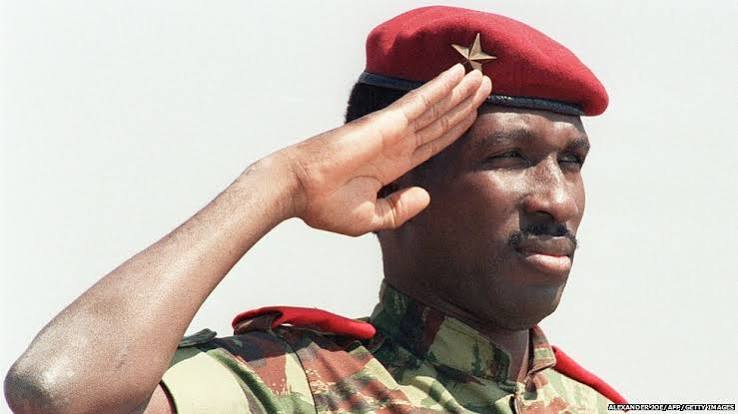
There are rare moments in the grand arc of human history when a single individual steps onto the stage and completely alters the gravity of an entire continent. They do not merely occupy an office; they disrupt a system. They turn old, tired formulas inside out and dare to imagine an entirely different way of existing. Thomas Sankara was exactly that kind of historic lightning strike. Long before his name became a fixture on protest posters and vintage t-shirts worn by radical youth across the globe, he was a flesh-and-blood revolutionary who tried to completely decouple his country from the choking grip of neocolonial dependency.
For anyone looking into the life of this charismatic captain, the story is not just a collection of dates and military decrees. It is a deeply moving, sometimes contradictory drama about the sheer audacity of hope and the devastating price of betrayal. In just four brief years at the helm of his nation, Sankara launched an administrative and social experiment so radical that its ripples are still felt across African political landscapes today. He was a man who famously believed that to achieve fundamental change, you needed a certain amount of madness.
Early Roots
Every icon begins somewhere far away from the cameras and the cheering crowds. Thomas Isidore Noël Sankara came into the world on December 21, 1949, in Yako, a town in what was then French Upper Volta. He was born the third of ten children into a deeply religious Roman Catholic family. His father, Joseph Sankara, was a gendarme of Silmi-Mossi heritage, while his mother, Marguerite Kinda, was of direct Mossi descent. Because of his father’s employment with the colonial state, the young Thomas grew up in a slightly more comfortable brick home on a hill in Gaoua, a humid southwestern town.
Living among the families of other colonial functionaries, he had a front-row seat to the staggering social inequalities of his time. He was a brilliant student who excelled in French and mathematics, regularly serving as an altar boy at the local church. The priests, noticing his intense energy and sharp intellect, actively pushed him toward a life in the priesthood. His parents desperately wanted that quiet, holy path for him, but the streets of Upper Volta were vibrating with a different kind of energy. The country had just ousted its first, highly unpopular president, Maurice Yaméogo, and young intellectuals began looking at the military not as an instrument of oppression, but as the only disciplined institution capable of modernizing the state and neutralizing the corrupt bureaucracy.
At the age of 17, Sankara made a definitive pivot that would change his life forever. He took the entrance exam for the military academy of Kadiogo in Ouagadougou and passed, securing a scholarship his family otherwise could not afford. It was here, during the intake of 1966, that his formal political education truly began. The academic director at the time, Adama Touré, was a man of progressive, left-wing ideals. Touré quietly invited his brightest, most inquisitive students to informal discussions outside the classroom. For hours, a young Sankara would sit and debate the mechanics of imperialism, neocolonialism, socialism, and the liberation movements sweeping across the African continent. Yet, he wasn't just a grim intellectual brooding over political texts. He was also a passionate artist, spending his nights strumming an electric guitar in a popular local band called Tout-à-Coup Jazz.
Ideological Spark
By 1970, the twenty-year-old officer was sent to Madagascar for advanced training at the military academy of Antsirabe. This period proved to be an existential turning point. While studying standard military strategy, Sankara was also given lessons in agricultural science, learning how to practically raise crop yields and improve the daily lives of rural farmers. More importantly, he arrived just in time to witness a massive wave of popular uprisings by students and workers that successfully toppled Madagascar’s government. It was an unforgettable proof of concept. Organized, ordinary people could break a regime.
During these formative years, Sankara read voraciously. He devoured the foundational texts of Karl Marx and Vladimir Lenin, which fundamentally anchored his materialist worldview. After a subsequent stint at a parachute academy in France—where he was exposed to European left-wing student movements—he returned to Upper Volta an entirely different man. When a border war broke out between his country and Mali in 1974, Sankara fought heroically, earning widespread public attention and military fame. Yet, instead of letting the praise inflate his ego, his growing political consciousness led him to publicly renounce the conflict as completely useless and unjust.
By 1976, he was given command of the elite Commando Training Centre in Pô. It was here that he formed a deep, fateful friendship with another young, ambitious officer named Blaise Compaoré. Along with Henri Zongo and Jean-Baptiste Boukary Lingani, they formed a highly secretive, revolutionary underground network within the military. The fuse had been lit.
Radical Awakening
As Upper Volta spun into a chaotic loop of labor strikes, economic stagnation, and rapid-fire military coups throughout the early 1980s, Sankara’s grass-roots popularity made him impossible for successive regimes to ignore. In September 1981, he was appointed Minister of Information. Right away, Sankara made it clear that he was not your typical suit-and-tie bureaucrat. He shocked the establishment by ditching government-issued luxury cars and riding a bicycle to work every single day. Instead of using his office to censor stories and gag critics, he actively encouraged investigative journalism, giving newspapers the green light to publish government corruption scandals.
Predictably, his unyielding integrity put him at total variance with the conservative leadership. On April 12, 1982, disgusted by the regime’s anti-labor policies, he walked away from his post, leaving behind a legendary parting shot declaring misfortune to anyone who gagged the people.
Another coup in late 1982 brought Major-Doctor Jean-Baptiste Ouédraogo to power, and by January 1983, Sankara was selected as Prime Minister. This new high-profile platform allowed him to step onto the international stage, traveling to meetings of the Non-Aligned Movement where he shook hands with legendary figures like Fidel Castro of Cuba and Samora Machel of Mozambique. His fiery, uncompromising rhetoric increasingly terrified the conservative factions in the government and their Western handlers.
On May 17, 1983, immediately following a closed-door meeting between Ouédraogo's conservative allies and a top French adviser, Sankara was abruptly dismissed and thrown under house arrest. It was a classic neo-colonial correction. But the powers that be severely miscalculated the deep love the streets had for Sankara. His imprisonment triggered an immediate wave of massive public demonstrations and furious mutinies among the younger officer corps. Recognizing that the historical moment had arrived, Blaise Compaoré led a disciplined force of commandos to Ouagadougou. On August 4, 1983, they successfully overthrew the regime, freeing Sankara and installing him as the President of the National Council of the Revolution at the age of just thirty-three.
Nation Reborn
Sankara didn't want to just paint over the cracks of a broken state; he wanted a total cultural and structural rebirth. On the first anniversary of the revolution in 1984, he formally dissolved the colonial ghost of Upper Volta and rechristened the nation as Burkina Faso. Drawing from the country's indigenous languages, the new name proudly proclaimed his people's identity as the Land of Upright People. He personally composed a spirited new national anthem, designed a fresh flag, and introduced a new coat of arms.
This was not empty, performative symbolism. It was an essential declaration of absolute mental and geopolitical sovereignty. Sankara completely rejected the economic orthodoxies of the West, fiercely turning his back on high-interest development loans from the International Monetary Fund and the World Bank. He looked at the systemic poverty of his country and realized it was an artificial creation of exploitation. He forcefully argued that foreign food aid was a trap designed to keep the global South permanently dependent.
Great Transformations
What followed over the next few years was one of the most stunning, hyper-efficient programs of socioeconomic reform ever seen on the African continent. Sankara focused the state's entire weight on the long-neglected, marginalized peasantry. To tackle a staggering 90 percent national illiteracy rate, his government launched an intensive, nationwide literacy campaign that dramatically drove up reading levels in a matter of years.
His public health initiatives were even more miraculous. In an unprecedented logistical feat, his administration vaccinated over 2.5 million Burkinabè against deadly killers like meningitis, yellow fever, and measles in a matter of mere weeks. Infant mortality rates, which had hovered at a catastrophic 20.8 percent, plummeted to 14.5 percent. Long before Western nations were comfortably discussing the global AIDS epidemic, Burkina Faso became the very first African nation to publicly declare the virus a major threat.
Sankara treated environmental sustainability as a matter of immediate national security. To halt the aggressive southward march of the Sahara Desert, his administration launched an initiative that saw over ten million trees planted across the arid landscape in just fifteen months. On the trade and economic front, he championed radical self-reliance. He banned luxury imports and ordered his people to look inward. Suddenly, public servants were required to wear traditional tunics, beautifully hand-woven from local Burkinabè cotton by local craftsmen. He nationalized all land, stripping feudal landlords of their historical privileges and redistributing farmland directly to the peasants. Within three short years, national wheat and cereal production skyrocketed, making the historically starved country completely food self-sufficient.
At the same time, Sankara was a fierce forerunner for women’s liberation in West Africa. He explicitly stated that there is no true social revolution without the liberation of women. His administration completely outlawed horrific practices like female genital mutilation, forced child marriages, and polygamy. He actively recruited women into the military, promoted contraception, and appointed women to high government positions, including major cabinet ministries.
Shadows and Friction
Yet, the raw speed and uncompromising nature of Sankara's revolution created deep, painful fractures within the fabric of Burkinabè society. To accelerate his sweeping transformations, his administration increasingly leaned on authoritarian methods of control. He banned traditional labor unions and political parties, effectively choking out open political opposition. To bypass the slow judicial system, he set up a network of Cuban-inspired Popular Revolutionary Tribunals designed to try former officials for corruption in public show trials.
However, defendants in these trials were denied access to legal counsel and forced to carry the heavy burden of proving their own innocence. The tribunals eventually morphed into instruments for personal score-settling, where overzealous local Committees for the Defense of the Revolution terrorized ordinary workplaces. When teachers launched a major strike to protest the regime's drift, Sankara reacted with an iron fist, summarily firing nearly 2,500 striking teachers and replacing them with random college graduates.
Furthermore, his aggressive dismantling of traditional structures completely alienated the highly influential tribal elites, especially the leadership of the Mossi ethnic group. By stripping the traditional king of his executive powers and ending tribute payments, Sankara made bitter, dangerous enemies out of the old ruling class.
Agacher Conflict
The fragility of Burkina Faso's international and domestic standing was laid completely bare in December 1985 during the brief, bloody Agacher Strip War. Tensions had been steadily rising between Sankara’s revolutionary state and the military dictatorship of Mali. Regional heads of state were deeply unnerved by Sankara's fiery anti-imperialist rhetoric, fearing his massive popularity would ignite similar revolutions across their borders.
When Burkina Faso launched its national census, military personnel entered disputed border villages to assist with data collection. Mali quickly blasted the move as a direct violation of its territorial sovereignty. On Christmas Day in 1985, the vastly superior Malian Armed Forces launched a full-scale invasion, crossing the frontier with tanks and bombing northern Burkinabè towns.
The Burkinabè army struggled desperately against the onslaught. Captain Blaise Compaoré took direct command of the western front, organizing soldiers into small mobile units that used hit-and-run guerrilla tactics. A ceasefire was cobbled together by the end of December, but the damage was done. The military performance severely dinged the domestic credibility of the ruling council. It forced Sankara to recognize his country’s profound strategic isolation, prompting him to tone down his aggressive rhetoric.
Fatal Betrayal
By 1987, the internal pressures within the regime had reached a boiling point. Sankara was becoming deeply isolated within his own inner circle. His absolute refusal to compromise on corruption, his scaling back of military perks, and his insistence on a lifestyle of extreme personal austerity began to deeply anger an emerging class of ambitious military officers. As president, he drew a meager salary of just $450 a month, and his earthly possessions consisted of a modest house, a tiny Renault 5 car, a few bicycles, and some guitars. He explicitly forbade the hanging of his portrait in public buildings, pointing out that there were seven million Thomas Sankaras.
But his revolutionary purity was no match for the brutal realities of geopolitics. Conservative regional dictators and the French political establishment were completely tired of the troublesome young president. A quiet, deadly rift began to widen between Sankara and his closest friend, Blaise Compaoré.
The haunting details of his final day read like a tragic political thriller. On the afternoon of October 15, 1987, Sankara was sitting in a meeting room working on documents with close advisers. At around 4:30 PM, the quiet afternoon was suddenly shattered by the deafening roar of automatic rifle fire out in the courtyard. Compaoré's elite execution squad had arrived. Sankara, realizing that the end had come and wanting to spare the lives of his team, stood up and calmly told his terrified advisers to stay, stating that it was he the gunmen wanted. He walked out of the door with his hands raised in surrender. The assassins opened fire immediately, riddling his body with bullets. They then burst into the meeting room and methodically executed twelve other officials. Under the dark cover of night, Sankara’s body was callously buried in an unmarked, shallow grave.
Justice and Immortality
The very next morning, Blaise Compaoré declared himself the new President. He immediately launched a massive rectification campaign, overturning nearly all of Sankara's progressive social and economic policies. He ran straight back to the IMF and the World Bank, taking out massive loans that plunged the country right back into financial dependency. Backed heavily by foreign powers, Compaoré built a corrupt patronage system that ruled the country for the next twenty-seven years.
But you cannot kill an idea. Decades later, the ghost of Sankara returned to haunt his killers completely. In October 2014, when Compaoré tried to rewrite the constitution to extend his rule, a historic popular insurrection exploded across Burkina Faso. Millions of protesters flooded the streets carrying iconic portraits of Thomas Sankara. They defiantly stormed government buildings, forcing Compaoré to resign and flee the country.
With the dictatorship broken, historical justice finally arrived. In May 2015, forensic teams officially exhumed his remains from the unmarked grave. In April 2022, a military tribunal in Ouagadougou delivered a definitive verdict. Blaise Compaoré and his chief of security were found guilty of complicity in the assassination and sentenced to life imprisonment in absentia. In a beautiful closing of the historical circle, the government officially proclaimed Sankara a Hero of the Nation. In 2025, his remains were reinterred with full state honors in a magnificent new public mausoleum built on the exact site where he was murdered.