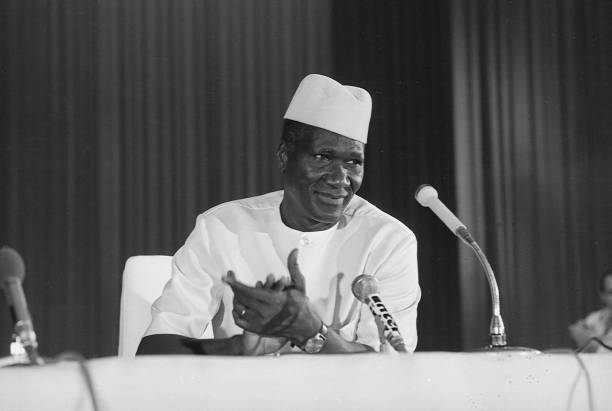
In late August 1958, the grand banquet halls of Conakry played host to a historical collision that would forever change the map of West Africa. General Charles de Gaulle, the towering president of France, had arrived in French Guinea. He was touring the colonies to present a high-stakes referendum: vote "Yes" to join a new, quasi-federal, quasi-autonomous French Community, or vote "No" and break away into immediate, completely unassisted independence.
De Gaulle assumed the territories would bow to the threat of economic abandonment. But as he sat on the stage, a charismatic, 36-year-old trade union leader turned politician stood before the microphone.
His name was Ahmed Sékou Touré.
Looking the French general directly in the eye, Sékou Touré delivered a line that reverberated across the global Black diaspora:
"We prefer freedom in poverty and hardship to wealth in slavery."
Guinea went on to vote "No" with an overwhelming 95% majority, becoming the first and only French colony to reject de Gaulle's ultimatum and demand immediate independence. In retaliation, the departing French administration engaged in an act of calculated, vindictive sabotage, pulling out thousands of civil servants, ripping out telephone wires, burning vital medicines, and unscrewing lightbulbs on their way out.
Yet, against all odds, Sékou touré sustained his state, ruling Guinea as its first president for twenty-six turbulent years. Known colloquially to his adoring masses as Syli (The Elephant) for his immovable strength, his life is a monumental masterclass in anti-colonial resistance, revolutionary Pan-Africanism, and the tragic paranoia that so often corrupts absolute power.
The Blood of a Warrior: From Faranah to the Labor Front
To understand the unrelenting defiance of the statesman, one must first look at the lineage of the boy. Ahmed Sékou Touré was born on January 9, 1922, deep in the interior town of Faranah on the banks of the Niger River. He was born into a poor, Muslim family of Mandinka peasant farmers. However, Touré carried an elite revolutionary pedigree: he was the great-grandson of the legendary military strategist Samori Ture. Samori had established a powerful Islamic empire in the 19th century and waged a fierce, multi-decade scorched-earth resistance against French colonial conquest. This ancestral history of unyielding struggle profoundly shaped Sékou Touré’s consciousness from his earliest years.
THE REVOLUTIONARY LINEAGE
Samori Ture (Great-Grandfather)
- Waged a scorched-earth war against France
- Captured and exiled in 1898
Ahmed Sékou Touré (Great-Grandson)
- Trade unionist and anti-colonial champion
- Proclaimed Guinea's independence in 1958
Raised as a Muslim, young Sékou attended a local Quranic school before enrolling in a French technical college in Conakry in 1936. It didn't take long for his anti-authoritarian streak to surface. At just fifteen years old, he was summarily expelled for organizing a massive student food strike against the colonial school administration. Denied a formal higher education, Touré did not despair; he embarked on a rigorous path of self-education, working menial jobs like shining shoes to buy clothing and socialist literature, immersing himself deeply in the works of Karl Marx and Vladimir Lenin.
By 1941, he passed his exams and entered the colonial civil service as a postal clerk for the Post, Telegraph, and Telecommunications (PTT) department. It was on the floor of the post office that Touré found his true calling: mass organization. In 1945, he founded the Post and Telecommunications Workers' Union, the very first trade union in French Guinea's history.
Touré quickly realized that labor union activism was the most potent weapon to crack the foundations of colonial rule. In 1953, he organized a historic, territory-wide general strike that paralyzed French West Africa for seventy-one days. He successfully forced the colonial administration to back down and implement a new, equitable overseas labor code. He campaigned fiercely for cross-ethnic solidarity, using the union to systematically dismantle the tribal divisions that the French used to divide and rule.
The Political Ascent: Mayoral Ties and the French Deception
His magnetic, spellbinding oratory in French, Soussou, and Malinke made him an unstoppable political force. In 1946, alongside Félix Houphouët-Boigny of the Ivory Coast, Touré helped launch the Rassemblement Démocratique Africain (RDA), a broad, pan-African alliance of political parties fighting for decolonization across French West Africa. He founded the Parti Démocratique de Guinée (PDG) as the local Guinean branch, transforming it from an elite talking shop into a powerful mass organization of workers and peasants.
The French colonial authorities recognized his immense danger and actively tried to sabotage his career. When Touré won elections to the French National Assembly in Paris in 1951 and 1954, the colonial administration brazenly rigged the final tallies to bar him from taking his seat, a systemic election fraud later admitted by French ministers.
But Touré's grassroots momentum could not be stopped. In 1955, he was elected Mayor of Conakry by a landslide, and by 1956, the French were forced to allow him to take his seat as Guinea's official deputy in Paris. He utilized his newly acquired legislative platform to fiercely denounce the economic exploitation of the metropole.
The Vote of Absolute Defiance: 1958
When France's Fourth Republic collapsed under the weight of the Algerian War in 1958, Charles de Gaulle returned to power and pushed for a referendum on an updated constitution. De Gaulle traveled across Africa, expecting every single territory to accept home rule within the French Community.
But Ahmed Toure refused to surrender his country's dignity for French handouts. He organized a massive grassroots "No" campaign through the networks of his labor unions and the PDG. On September 28, 1958, the citizens of Guinea delivered their historic verdict, rejecting the constitution by an overwhelming 95%.
The French response was swift, brutal, and vindictive. Within two months, all French personnel withdrew, intentionally destroying everything they could pack up or tear down. They took state records, cut telephone lines, tore up architectural blueprints for sewage pipelines, and intentionally poured concrete down drains to cripple the young nation's infrastructure. They left Guinea completely isolated, hoping the country would rapidly collapse as a stark warning to any other colony thinking of defying Paris.
But on October 2, 1958, the independent Republic of Guinea was officially proclaimed, and Ahmed Sékou Touré took his place as its first president. He had won his people their freedom, but he now faced the monumental task of building a state out of the ashes of colonial abandonment.
The Socialist Experiment: Self-Reliance and Cultural Decolonization
Cut off from Western capital, Touré steered Guinea down a militantly socialist, non-capitalist path of development. He launched comprehensive state-led economic plans, nationalizing foreign companies, banks, energy, and transportation infrastructure, while Africanizing the entire civil service bureaucracy. In March 1960, he executed a decisive break from French economic hegemony by withdrawing Guinea from the CFA franc zone and creating the independent Guinean franc (later renamed the syli). For his structural commitment to anti-imperialist development, he was awarded the Soviet Union's Lenin Peace Prize in 1961.
Touré’s decolonization project went far beyond economics; it was fundamentally cultural. He launched aggressive national programs to eradicate illiteracy and build schools that taught African history rather than European mythology. Most significantly, he launched an ambitious linguistic policy that officially recognized eight local indigenous languages for state administration and education, completely breaking the monopoly of the French language over intellectual life. He actively championed the emancipation of women, ensuring their robust participation in political structures and appointing them to key ministerial cabinets.
The Vanguard of Pan-Africanism: A Haven for Revolutionaries

A historical photo of Sékou Touré and Kwame Nkrumah sitting together in Conakry after the 1966 Ghana coup.
On the continental stage, Ahmed Sékou Touré was a towering giant of the Pan-African movement. He held a deep, unshakeable conviction that individual national independence was an illusion unless it was tied to the total political unity of the African continent.
Just two months after Guinea claimed its freedom, Touré and his close ideological counterpart, President Kwame Nkrumah of Ghana, signed a historic treaty creating the Ghana-Guinea Union (later joined by Modibo Keïta’s Mali). While this union remained largely on paper due to immense logistical barriers, it served as the direct structural blueprint for the eventual creation of the Organization of African Unity (OAU) in 1963, a foundational process in which Touré played an indispensable role.
When Kwame Nkrumah was tragically overthrown in a Western-backed military coup in 1966, Touré did not blink. He immediately welcomed the exiled leader to Conakry, granted him political asylum, and gave him the unprecedented, honorary title of Co-President of the Republic of Guinea.
Under Touré’s leadership, Guinea became the safe house and launchpad for liberation movements across the continent. He provided arms, funding, and diplomatic passports to freedom fighters battling white-minority rule and Portuguese imperialism in Angola, Mozambique, Zimbabwe, and South Africa. He transformed Conakry into the rear base for the PAIGC guerrillas led by Amílcar Cabral, who were waging a revolutionary war against Portuguese colonialism in neighboring Portuguese Guinea.
Towering figures of the global Black Power movement, including Malcolm X, Miriam Makeba, and Stokely Carmichael, found an ideological home in Guinea. Carmichael was so deeply moved by the clarity of Touré and Nkrumah's vision that he permanently relocated to Guinea, changed his name to Kwame Ture, and spent the rest of his life working for the Pan-African revolution.
The Paranoid Crucible: Conspiracies, Purges, and Camp Boiro
But the higher Touré built his revolutionary towers on the international stage, the darker, insular, and more terrifying his domestic regime became. The constant, genuine threat of subversion by hostile Western intelligence agencies and colonial neighbors bred a culture of absolute, consuming paranoia within Flagstaff House.
The threat was not imaginary. On November 22, 1970, the Portuguese military, alongside armed Guinean dissidents of the FLNG, launched an amphibious invasion of Conakry (Operation Green Sea). Their objectives were clear: destroy the PAIGC rebel bases, liberate Portuguese prisoners of war, and assassinate Sékou Touré to replace his government with a puppet regime. While the invasion succeeded in rescuing the prisoners, it failed to dislodge Touré.
The political vacuum he left behind collapsed immediately. Just hours before the PDG was scheduled to choose his successor on April 3, 1984, the military launched a bloodless coup d'état. Led by Colonel Lansana Conté, the military junta dissolved the National Assembly, suspended the constitution, and explicitly denounced the final years of Touré’s rule as a bloody, ruthless dictatorship. They released 1,000 political prisoners from the cells of Camp Boiro, effectively ending the socialist experiment. In a final, tragic footnote to his story, on July 14, 2020, an unknown individual desecrated Touré’s tomb at the Camayanne Mausoleum in Conakry, setting fire to the national flag draped across his grave, a stark testament to how deeply divided his memory remains. A Duality Unresolved: The Historiographical Judgment. Ahmed Sékou Touré remains one of the most polarizing and complex titans in the history of post-colonial Africa. His legacy cannot be neatly packaged into a single narrative; it exists in a permanent, irreconcilable duality. To the families of the thousands who perished within the concrete walls of Camp Boiro, or the millions who were driven into exile, he was a paranoid, ruthless tyrant who destroyed his nation's democratic potential and governed through fear. Yet, to millions of Pan-Africanists, anti-colonial historians, and youth across the continent, he remains an immortal hero of Black dignity. He was the man who had the absolute, historic courage to say "No" to the face of an empire when the rest of the continent faltered. He proved that an African nation could choose self-reliance over neocolonial submission. Long after the controversies of his internal governance have faded into the annals of time, the echo of his defiant 1958 declaration stands as an eternal monument to the sovereignty, pride, and unyielding freedom of the African continent.