For decades following its independence, Cote d'Ivoire was heralded as the undisputed jewel of West Africa. While neighboring countries succumbed to military coups, economic collapse, and violent insurgencies, the Ivory Coast remained a beacon of astonishing stability and economic prosperity. It was the world's leading producer of cocoa, boasting gleaming skyscrapers in Abidjan and a thriving, cosmopolitan society.
But beneath the surface of the "Ivorian Miracle," deep tectonic plates of ethnic tension, religious division, and xenophobia were slowly grinding together. When the earthquake finally struck in the early 2000s, it completely shattered the nation into two.
The First Ivorian Civil War (2002-2007) was a devastating five-year conflict in the West African country of the Ivory Coast. It pitted countrymen against countrymen, drew in a dizzying array of foreign mercenaries and global superpowers, and fundamentally altered the trajectory of the region. This is the exhaustive, dramatic history of the civil war in the Ivory Coast, a conflict that proved how quickly a peaceful oasis can burn.
The Architect of Peace and the Seeds of Resentment
To understand the outbreak of the Ivorian civil war, one must look at the legacy of the nation's founding father. Following independence from France, the country’s first president, Felix Houphouet-Boigny, ruled with an iron but exceptionally pragmatic hand from 1960 to 1993.
Houphouet-Boigny was a master political tactician. The demographic background of the conflict reflected deep religious and regional divisions in the Ivory Coast, specifically between the predominantly Muslim north and the predominantly Christian south. Recognizing this fragility, Houphouet-Boigny deliberately spread infrastructure projects across the country and maintained the peace between the disparate regions for over three decades.
Furthermore, to fuel the booming cocoa and coffee plantations in the fertile south, Houphouet-Boigny enacted an open-door immigration policy. He invited millions of migrant workers from neighboring countries to help build the Ivorian economy. However, this massive influx of immigrants, particularly from neighboring Burkina Faso, would eventually exacerbate local tensions, as native-born Ivorians began to fiercely debate whether these newcomers should be granted full voting and citizenship rights.
When Houphouet-Boigny passed away in 1993, the glue holding the nation together dissolved. His successors were not as successful at balancing the fragile ethnic coalitions. In the scramble for political power, opportunistic politicians weaponized a hyper-nationalist concept known as Ivoirité (Ivorianness). This toxic political ideology was designed to distinguish "pure" southern Ivorians from northern citizens and immigrants. By the year 2000, these exclusionary politics had generated open tensions between the North and the South.
The Eruption: Mutiny and the Division of the State
The powder keg finally exploded on September 19, 2002. What began as a mutiny by a group of disgruntled northern soldiers quickly escalated into a full-scale armed rebellion.
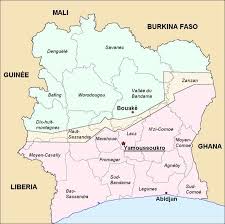
The main belligerents of the conflict were the central government of the Ivory Coast, led by President Laurent Gbagbo, and a powerful northern rebel coalition. Gbagbo’s government controlled the wealthy, Christian-dominated south, including the commercial capital of Abidjan and the vital cocoa exporting ports.
The insurgents were led by a charismatic former student leader named Guillaume Soro, and their forces were collectively called the Forces Nouvelles de Côte d’Ivoire (the New Forces). Within weeks of the initial uprising, Soro's rebel troops swept across the northern half of the country, capturing the major city of Bouaké and effectively cutting Cote d'Ivoire in half. The New Forces claimed they were fighting to end the marginalization and disenfranchisement of northern Muslims and immigrants.
The Mercenaries and Global Proxies
What made the Côte d'Ivoire civil war particularly chaotic was the astonishing level of international interference and the deployment of proxy fighters. The conflict quickly became a magnet for guns for hire.
President Laurent Gbagbo’s central government was supported by France and the United States. However, to bolster his heavily strained national army, Gbagbo also recruited a fierce, ultra-nationalist militia known as the "Young Patriots" of Abidjan, along with battle-hardened Liberian mercenaries and specialized combat pilots from Belarus. The Young Patriots, led by Charles Blé Goudé, terrorized the streets of the capital, violently targeting immigrants, suspected rebel sympathizers, and Western expatriates.
On the other side of the "Zone of Confidence" (the heavily guarded frontline separating the two halves of the country), the insurgents also had heavy foreign backing. Guillaume Soro's New Forces were supported by Russia, Bulgaria, and the neighboring government of Burkina Faso.
The resulting violence was devastating. More than three thousand soldiers, militia members, and innocent civilians were killed in the conflict. Widespread human rights abuses, including massacres, sexual violence, and the use of child soldiers, were reported on both sides of the frontline.
The Stagnation and International Intervention
Fearing that the total collapse of the Ivory Coast would destabilize the entire West African region, the international community intervened. France deployed thousands of troops under Operation Licorne to protect its citizens and establish a buffer zone.
In 2004, United Nations peacekeepers, consisting mainly of soldiers from the Economic Community of West African States (ECOWAS), entered the Ivory Coast, but their efforts were ultimately unsuccessful in stopping the fighting entirely.
The country devolved into a bitter, stagnant stalemate. The government could not push north, and the rebels could not push south. The economy bled. The famed Ivorian education system collapsed in the north, and the lucrative cocoa trade was smuggled across borders to fund rebel weapons purchases. Every attempt at a diplomatic peace treaty, from the Linas-Marcoussis Accord in France to agreements in Accra and Pretoria, failed to take permanent hold, as both sides repeatedly accused each other of operating in bad faith.
The World Cup Miracle: Didier Drogba's Plea
While politicians and warlords failed repeatedly to bridge the national divide, the most profound breakthrough of the civil war in the Ivory Coast came from an entirely unexpected source: the national football team.
In October 2005, amid the darkest days of the national stalemate, the Ivorian national football team achieved something historic: they secured their first-ever FIFA World Cup qualification. The team, affectionately known as "The Elephants," was a perfect microcosm of the country itself, featuring players from the Christian south and the Muslim north, working together flawlessly on the pitch.
In the locker room immediately following the qualifying match, the team's superstar and captain, Didier Drogba, took a microphone surrounded by live television cameras. In a moment of raw, unscripted emotion that was broadcast to the entire fractured nation, Drogba and the players fell to their knees.
Looking directly into the camera, Drogba begged the warring factions to lay down their arms and forgive each other. He pleaded that a country possessing such immense wealth and talent should not be destroying itself. This iconic, desperate plea had a massive psychological impact on the population; it led directly to a temporary ceasefire and catalyzed overwhelming public pressure for a renewed peace dialogue.
The Ouagadougou Peace Agreement (2007)
Propelled by the public exhaustion with the war and the unifying spirit of the national football team, both sides finally agreed to reconsider a diplomatic approach.
Direct negotiations were hosted in Burkina Faso, stripping away Western mediators to create an "African solution to an African problem." These talks culminated in the signing of the historic Ouagadougou Peace Agreement on 4 March 2007.
The treaty was a massive political compromise. As part of the agreement, rebel chief Guillaume Soro was appointed as the Prime Minister under President Laurent Gbagbo's administration. The UN buffer zone that physically divided the country was slowly dismantled, and the Ivorian government officially declared the Ivorian civil war to be over. To symbolize the reunification, a symbolic "flame of peace" was lit in the rebel stronghold of Bouaké, with both Soro and Gbagbo in attendance.
The Bitter Aftermath and the Second Civil War
Tragically, while the 2007 treaty brought an immediate period of peace, it ultimately failed to resolve the deeply entrenched, fundamental issues of disarmament and the poisonous politics of national identity (Ivoirité). The nation remained heavily polarized, with the rebels slow to hand over their weapons and the government slow to issue national identification cards to northerners.
The ultimate test of the peace process was supposed to be a free and fair democratic election. After being delayed multiple times over several years, the long-awaited presidential election was finally held in late 2010.
The runoff pitted the incumbent southern President Laurent Gbagbo against Alassane Ouattara, a prominent northern candidate whose citizenship had previously been questioned under the laws of Ivoirité. When the independent electoral commission declared the northern candidate Alassane Ouattara the legitimate winner of the election, Gbagbo flatly refused to step down from power.
This massive constitutional crisis instantly shattered the fragile peace that had been built since 2007. Gbagbo mobilized the military and the Young Patriots to retain control, while Soro's former rebels mobilized to install Ouattara. The country was instantly plunged into the Second Ivorian Civil War in 2011, a brief but incredibly bloody conflict that ultimately required French military forces and UN helicopters to bombard the presidential palace to forcibly remove Gbagbo.
The Legacy of the Conflict
The First Ivorian Civil War serves as a profound historical warning. It demonstrated how decades of economic prosperity and superficial stability can completely evaporate when political leaders choose to weaponize xenophobia and ethnic identity for personal gain.
Today, Cote d'Ivoire has largely rebuilt its economy and reclaimed its status as a West African powerhouse. The skyscrapers in Abidjan gleam once more, and the country remains a titan in global agriculture. Yet, the physical and emotional scars of the years between 2002 and 2007 remain etched into the national consciousness, a stark reminder of the devastating price a nation pays when its leaders forget that their greatest strength is their unity.