For centuries, the story of human civilization along the Nile River has been dominated by a single, monolithic narrative: the glory of Ancient Egypt. But just south of the First Cataract of the Nile, in the sun-baked landscapes of modern-day Sudan, lay a civilization of equal majesty, staggering wealth, and unparalleled military prowess.
This was the Kingdom of Kush.
Often relegated to the footnotes of Eurocentric historical texts or viewed merely as a periphery state of Egypt, modern archaeology and historical reclamation have proven otherwise. Ancient Kush was an advanced, highly complex society that mastered archery, engineered unique pyramids, controlled a massive iron-smelting industry, and developed its own written language. At the absolute zenith of its power, the Kush kingdom did the unthinkable: it marched north, conquered Egypt, and ruled as the mighty 25th Dynasty, establishing an empire that stretched from the Nile's confluence to the borders of the Middle East.
From the bustling trade hub of Kerma to the iron forges of Meroe, and from the legendary warrior queens to the frequent mentions of Kush in the Bible, this is the exhaustive, sweeping history of the kingdom of Kush. This empire shaped the ancient world.
The Genesis: Kerma and the Land of Gold
Long before the kingdom of Kush emerged as an imperial superpower, the region, known broadly as Nubia, was an early cradle of civilization. By 2500 BCE, the powerful city-state of Kerma had emerged as the dominant political force, controlling a massive swath of the Nile Valley.
Kerma was a wealthy, thriving metropolis built around colossal mud-brick religious centers known as deffufas, the largest of which rose to a height of nearly 60 feet. The Egyptians came to rely heavily on this southern neighbor for luxury imports, including ebony, incense, exotic animals, ivory, and above all, gold. In fact, the region was so abundant in gold that the Egyptians referred to it as "Ta-Nehesy" (Land of the Black People) and the word 'Nubia' itself is widely thought to be derived from the Egyptian word for gold, nub.
However, wealth breeds envy. During the Egyptian New Kingdom period (c. 1550–1070 BCE), Egyptian pharaohs like Thutmose I and Thutmose III launched brutal military campaigns southward, destroying Kerma and annexing Nubia into the Egyptian Empire. For nearly 500 years, ancient Kush was treated as a colonized province governed by an Egyptian viceroy. The indigenous population was heavily "Egyptianized," adopting the worship of the god Amun and incorporating Egyptian hieroglyphics and burial practices.
But empires always fracture. Around 1069 BCE, the Egyptian New Kingdom collapsed into the chaos of the Third Intermediate Period. Egypt’s weakness became Kush’s greatest opportunity. Free from foreign domination, the Kushites established a new, independent kingdom Kush centered at the city of Napata.
The Black Pharaohs: The 25th Dynasty
Operating out of Napata, located near the sacred mountain of Jebel Barkal, which the Kushites believed was the true home of the god Amun, the Kushite kings began to look northward at a fragmented, floundering Egypt.
In the 8th century BCE, a Kushite king named Kashta peacefully extended his influence into Upper Egypt by having his daughter, Amenirdis I, appointed as the "God's Wife of Amun" at Thebes. This was a position of massive political and religious power, effectively giving the Kush control over southern Egypt without a single drop of blood being shed.
But it was Kashta's son, King Piye (r. 747-721 BCE), who forever altered the course of history. When princes in Lower Egypt rebelled against Kushite influence, Piye marched a massive army north. He utilized brilliant military tactics, including the construction of siege towers to allow his legendary Kushite archers to fire down into walled cities. Piye conquered all of Egypt, but rather than destroying it, he presented himself as the righteous restorer of traditional Egyptian values and religion.
Piye founded the 25th Dynasty of Egypt, an era where Black African monarchs ruled a unified Nile Valley.
The absolute climax of this dynasty was reached under the reign of Pharaoh Taharqa (c. 690-664 BCE). Taharqa presided over an era of immense prosperity and became one of the greatest builders in ancient history. He restored temples across Memphis, Karnak, and Jebel Barkal, and his reign saw the first widespread construction of pyramids in the Nile Valley since the Middle Kingdom.
The Clash of Empires and "Kush in the Bible"
It was during this era of imperial supremacy that the Kush made a spectacular entrance onto the global political stage, interacting heavily with the Near East. This is why references to Kush in the Bible are so frequent and uniformly depict the kingdom as a formidable, terrifying military powerhouse.
In biblical texts, ancient Kush is inextricably linked to the lineage of Noah through his grandson Cush, the son of Ham (Genesis 10:6). However, the most famous intersection of biblical history and Kushite military might occurred in 701 BCE.
The Neo-Assyrian Empire, led by the ruthless King Sennacherib, was rampaging across the Levant and laid siege to Jerusalem, the capital of Judah ruled by King Hezekiah. Desperate, Judah called for aid. The Kush kingdom, seeking to halt Assyrian expansion, sent a massive army led by Taharqa. According to 2 Kings 19:9 and Isaiah 37:9, the mere rumor of Taharqa's approaching Kushite army forced the Assyrians to divert their attention, ultimately contributing to the miraculous survival of Jerusalem.
Because of their military might and willingness to protect states like Judah from Assyrian aggression, Hebrew scribes described the Kushites as a "people feared far and wide" and a "nation which tramples down with muscle power" (Isaiah 18). Similarly, classical Greek authors like Homer and Herodotus viewed them with deep reverence, referring to the region as Aethiopia ("Land of the Burnt-Faced Persons") and romanticizing the Kushites as the tallest, most handsome, and most pious of all men.
Ultimately, the rivalry with the Assyrian Empire proved fatal to the 25th Dynasty. In 671 BCE, the Assyrian King Esarhaddon invaded Egypt with a superior iron-equipped army. Taharqa was pushed back into Nubia, and despite fierce resistance by his successor Tantamani, the Assyrians sacked Thebes in 663 BCE, permanently severing Kushite control over Egypt.
The Golden Age of Meroe and Cultural Independence
Following a subsequent attack by an Egyptian pharaoh in 590 BCE, the Kushites relocated their capital further south to the city of Meroe. Positioned between the Fifth and Sixth Cataracts of the Nile, Meroe was safely out of reach of northern invaders and sat on the fringe of a summer rainfall belt.
Most importantly, Meroe was surrounded by massive deposits of iron ore and dense acacia forests. The kingdom of Kush transformed Meroe into the Pittsburgh of antiquity. They utilized bloomeries and blast furnaces to build a highly lucrative iron-smelting industry, trading iron tools and weapons alongside gold, ivory, and exotic animals. The city grew so wealthy that it became legendary; the Persian King Cambyses II supposedly launched a disastrous expedition just to try and sack it in 525 BCE.
It was during the Meroitic period that kingdom Kush finally threw off the remaining vestiges of Egyptian cultural dominance. Around the 3rd century BCE, a Greek-educated Kushite king named Arkamani I (Ergamenes) grew tired of the Priests of Amun, who historically held the power to order a king to commit suicide when they deemed his reign over. Arkamani marched into the temple, slaughtered the priests, and radically reformed the state.
Under Arkamani, ancient Kush abandoned Egyptian hieroglyphics in favor of a new, indigenous alphabet known as the Meroitic script, a complex language consisting of 23 signs that remains partially undeciphered to this day. They also elevated indigenous African deities, such as the lion-headed god of war, Apedemak, over traditional Egyptian gods.
The Candaces: The Warrior Queens of Kush
Perhaps the most fascinating and progressive aspect of the Kush kingdom was its social structure, particularly its uniquely high levels of female participation and empowerment. Unlike the strictly patriarchal societies of Greece or Rome, the Kingdom of Kush was frequently ruled by a lineage of fiercely independent female monarchs known as the Candaces (or Kandake, meaning "Queen Mother" or "Royal Woman").
Ruling autonomously between c. 284 BCE and c. 314 CE, these women were not mere figureheads or regents; they were absolute monarchs and military commanders. The earliest recorded Candace, Queen Shanakdakhete (c. 170 BCE), is famously depicted in full armor leading her troops into battle.
The most legendary of these warrior queens was Queen Amanirenas (c. 40-10 BCE). Following the Roman annexation of Egypt by Augustus Caesar, Roman forces attempted to push south into Kushite territory and impose heavy taxation. Amanirenas did not wait to be conquered. In 24 BCE, she led an army of 30,000 Kushite warriors north, sacking the Roman-held cities of Aswan and Philae, and defiantly beheading a bronze statue of the Emperor Augustus, burying the head beneath the steps of a temple in Meroe so her people could perpetually trample the Roman emperor underfoot.
Although the Romans retaliated and sacked Napata, Amanirenas's relentless military campaigns forced the Roman Empire to the negotiating table. In 22 BCE, she secured a highly favorable peace treaty from Augustus that canceled the tribute and established a recognized border, guaranteeing peace between Rome and Kush for the next 300 years.
Technological Marvels: Pyramids, Water Wheels, and Antibiotics
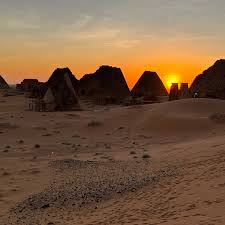
The legacy of the kingdom of Kush is etched deeply into the physical landscape of Sudan. The Kushites were master architects, constructing over 200 pyramids at the royal necropolis of Meroe, giving Sudan more pyramids today than Egypt possesses. Kushite pyramids were distinct: they were smaller, possessed much steeper 70-degree angles, and featured east-facing mortuary chapels adorned with unique Kushite reliefs.
Beyond architecture, the Kushites were brilliant engineers. To combat the arid climate, they engineered massive reservoirs known as hafirs to catch and store rainfall. The Great Hafir at Musawwarat es-Sufra measured 250 meters in diameter and was over 6 meters deep. During the Meroitic period, they also adopted the saqiyah, a sophisticated animal-driven water wheel that drastically improved agricultural irrigation along the Nile.
Most astonishingly, paleopathology studies conducted in the 1990s revealed that ancient Kush was a pioneer in modern medicine. Analyses of Nubian bone remains dating between 350 and 550 CE showed heavy, consistent exposure to tetracycline, a broad-spectrum antibiotic that wasn't officially "discovered" by modern science until the mid-20th century. It is believed the Kushites ingeniously brewed a specific type of beer using grain contaminated with the Streptomyces bacterium, effectively creating a medicinal, antibiotic brew that they consumed regularly.
The Fall of the Empire
Despite its wealth, military might, and medical advancements, the kingdom of Kush could not outlast the devastating forces of environmental collapse and foreign invasion.
The very industry that made Meroe wealthy, iron smelting, ultimately doomed it. The blast furnaces required unimaginable amounts of charcoal, leading to the massive, unchecked deforestation of the surrounding acacia forests. Without tree roots to anchor the soil, the heavily overgrazed agricultural fields suffered catastrophic soil erosion, drastically reducing the kingdom's ability to feed its massive population.
As the environment collapsed and traditional trade routes shifted toward the Red Sea, a new superpower emerged to the southeast: the Kingdom of Aksum (in modern-day Ethiopia). Around 330 CE, the Aksumite King Ezana launched a devastating invasion into Kushite territory, sacking the capital of Meroe.
Already severely weakened by drought, famine, and internal rebellions by nomadic tribes like the Noba, the Aksumite invasion was the final, fatal blow. By 350 CE, the once-glorious capital of Meroe was abandoned to the desert sands, and the centralized kingdom of Kush fractured into three smaller, subsequent Christian kingdoms: Nobatia, Makuria, and Alodia.
The Eternal Legacy
For far too long, the history of the Kush was viewed exclusively through the lens of Egyptology, treated as a secondary, peripheral state whose achievements were merely reflections of Egyptian brilliance.
Today, that paradigm has shifted entirely. The kingdom of Kush stands as a towering testament to the complexity, power, and innovation of ancient African civilizations. From the archers who conquered the Nile Valley and the kings who defended Jerusalem, to the Candaces who humbled the Roman Empire and the engineers who brewed antibiotics, Kush was a civilization that bowed to no one. It remains an indelible, magnificent chapter in the story of human history, reminding us that the deep roots of African excellence are vast, ancient, and undeniably powerful.