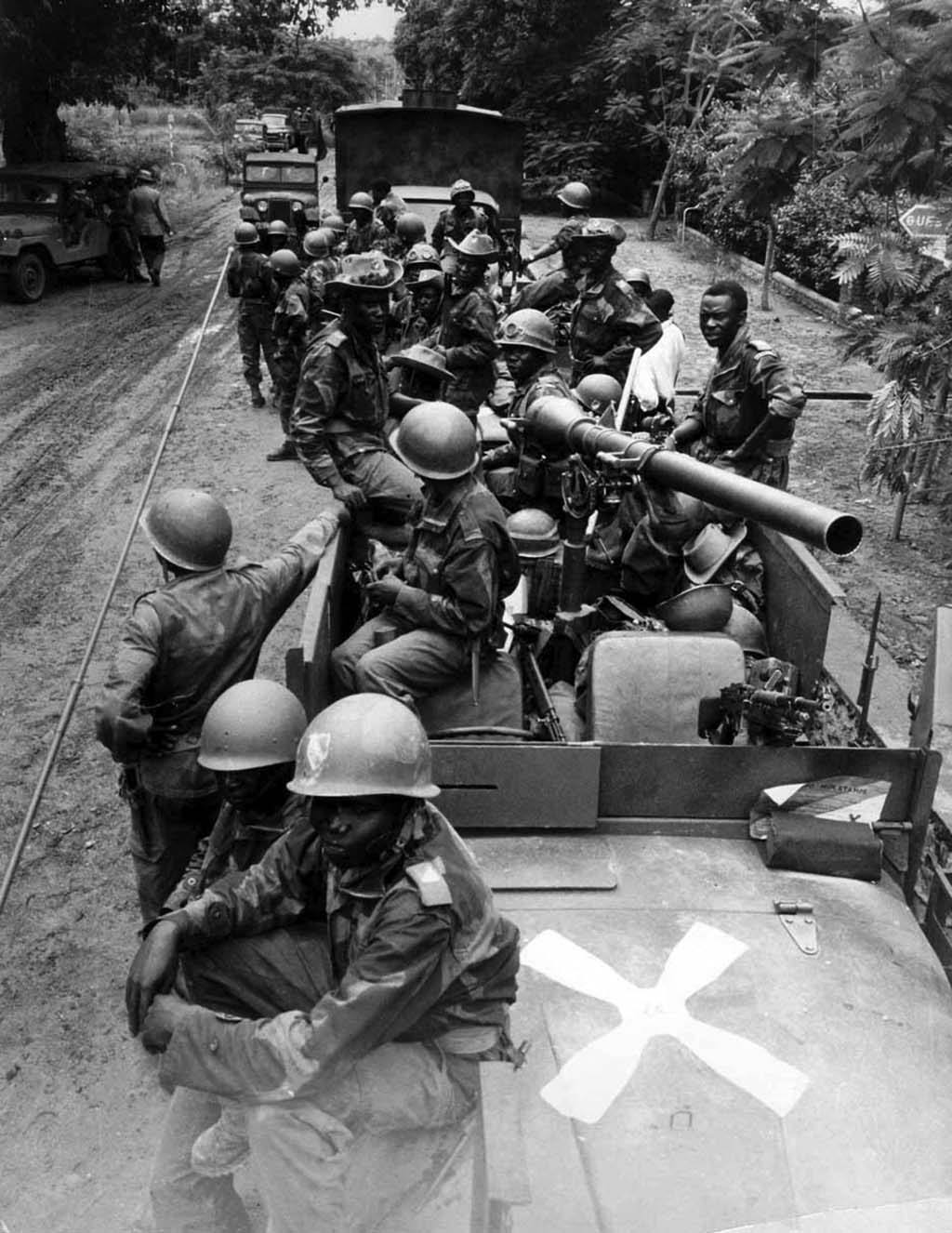
History has a cruel way of transforming a triumph of human dignity into a theater of geopolitical tragedy. On June 30, 1960, the global community watched what should have been the spectacular birth of a sovereign giant. The Republic of the Congo was officially liberated from the brutal, paternalistic machinery of Belgian colonial rule. It was a land of staggering proportions, immense water networks, and a mineral reserve so vast it practically underwrote the technological and military advancements of the Western world.
Yet, within mere days, this birth degenerated into an absolute wildfire. What followed is known interchangeably as the Congo Crisis or the First Congo War, a four-year political tumult that cost an estimated 100,000 lives. It swallowed the nation’s brilliant first Prime Minister, Patrice Lumumba, and claimed the life of United Nations Secretary-General Dag Hammarskjöld in a mysterious plane crash.
To look back at this highly volatile chapter in the Congo is to see how the aspirations of an indigenous African population were systematically crushed between the grinding gears of local ethnic fragmentation and global Cold War paranoia. This is the exhaustive, narrative history of the civil war in Congo, a conflict whose ghosts continue to haunt the DR Congo to this very day.
The Architecture of the Betrayal
To understand why the war in Congo erupted with such visceral immediacy, one must analyze the total absence of structural preparation left behind by the departing Belgian authorities. For nearly a century, Belgium had treated the territory as a corporate money-making machine. The colonial administration purposefully stunted the intellectual development of the native populace. At the midnight hour of independence in June 1960, there were exactly sixteen university graduates in the entire country. The administrative bureaucracy was empty of African leadership, leaving the fledgling state dangerously reliant on the very colonial structures it sought to escape.
The political framework of the new state was structurally fragile from the start. Under the compromise constitution known as the Loi Fondamentale, executive power was awkwardly split between President Joseph Kasa-Vubu and Prime Minister Patrice Lumumba, a system of joint consultation known as bicephalisme. Kasa-Vubu, the leader of the ABAKO party, was an ethnic nationalist who viewed the state through the lens of regional identity and local autonomy. Lumumba, the charismatic head of the mass-based Mouvement National Congolais (MNC), was a radical, uncompromising nationalist who demanded a fiercely centralized, pan-African state completely free from Western economic manipulation.
The spark that lit the fuse happened just five days after the independence celebrations. Inside the barracks of the Force Publique, the colonial military force that lacked a single Black African officer, the rank-and-file soldiers grew increasingly restive. They had assumed that independence would bring immediate promotions and material equality. Instead, the arrogant Belgian commander, Lieutenant-General Émile Janssens, gathered his Léopoldville garrison, walked to a blackboard, and wrote a sentence that sealed the empire's fate:
"Before Independence = After Independence."
It was a staggering display of colonial hubris. The implication was clear: the white man would remain in command, and the Black soldier would remain subservient. By July 5, the garrison at Camp Hardy near Thysville mutinied against their white officers, seizing the armories. Within forty-eight hours, the insurrection spread across the entire country like a tidal wave. White civilians were harassed, properties were looted, and the international press, completely blinded by decades of deceptive Belgian propaganda that painted the colony as a model of peaceful stability, reacted with absolute shock.
The Secession Sacrilege: Katanga and South Kasai
Seeking to restore order, Lumumba took a radical step: he dismissed General Janssens, promoted every single Black soldier by at least one rank, and renamed the force the Armée Nationale Congolaise (ANC). He appointed Victor Lundula as Major-General and commander-in-chief, and named his close personal military aide, Joseph-Désiré Mobutu, as Army Chief of Staff.
But Belgium had no intention of letting its most lucrative assets slide away. On July 9, without the permission of the sovereign Congolese government, Belgian paratroopers descended on Kabalo and Léopoldville under the pretext of protecting fleeing European refugees. Two days later, the Belgian Navy bombarded the vital port city of Matadi, killing nineteen Congolese civilians and triggering an even more furious wave of anti-white retaliation across the interior.
Then came the true, calculated blow to the state's survival. On July 11, 1960, Moïse Tshombe, the leader of the pro-Western CONAKAT party, officially declared the mineral-rich southern province of Katanga independent. Katanga was the golden goose of the Congo, producing a vast percentage of the world’s copper, cobalt, and uranium. Tshombe's secession was explicitly engineered and sustained by the Union Minière du Haut-Katanga (UMHK), a massive Belgian mining conglomerate with deep ties to the government in Brussels.
Backed by millions of dollars in corporate funding, the breakaway State of Katanga built an elite army commanded by white European mercenaries. Less than a month later, on August 8, Albert Kalonji followed suit, declaring the autonomy of the diamond-rich region of South Kasai. Without control over Katanga and South Kasai, the central government in Léopoldville was instantly robbed of approximately forty percent of its national revenues, plunging the new republic into near-immediate bankruptcy.
The Proxy Trap: The Cold War Infiltrates the Congo
Desperate to protect his nation's sovereignty, Lumumba joined President Kasa-Vubu in appealing to the United Nations Security Council. On July 14, the UN adopted Resolution 143, sending a multinational peacekeeping force (ONUC) to stabilize the territory. However, a fundamental, tragic ideological disconnect immediately emerged between Lumumba and UN Secretary-General Dag Hammarskjöld.
Lumumba believed the UN troops were there as an offensive instrument to crush the Belgian-backed rebels in Katanga and South Kasai. Hammarskjöld, rigidly adhering to the doctrine of Western institutional neutrality, flatly refused. He argued that the secessions were an internal political matter and that using UN forces to subdue them would violate Congolese sovereignty.
Feeling completely abandoned by both the United Nations and the United States, Lumumba made a desperate, fateful move that transformed the war in Congo into an open proxy battlefield of the Cold War. He officially reached out to the Soviet Union for bilateral military assistance.
Premier Nikita Khrushchev eagerly complied, instantly dispatching nearly 1,000 Soviet military advisors, transport planes, and heavy artillery to Léopoldville. Armed with Soviet material support, Lumumba launched a highly aggressive military offensive into South Kasai to retake the diamond fields. The campaign was highly successful, but it devolved into brutal ethnic infighting. The ANC massacred approximately 3,000 Luba civilians, triggering an exodus of thousands of refugees and causing international approbation.
Inside Washington, the arrival of Soviet technicians sparked immediate alarm. The Eisenhower administration, already deeply traumatized by the recent rise of Fidel Castro in Cuba, viewed Lumumba as a dangerous, unstable communist asset who threatened to turn Central Africa into a Soviet client state. The CIA station chief in Léopoldville, Lawrence Devlin, sent a flurry of urgent cables warning that the region was experiencing a classic communist takeover. The directive from the highest levels of the American government was absolute: Patrice Lumumba had to be permanently removed from the board.
The Anatomy of an Execution: The Fall of Lumumba

The structural split within the Congolese government has now reached a dead end. On September 5, 1960, President Kasavubu, backed by American financial and diplomatic promises, went on national radio to announce that he had unilaterally dismissed Lumumba as Prime Minister. Lumumba, fiercely resilient, immediately rushed to the national radio station to declare Kasavubu deposed. Both chambers of the Congolese Parliament stood behind Lumumba, creating an explosive constitutional impasse.
Seeing an opening to consolidate power, Army Chief of Staff Colonel Joseph-Désiré Mobutu intervened. On September 14, 1960, with the direct backing and coordination of the CIA and Belgian intelligence, Mobutu orchestrated a bloodless military coup. He neutralizes both Kasa-Vubu and Lumumba, suspends Parliament, and establishes a provisional government run by university graduates called the College of Commissionaires-General. Mobutu immediately orders all Soviet military advisors out of the country.
Lumumba was placed under strict house arrest, guarded by an inner ring of UN peacekeepers and an outer cordon of Mobutu's ANC soldiers. Realizing that his political survival depended on reaching his stronghold in the east, Lumumba slipped out of his confinement on November 27, 1960, during a tropical rainstorm, heading toward the city of Stanleyville. His supporters, led by Antoine Gizenga, had already established a rival rebel government there, the Free Republic of the Congo.
Mobutu’s forces caught up with him at Lodi as he crossed the Sankuru River on December 1. Lumumba was brutally beaten in front of the world's press, bound in shackles, and flown back to Léopoldville.
Even in captivity, Lumumba's immense charisma terrified his captors; rumors began to circulate that the soldiers guarding him at the Thysville military camp were on the verge of launching a mutiny to release him. Under direct pressure from Belgian and American mentors, Mobutu and Kasa-Vubu decided to transfer their prize to a location where his death would be absolute.
On January 17, 1961, Lumumba and two of his loyal ministers, Maurice Mpolo and Joseph Okito, were flown to the breakaway state of Katanga, the territory ruled by his worst enemy, Moïse Tshombe. During the flight, they were subjected to horrific torture by the escorting soldiers. Upon landing in Élisabethville, they were driven to an isolated clearing in the savanna. Standing beside a hastily dug shallow grave, under the direct command of Belgian officers and Katangese execution squads, the three men were shot to death one by one.
To completely erase his memory and prevent his gravesite from becoming a shrine for African nationalists, Belgian police officials later exhumed the bodies, hacked them into pieces with a saw, and dissolved their remains in vats of concentrated sulfuric acid.
Operation Grandslam and the Fall of Katanga
The announcement of Lumumba’s execution on February 13, 1961, triggered a global shockwave of outrage. Massive, violent demonstrations erupted outside Belgian and American embassies from London and Belgrade to New York City. The United Nations, deeply embarrassed and compromised by its perceived complicity in the tragedy, was forced to dramatically escalate its military stance.
Following the death of Secretary-General Dag Hammarskjöld in a mysterious plane crash near Ndola in late 1961, his successor, U Thant, abandoned the policy of moderate non-interference. Supported by a reinforced contingent of 20,000 men, the UN Security Council passed Resolution 169, completely rejecting Katanga's claim to statehood and explicitly authorizing ONUC forces to use all necessary force to assist the central government.
In December 1962, UN troops launched Operation Grandslam. Indian, Swedish, and Irish UN units launched a coordinated, aggressive offensive that completely overran the rebel lines, capturing the capital of Élisabethville. Moïse Tshombe was forced to flee into exile, and on January 17, 1963, his final stronghold at Kolwezi surrendered, effectively bringing an end to the Katangese secession. South Kasai had been reabsorbed by central forces a few months prior, theoretically unifying the Congo under one central administration in Léopoldville for the first time since independence.
The Fire This Time: The Simba Rebellion (1964)
The defeat of the secession did not bring peace; it merely exposed the deep, systemic disillusionment felt by the agrarian population. The urban elites in Léopoldville were increasingly viewed as corrupt kleptocrats who had sold out the revolution to Western business interests. This massive popular anger crystallized into a demand for a "second independence".
In January 1964, a massive, Maoist-inspired Marxist insurrection erupted across the eastern and central provinces. Led by Pierre Mulele and Christophe Gbenye, both fierce loyalists of the martyred Lumumba, the fighters called themselves the Simbas (the Swahili word for "lions"). The Simbas possessed a populist, highly volatile ideology centered around absolute equality and anti-Western sentiment. They integrated traditional African spiritual practices into their military doctrine, utilizing initiation rituals and witchcraft to convince their young, uneducated recruits that they were spiritually invulnerable to Western bullets.
The Simba advance was stunningly rapid. Armed with weapons supplied by the Soviet Union and China via Tanzania, they captured massive territories, overrunning cities like Albertville, Paulis, and Lisala. In August 1964, they seized the strategic eastern city of Stanleyville, proclaiming a communist state: the People's Republic of the Congo. The insurrection received an international boost when Cuba dispatched a team of over 100 elite military advisors, led personally by Ernesto "Che" Guevara, to train the Simba guerrillas in revolutionary warfare. At the height of the summer of 1964, the civil war in the Congo had escalated to such a degree that it threatened to become a full-scale American military conflict on the scale of the Vietnam War.
The Last Stand: Operation Dragon Rouge and the Rise of Mobutu
Faced with the collapse of the central government, President Kasa-Vubu made a highly ironic, desperate political calculation: he recalled Moïse Tshombe, the former leader of the secessionist Katanga province, from his European exile and appointed him interim Prime Minister, giving him a direct mandate to crush the communist Simbas.
Tshombe immediately turned to his old methods. He recalled his elite white mercenaries, forming the notorious 5 Commando ANC under the leadership of "Mad Mike" Hoare. Materially and financially supported by the CIA, which provided T-28 combat aircraft flown by exile Cuban pilots, this mercenary force served as the brutal spearhead of the ANC, gradually forcing the Simbas back.
The crisis reached its climax in November 1964. Recognizing that they were losing ground, the desperate Simba leadership rounded up over 1,000 white European civilians and American missionaries in Stanleyville, holding them hostage inside the Victoria Hotel as human shields and bargaining chips against the advancing army.
This triggered a rapid, high-stakes military intervention known as Operation Dragon Rouge. On November 24, 1964, United States Air Force transport planes dropped a highly disciplined force of elite Belgian paratroopers directly into Stanleyville. The operation was a rapid, tactical success; the paratroopers quickly secured the hotel and evacuated the vast majority of the hostages. Though approximately seventy hostages and 1,000 Congolese civilians perished in the crossfire, the intervention completely broke the back of the eastern insurrection. The Simba state collapsed in disarray, and the rebel leadership scattered into permanent exile.
With the Simba rebellion thoroughly suppressed, the political elite in Léopoldville immediately returned to their old patterns of self-serving infighting. Following the general elections of March 1965, a severe political stalemate developed between Prime Minister Tshombe and President Kasa-Vubu, completely paralyzing the administration.
On November 25, 1965, arguing that the politicians were driving the nation back into the burning smoke of disaster, Lieutenant-General Joseph-Désiré Mobutu mounted his second coup d'état. This time, he did not establish a provisional council; he took absolute personal control of the state. Backed by Western leaders who viewed him as an ironclad, reliable bulwark against communist expansion in Africa, Mobutu abolished the parliament, outlawed all opposition parties, and established a brutal, centralized, one-party dictatorship that would endure for over thirty years.
The Unbroken Shadow: Memory and the Failed State
The Congo civil war completely fractured the structural trajectory of Central Africa. By replacing an authentic, independent democratic experiment with a deeply corrupt, Western-backed autocracy, the crisis ensured that the immense mineral wealth of the country would continue to enrich multinational corporations while leaving the indigenous population in systemic poverty. In 1971, Mobutu renamed the nation Zaire as part of his Authenticité campaign, but his regime ultimately transformed the state into a historical textbook example of a kleptocracy.
The structural scars of those four years remain open. The issues of extreme centralization, regional ethnic nationalism, and the manipulation of local resources by foreign actors were never resolved. In 1997, Laurent-Désiré Kabila, the old Maoist guerrilla commander who had fought alongside Che Guevara during the Simba rebellion, successfully marched across the country, deposed the aging Mobutu, and restored the nation's name to the Democratic Republic of the Congo.
In the collective memory of the Congolese people, the first civil war remains an unfinished tragedy. The murder of Patrice Lumumba is viewed not as a historical footnote, but as the exact, devastating moment where the country was robbed of its true sovereignty. The history of the Congo Crisis serves as a permanent, cautionary monument to post-colonial liberation: a reminder that true freedom is never simply granted by a departing empire, it must be defended against the hidden, predatory mechanisms of global avarice.