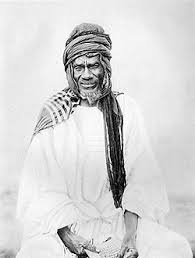
When European powers sat around a table in Berlin in 1884 to carve up the African continent, they assumed their Gatling guns and artillery would easily sweep aside any indigenous resistance. But in the deep savannas and dense forests of West Africa, the French colonial army encountered a man who would turn their imperial ambitions into a decades-long nightmare.
His name was Samori Ture (also spelled Samori Touré or Samory Touré).
Born into a family of traveling merchants, he rose to become the Almamy (religious and political leader) and founding Faama (military monarch) of the Wassoulou Empire (also known as the Mandinka Empire). Stretching across present-day Guinea, Mali, Côte d'Ivoire, and Sierra Leone, his state was an administrative marvel and a military juggernaut.
Often compared to Shaka Zulu for his military genius, and famously dubbed the "Black Napoleon" by the very French officers who fought him, Samori’s legacy as a master tactician, devout Muslim, and relentless anti-colonial hero remains unparalleled in African history. (His legacy was so enduring that his great-grandson, Ahmed Sékou Touré, became the first president of independent Guinea.
This is the exhaustive, epic history of Samori Ture and his refusal to surrender the African soul.
The Dyula Merchant Turns Warrior: Early Life
Samori Ture was born around 1830 in the village of Manyambaladugu, located in present-day southeastern Guinea. He was born into the Touré clan, a family of Malinke (Mandinka) Dyula traders. As a young man, Samori followed the family trade, traveling across West Africa selling kola nuts and cloth. This early career as a roving trader gave him a profound, intimate knowledge of regional geography, supply routes, and the diverse ethnic groups of the region.
However, the 19th-century West African landscape was highly volatile. The influx of European firearms had changed traditional patterns of warfare, making local conflicts deadlier. In 1853, tragedy struck: Samori's mother, Masara Touré (or Sokhona Camara), was captured during a raid by the Cissé clan led by Prince Sere Brahima.
In a profound act of filial devotion, Samori traveled to the Cissé capital of Madina and offered himself as a soldier in their army in exchange for his mother's freedom. According to oral tradition, he served for "seven years, seven months, and seven days". During this grueling service, Samori transformed. He learned how to handle European firearms, mastered military organization, and converted to Islam.
When he and his mother were finally freed, Samori did not return to the quiet life of a merchant. He had found his calling.
Forging the Wassoulou Empire (1866–1882)
By 1861, Mande leaders recognized his prowess and designated him a war chief (keletigi). Samori began uniting the scattered, warring chiefdoms of the Milo River Valley. His early expansionist phase relied on a brilliant mixture of diplomacy, bribery, and overwhelming force. For instance, during the Battle of Saman-saman, he successfully bribed a powerful enemy lieutenant, Jamoro Adjigbe Diakite, to switch sides by appealing to their shared Islamic faith.
In 1878, Samori officially proclaimed himself Faama (military leader) of the newly forged Wassoulou Empire. He established his capital at Bissandougou.
The Wassoulou Empire was not a primitive chiefdom; it was a highly centralized, sophisticated, and modern state. Samori divided his territory into ten provinces governed by military and civilian officials, implementing a legal system based on Islamic law and a complex tax system to fund his government. In 1884, he adopted the title Almamy, solidifying his role as both the political and religious head of a theocratic Muslim state.
The Sofa: Building a Modern African Army
What truly set Samori Ture apart from his contemporaries was his military brilliance. He realized that raw courage and traditional weapons were useless against European armies. Therefore, he completely revolutionized his military forces.
He established a professional standing army known as the Sofa. By 1887, his army boasted between 30,000 and 35,000 infantrymen and a cavalry unit of 3,000 elite horsemen. The army was structured into permanent, highly disciplined units that rewarded soldiers based on merit and loyalty, fostering deep camaraderie. Furthermore, Samori instituted a reserve system where one out of every ten men in every village was trained and ready to be called up, allowing him to field an additional 10,000 men per province.
Crucially, Samori solved the weapon supply issue. He used revenue from the Buré gold mines to purchase modern breech-loading rifles from British merchants in Sierra Leone. When European powers later embargoed weapon sales to him, Samori employed hundreds of skilled local blacksmiths who reverse-engineered and successfully manufactured their own spare parts and functional copies of French Chassepot rifles.
The First Clash with the French (1882–1889)
The French began pushing aggressively eastward from Senegal in the late 1870s, attempting to link their territories with bases in Côte d'Ivoire. This imperial ambition put them on a direct collision course with the Wassoulou Empire.
The first major confrontation occurred in February 1882 at Samaya. Initially using traditional frontal charges, the sofas suffered heavy casualties against French artillery. But Samori was a rapid learner. He instantly abandoned frontal assaults and pivoted to guerrilla warfare, utilizing hit-and-run cavalry attacks that harassed the French back to the Niger River. This victory made Samori a legend across Africa; he was the man who could stand up to the toubab (European colonizers).
For the next several years, the relationship between Samori and the French fluctuated between fierce combat and tactical diplomacy. Samori signed several treaties with the French, such as the Treaty of Kenieba Koura (1886) and the Treaty of Bissandougou (1887). He used these temporary ceasefires brilliantly, buying time to reorganize his army, crush internal rebellions (such as the war against the Kenedougou Kingdom at Sikasso), and secure more firearms.
The Scorched Earth Strategy and the Second Empire (1891–1898)
By 1891, the treaties were dead. French Colonel Louis Archinard launched a massive, full-scale offensive aimed at the heart of the Wassoulou Empire. Archinard arrogantly expected to subdue Samori in a few weeks. He was severely mistaken.
Knowing he could not defeat French artillery in static defensive sieges, Samori initiated one of the most ruthless and brilliant strategic retreats in military history: the scorched earth policy.
As the French advanced, Samori evacuated his entire population. His forces burned their own villages, destroyed crops, and poisoned wells. When the French finally captured Samori’s capital of Bissandougou, they found nothing but ashes. The French army was forced to lengthen its supply lines across hundreds of miles of devastated, barren terrain, slowing their advance and draining their treasury.
In a staggering logistical feat, Samori relocated his entire empire, his army, his administration, and tens of thousands of civilians, hundreds of kilometers to the east, into the northern regions of present-day Côte d'Ivoire and western Ghana. There, he conquered new territories and established his "Second Empire," moving his capital to the ancient trading city of Kong, and later Dabakala.
For seven years, operating out of his Second Empire, Samori waged a devastating guerrilla war. He defeated French columns at Dabadugu, intercepted arms caravans, and even defeated a British force under Henderson at Dokita.
The Final Stand and Exile
By 1898, the walls were finally closing in. The French captured the neighboring stronghold of Sikasso, allowing them to concentrate all their colonial forces against Samori. Furthermore, European powers had signed the Brussels Conference Act of 1890, successfully cutting off Samori’s access to modern breech-loading rifles from the British coast.
Forced to migrate yet again, this time toward the dense, unfamiliar mountainous forests of Liberia, the campaign turned into a disaster. Cut off from trade and food, Samori’s army and the civilian refugees accompanying him began to starve. Desertion rates soared.
On September 29, 1898, a French force led by Captain Henri Gouraud, using information from sofa deserters, launched a surprise attack on Samori's camp at Guélémou (in present-day Côte d'Ivoire). Against impossible odds, the great Almamy was finally captured.
The French, fearful of his immense popularity, refused to let him remain in West Africa. Emotionally devastated, especially after his beloved wife, Saranken Konate, refused to accompany him, Samori attempted suicide before his deportation. He survived and was exiled thousands of miles away to the small island of Ndjolé in the Ogooué River of Gabon, a prison camp notoriously known as the "dry guillotine".
There, the man who had terrified the French Empire for nearly two decades contracted pneumonia. Samori Ture died in exile on June 2, 1900, at the age of 70.
The Immortal Legacy
The empire he built may have been dismantled, but the spirit of Samori Touré could not be extinguished by a colonial prison.
During the mid-20th century, as the winds of African independence began to blow, anti-colonial intellectuals resurrected Samori’s memory. He was no longer framed by the French as a warlord; he was reclaimed as the ultimate martyr of African resistance.
His legacy proved so potent that in 1958, when the nation of Guinea held a historic referendum, his great-grandson, Ahmed Sékou Touré, proudly invoked his heritage. Inspired by his ancestor’s refusal to submit, Sékou Touré became the only African leader to vote 'NO' to remaining in the French Community, declaring that Guinea preferred "freedom in poverty to opulence in slavery".
Today, Samori Ture is immortalized in West African culture. Griots still sing the Wassoulou Anthem to his glory. Reggae superstar Alpha Blondy eulogized him in the hit song "Bory Samory," and his life remains a masterclass studied by military historians worldwide.
Samori Ture proved to the world that long before the Europeans arrived, Africa was capable of building highly sophisticated, centralized states. He fought not just for land, but for the inherent right of Africans to determine their own destiny.