In many global cultures, respect is treated as a transactional commodity, something you offer if you receive it, or something you earn through personal merit. In Yorubaland, however, respect is not a transaction; it is the very breath of social existence. It is a foundational pillar that holds the community together, defines the hierarchy of wisdom, and connects the living to the ancestors.
To be Yoruba is to understand that the world is a complex hierarchy of wisdom, and one's place in it is defined by how gracefully one honors those who have walked the path before them.
The Language of the Body: Physical Expressions of Reverence
The physical manifestation of respect is the most visible signifier of Yoruba identity. These are not merely performative actions; they are deeply symbolic rituals of humility that serve to minimize the ego.
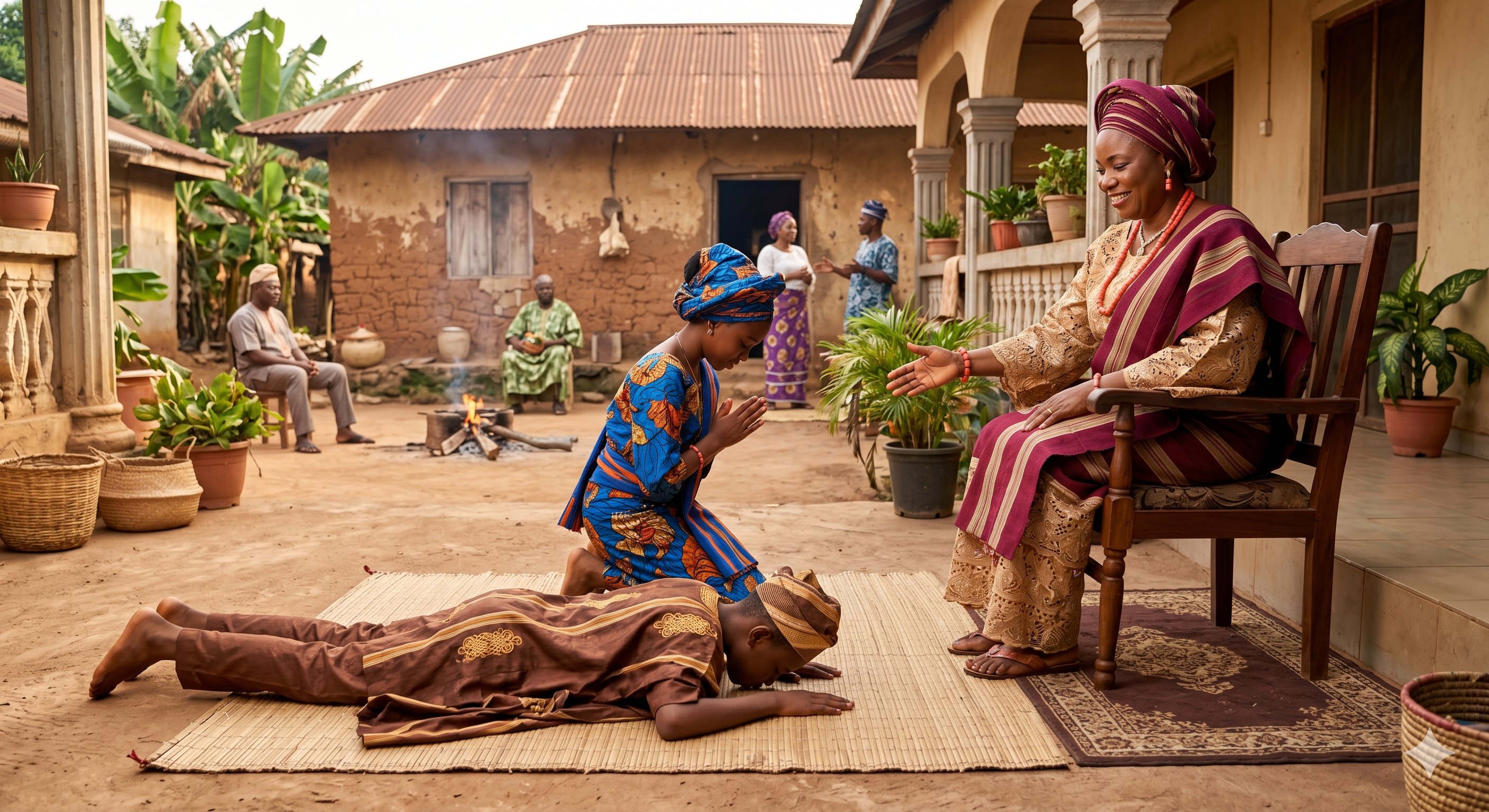
- The Ìdọ̀bálẹ̀ (Prostration): This is the highest form of respect for men. When a younger man greets an elder, he prostrates himself flat on the floor, face down. This act represents complete surrender and acknowledgment of the elder's superior wisdom and life experience.
- The Ìkúnlẹ̀ (Kneeling): For women, the standard sign of respect is kneeling on both knees before an elder or someone in authority. It is a graceful gesture of acknowledgment that mirrors the man’s prostration in intent, signifying that the younger person puts the elder’s status and seniority above their own.
- Postural Deference: Beyond formal greetings, body language is strictly governed by respect. When interacting with an elder, it is customary to bow the head slightly and avoid direct, prolonged eye contact, which can be interpreted as a challenge to authority. If you are spoken to, it is common to place your arms behind your back as a sign of attentiveness and non-aggression.
The Power of Language: The "Ẹ" Factor
In the Yoruba language, social status is encoded directly into grammar. The use of pronouns is perhaps the most frequent way respect is demonstrated, and it serves as constant social training in humility.
- Plurality as Honor: The singular "O" (you) is reserved for peers or those younger than oneself. However, when addressing anyone older or anyone in a position of authority, the plural "Ẹ" (you) must be used. By using this plural form, you are linguistically elevating the person to a status of greater importance, acknowledging their years, their experience, and their role in the communal hierarchy.
- The Necessity of Titles: It is strictly forbidden to address an elder by their first name. This is seen as a sign of extreme familiarity and lack of breeding. Instead, society relies on a web of honorific titles: Boda (Brother), Auntie, Baba (Father), or Mama (Mother). These are not just labels; they are relational roles. By calling a stranger Baba, you are immediately establishing a framework where they are a mentor, and you are a learner, creating an instant bond of mutual responsibility.
The "Right Hand Protocol" and Daily Conduct
Respect in Yorubaland is not just for the grand occasions; it is practiced in the mundane, everyday tasks. These rituals ensure that a person is always mindful and never careless.
- The Left Hand Taboo: Perhaps the most famous rule of conduct is the prohibition against using the left hand for social interactions. Because the left hand is traditionally associated with personal hygiene, passing money, gifts, food, or documents with the left hand is considered a severe, intentional insult. If your right hand is injured, you are required to apologize profusely before using the left: "Ẹ jọ̀ọ́, ọwọ́ òsì nìyí"—"Please, please, this is the left hand".
- Conversational Restraint: In Western cultures, debating and interrupting are often seen as signs of intelligence. In Yoruba culture, they are often seen as signs of immaturity. Children and younger individuals are expected to listen patiently when an elder speaks. If an elder is wrong, the respectful path is to wait for a private, calm moment to gently voice a different perspective, rather than challenging them in public.
4. Shared Meals and Communal Hierarchy
The act of eating is deeply communal and hierarchical. There is an unspoken order to everything:
- First Bite Priority: At any meal where generations are present, the youngest person does not start eating until the oldest person has taken their first bite.
- Reserved Portions: It is an established norm that the most choice cuts of meat, the most nourishing or prized parts of the meal, are always set aside for the elders. This is a material way of acknowledging their status and the fact that they have contributed most to the community over time.
5. Why This Culture Endures
Some might view these practices as relics of the past. However, the power of Yoruba respect lies in its ability to build a cohesive, stable community. In a society that practices these rituals, the elderly are never isolated; they are constantly integrated into the daily flow of life, treated as the central reservoirs of knowledge.
When a younger person practices Ìdọ̀bálẹ̀, they are doing more than bowing; they are actively training their brain to prioritize someone else's worth over their own ego. They are learning to be observant, intentional, and humble. In an era of global individualism, these Yoruba values offer a radical, necessary alternative: the understanding that we are all links in an eternal chain, and our strength comes not from standing alone, but from honoring those who paved the way.