When we speak of the ancient world's most formidable empires, the traditional narrative usually points to the Roman Empire, the Persian Empire, and the Han Dynasty of China. But in the third century CE, a prominent Persian philosopher named Mani, the founder of Manichaeism, looked at the geopolitical landscape and recorded in the Kephalaia that there were actually four great powers.
The fourth was an empire located in the Horn of Africa. It was the Kingdom of Aksum.
Flourishing from classical antiquity to the Middle Ages (roughly 100 CE to 940 CE), the Aksumite Empire was an economic juggernaut, a military powerhouse, and an architectural marvel. Spanning across the highlands of modern-day northern Ethiopia and Eritrea, and extending its reach into Djibouti, Sudan, Yemen, and Saudi Arabia, Aksum was the beating heart of global commerce.
This is the exhaustive history of an African kingdom that minted its own gold, constructed monumental stone skyscrapers without mortar, adopted Christianity before most of Europe, and supposedly became the eternal resting place of the Ark of the Covenant.
The Roots: Pre-Aksumite Civilization and Debunking Colonial Myths
To understand Aksum, we must look at what came before it. Long before the first Aksumite king was crowned, the Tigray Plateau of northern Ethiopia was home to agrarian communities and a highly complex society known as Dʿmt (or Da'amat), which arose around the mid-fifth century BCE. The Dʿmt civilization was based in the village of Yeha, about 50 kilometers northeast of Aksum.
For decades, early European scholars like Carlo Conti Rossini propagated a Eurocentric historical view, claiming that the founders of Ethiopian civilization were actually "Sabaeans" immigrants from the Kingdom of Saba (Sheba) in southern Arabia. Modern archaeological consensus has completely refuted this myth. While there was indeed a cultural exchange and a brief Sabaean presence that influenced early scripts and religion, their footprint lasted only a matter of decades, and their overall influence is now considered minor.
Aksum was fundamentally an indigenous African powerhouse. Archaeological digs at Gobedra and the Betä Giyorgis hill northwest of Aksum reveal continuous, localized human activity dating back to the Stone Age. Out of a confederacy of smaller chiefdoms, a centralized regional polity emerged, giving birth to the Aksumite state.
The Geographic Jackpot: Mastery of the Red Sea
Aksum’s spectacular rise was largely due to its absolute mastery of geography and climate. The capital city was located some 2,000 meters (6,562 feet) above sea level on a lush plateau. The Aksumites were master agriculturalists, utilizing complex systems of terracing, dam construction, and irrigation. They cultivated a rich diversity of crops, including the indigenous Ethiopian super-grain teff, finger millet, sorghum, and Guizotia abyssinica, alongside imported crops like wheat and grapes.
But Aksum’s ultimate geopolitical trump card was its access to the Red Sea.
Around the first century CE, global maritime trade underwent a massive transformation. Sailors realized they could harness seasonal monsoon winds to bypass older, slower overland routes, sailing directly from Roman Egypt across the Arabian Sea to southern India. Positioned perfectly along this route, Aksum seized control of the vital Red Sea port of Adulis.
The Periplus of the Erythraean Sea, a first-century Greek shipping guide, explicitly notes Aksum's dominance. Overnight, Aksum became the ultimate middleman of antiquity. Merchants from the Roman Empire, Egypt, Persia, India, and Ceylon (Sri Lanka) docked at Adulis. The Aksumites exported massive quantities of African goods: ivory, gold, rhinoceros horn, hippopotamus hide, tortoise shells, frankincense, myrrh, and salt. In return, they imported luxury goods like silk, olive oil, Roman glassware, iron, steel, and Indian spices.
The Golden Age: First African Coinage and the Ge'ez Script

Aksumite gold coins
Because of its colossal trading wealth, Aksum achieved something no other sub-Saharan African empire had done: it minted its own official currency.
Beginning in the late third century under King Endybis, Aksum issued coins in pure gold, silver, and bronze. This was not merely an economic convenience; it was an act of profound international propaganda. Minting gold coins in the standard weight categories of the Roman Empire was a blazing declaration that the Aksumite "King of Kings" (nugusa nagast) considered himself the absolute equal of the Roman and Persian emperors. These coins, inscribed with the faces of Aksumite rulers, have been excavated as far away as Caesarea and southern India.
Aksum was also a center of profound intellectual development. The empire developed its own indigenous written alphabet, the Ge’ez script, which was later modified into an abugida (a syllabic alphabet that includes vowels). While Greek was frequently used for international diplomacy and commerce, much like English is today, Ge’ez became the language of the court, the common people, and eventually, a vast tradition of indigenous literature.
Skyscrapers of Antiquity: Engineering and Architecture
If you want to understand the sheer ambition of the Aksumite kings, you only need to look at how they built their cities and buried their dead.
Aksumite architecture was highly sophisticated. Elite palaces, such as the massive Ta'akha Maryam (which measured 120 by 80 meters) and the Dungur palace, utilized a unique architectural style. Buildings featured alternating layers of loose stone and horizontal wooden beams. Smaller round wooden beams protruded from the exterior walls, an iconic architectural feature known as "monkey-heads". Most astonishingly, their large granite blocks were often perfectly carved to fit snugly together without the use of mortar.
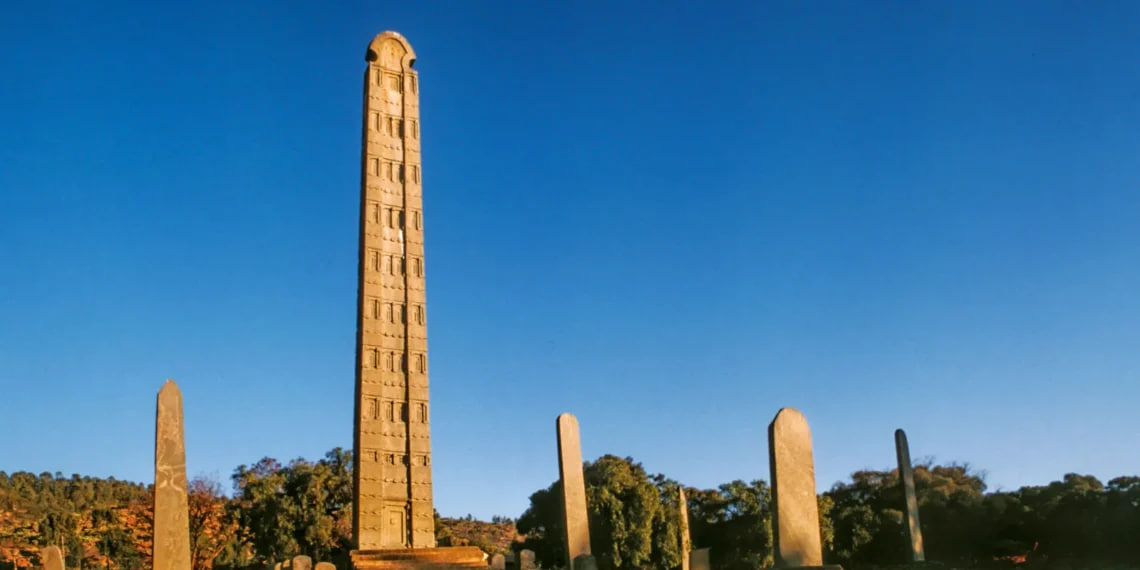
But their absolute crowning achievements were the stelae, colossal, monolithic obelisks carved from a fine-grained granite called nepheline syenite.
These towering stone skyscrapers were erected in royal cemeteries, serving as grave markers to identify magnificent underground burial chambers. They were intricately carved to represent multi-storied palaces, complete with false doors and false windows. The largest of these obelisks, which fractured and currently lies where it fell, measured an unbelievable 33 meters (roughly 108 feet) long and weighed over 500 tons. It remains one of the largest single pieces of stone that ancient human beings ever attempted to erect.
The Cross and the Crown: King Ezana's Revolution
For centuries, the Aksumites practiced a polytheistic, Ancient Semitic religion, worshipping indigenous deities like Mahrem (the god of war), Beher, and Medr, alongside imported gods like Astar and even Greek deities like Zeus and Ares.
But in the fourth century CE, the cultural trajectory of the entire region changed forever.
According to historical accounts, a Syrian Christian from Tyre named Frumentius was shipwrecked or captured on the Red Sea coast. He was taken to the Aksumite court, where his brilliance quickly saw him elevated to the role of advisor and tutor to the young crown prince, Ezana.
When Ezana assumed the throne (r. c. 320–360 CE), he officially converted to Christianity, making Aksum one of the very first states in the entire world to adopt the religion. Frumentius was appointed the first Bishop of Ethiopia by the Church of Alexandria.
The ideological shift was immediate and highly visible. King Ezana ordered the old polytheistic crescent-and-disc symbols removed from the empire's currency and replaced them with the Christian cross. Aksumite coins were the very first in the world to feature the image of the cross, long before the Byzantine Empire did so.
Following the Council of Chalcedon in 451 CE, the Ethiopian church opted to maintain a Monophysite (Miaphysite) doctrine, arguing that Jesus Christ had a single nature that was a synthesis of the divine and human. Rejecting the directives of Rome and Constantinople, the Aksumite Coptic Church forged its own unique, deeply independent theological path.
Myths and Mysticism: The Queen of Sheba and the Ark

The Church of Our Lady Mary of Zion in Aksum
No history of Aksum is complete without exploring its powerful, enduring mythology.
According to Ethiopian tradition and texts like the Kebra Nagast (The Glory of Kings), the city of Aksum was the home of the legendary Queen of Sheba (known locally as Makeda). Legend states that the Queen traveled to Jerusalem to witness the renowned wisdom of King Solomon of Israel. Enthralled by her intellect and beauty, Solomon slept with her, and she returned to Ethiopia pregnant with his son, Ibn al-Malik, better known as Menelik I.
Menelik I became the founding father of the Solomonic Dynasty, a lineage that Ethiopian emperors claimed descent from all the way until the late 20th century.
But the story does not end there. When Menelik grew older, he traveled to Jerusalem to visit his father. Upon returning to Aksum, he was accompanied by Azariah, the son of the high priest, and nobles from the tribes of Israel. According to the legend, Azariah received a divine dream instructing him to smuggle the Ark of the Covenant, the sacred golden chest containing the Ten Commandments, out of the temple in Jerusalem. He replaced it with a forgery and brought the true relic to Aksum.
To this very day, the Ethiopian Orthodox Tewahedo Church fiercely maintains that the Ark of the Covenant rests safely inside a heavily guarded chapel at the Church of Our Lady Mary of Zion in the city of Aksum.
The Military Zenith: King Kaleb and the Yemen Crusade
Fueled by immense wealth and a unifying religion, Aksum expanded aggressively. Under King Ezana, they conquered the ancient, tottering Kingdom of Kush (Meroe) in modern-day Sudan, dealing the final blow to a civilization that had once rivaled ancient Egypt.
But Aksum’s military zenith occurred in the sixth century under King Kaleb (reigned c. 514–542 CE). In 520 CE, Kaleb received word that a Jewish convert king in Yemen named Dhu Nuwas (Yūsuf As'ar Yath'ar) was violently persecuting the Christian communities of Najran. Acting as the righteous protector of the faith, and with the diplomatic urging of the Byzantine Emperor Justin I, Kaleb launched a massive amphibious invasion across the Red Sea.
The Aksumite forces crushed the Himyarite king, annexed Yemen, and installed an Arab viceroy named Esimiphaios. Under Kaleb, the Kingdom of Aksum reached its absolute maximum territorial extent, spanning roughly 2.5 million square kilometers (970,000 square miles) and solidifying complete imperial control over the Bab-el-Mandeb strait, one of the most critical maritime choke points in the medieval world.
The Great Collapse: Plagues, Persians, and Climate Change
Yet, empires rarely fall overnight. The decline of Aksum was a slow, agonizing suffocation brought on by a perfect storm of geopolitical, environmental, and biological disasters.
First came the Plague of Justinian in the sixth century. The bubonic plague swept through the Byzantine Empire and heavily impacted Aksum, devastating its population and manpower just as it had overextended its military forces in Yemen.
Then, the geopolitical map was violently redrawn. The Persian Sassanid Emperor Khosrow I sent a fleet under the commander Vahrez, invading Yemen around 570 CE and violently expelling the Aksumites from the Arabian Peninsula.
Decades later, the explosive rise of the Islamic Empire fundamentally altered global trade. Although early Muslims who fled persecution in Mecca were given asylum in Aksum by King Ashama ibn-Abjar in 615 CE (an event known in Islamic history as the First Hijrah), the later Arab dominance of the Red Sea completely cut Aksum off from its Roman and Byzantine trading partners. The port of Adulis was eventually destroyed by Islamic invaders in 710 CE. Economically starved and increasingly isolated, the empire ceased minting coins entirely by the early eighth century.
Simultaneously, the environment turned against them. Centuries of intense agricultural exploitation and a booming population caused catastrophic soil erosion and widespread land degradation on the Tigray plateau. This ecological disaster was exacerbated by a severe shift in climate between 730 and 760 CE, which drastically reduced the reliability of rainfall and abbreviated the growing season.
Plagued by famine and harassed by invasions from nomadic Beja tribes (like the Zanafaj) from the north, the Aksumite population was forced to abandon their magnificent capital and retreat deeper into the southern highlands to a new capital called Kubar.
The Final Blow: Queen Gudit and the Dark Age
The final blow to the empire is shrouded in oral tradition and mystery. Local histories and Arabic records from writers like Ibn Hawqal suggest that around 960 CE, a fierce, possibly Jewish warrior queen named Gudit (also known as Yodit or Ésato) invaded from the south.
She allegedly sacked the city of Aksum, burned its churches and literature to the ground, and slaughtered the remaining royalty, plunging the region into a dark age and officially ending the Aksumite Empire.
The Eternal Legacy
Following this dark age, political power eventually shifted to the Agaw people, who established the Zagwe dynasty in the 12th century. The Zagwe kings famously carved the incredible rock-hewn churches of Lalibela, architectural marvels heavily influenced by ancient Aksumite masonry and "monkey-head" designs. In 1270, Yekuno Amlak overthrew the Zagwe and founded the modern Solomonic dynasty, explicitly tracing his right to rule back to Dil Na'od, the final emperor of Aksum.
The Kingdom of Aksum may have fallen, but it was never truly erased. Today, the city of Aksum remains inhabited by roughly 50,000 people, making it one of the oldest continuously inhabited cities on the African continent. Its staggering ruins were designated a UNESCO World Heritage Site in 1980.
Aksum gave Africa the Ge'ez script, a fiercely independent Christian tradition, and irrefutable proof that the continent was a driving force in ancient globalization. It stands as a towering historical reminder that long before European ships ever mapped the coastlines of Africa, the kings of Aksum were looking across the ocean, moving mountains of solid stone, and bending the world's economy to their iron will.