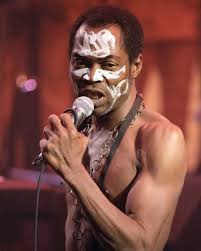
To understand the rhythm of modern Africa, you must understand the man who dared to weaponize it. Fela Anikulapo-Kuti was not merely a musician; he was a walking, saxophone-wielding revolution. If Kwame Nkrumah gave Africa its political roadmap to independence, and Nelson Mandela gave it a masterclass in resilience, Fela Kuti gave the continent its unyielding, rebellious voice.
He was a mass of brilliant contradictions: a classically trained musician who played in his underwear; a fierce advocate for human rights who was heavily criticized for his treatment of women; a Nigerian aristocrat who shed his elite status to become the voice of the ghetto. Best known as the pioneer of Afrobeat music, Fela was repeatedly arrested and savagely beaten for writing lyrics that questioned the Nigerian government.
He didn't just sing about freedom. He literally seceded from Nigeria, built his own nation within a nation, and went to war with the military junta using nothing but rhythm, brass, and Pidgin English. This is the story of the "Black President."
The Aristocratic Rebel
Fela Kuti was born on October 15, 1938, in the city of Abeokuta, Nigeria. He was born into a family of immense privilege and formidable intellectual power. His father, Reverend Israel Oludotun Ransome-Kuti, was a prominent Protestant minister and school principal. His mother, Funmilayo Ransome-Kuti, was a legendary feminist and anti-colonial activist who once led a tax revolt so powerful it forced a sitting king to abdicate.
With this pedigree, Fela was expected to join the respectable ranks of the Nigerian professional class. In 1958, he was sent to London with the strict expectation that he would study medicine. Instead, he rebelled, enrolling in the Trinity College of Music. There, he studied the trumpet, formed his first band (Koola Lobitos), and immersed himself in the London jazz scene.
But the Fela of the early 1960s was a far cry from the revolutionary he would become. He played highlife and jazz, wearing sharp suits and largely ignoring the political turmoil bubbling in newly independent Nigeria.
The American Awakening and the Birth of Afrobeat
The turning point came in 1969. Fela and his band traveled to the United States for a grueling, largely unsuccessful tour. However, in Los Angeles, Fela met Sandra Izsadore, an activist affiliated with the Black Panther Party. She introduced him to the writings of Malcolm X, Eldridge Cleaver, and the fiery politics of Black Power.
Fela had an epiphany: his music lacked a deep, authentic African identity. He realized he had been playing music designed to entertain the very colonial structures his mother had fought against.
He returned to Nigeria radically transformed. He changed the name of his band to "Afrika 70" and, alongside his brilliant drummer Tony Allen, completely engineered a new genre: Afrobeat.
Afrobeat was a massive, pulsating sonic architecture. It blended traditional West African Highlife and heavy Yoruba polyrhythms with American funk and jazz. But its true genius was its vocal delivery. Instead of singing in elite Queen’s English or a specific tribal language that would alienate other ethnic groups, Fela sang in West African Pidgin English. This ensured that the poorest citizens in the sprawling slums of Lagos, as well as listeners across the entire African continent, could understand every single word of his political sermons.
The Kalakuta Republic: A Nation Within a Nation

By 1970, following his return from the United States, Fela's political radicalization was complete. He moved to 14 Agege Motor Road in Idi-Oro, Mushin, a gritty, working-class neighborhood in Lagos. There, he established a massive communal compound that housed his family, his band members, and a recording facility. It even featured a free health clinic for the local community.
In a move of unparalleled audacity, Fela declared the compound an independent state, completely separate from Nigeria, ruled by the military junta. He named it the "Kalakuta Republic".
The name "Kalakuta" was a mocking reference to a specific prison cell, nicknamed "Calcutta", that Fela had inhabited during one of his numerous arrests. The name itself originally derived from the infamous "Black Hole of Calcutta" dungeon in India.
Kalakuta became a sanctuary for the disillusioned youth of Lagos, runaways, intellectuals, and political dissidents. It was a utopian, hedonistic, and fiercely anti-establishment enclave. Nigerian tabloids carried lurid, unverified tales of what went on behind its walls, but to the military government, Kalakuta was an intolerable insult. The military authorities stated it was utterly unseemly to have a republic existing within a republic.
"Zombie" and the Wrath of the Junta
Fela’s music became the daily soundtrack of Nigerian resistance. He openly attacked the rampant corruption of the oil boom, the brutality of the police, and the neo-colonial mindsets of the African elite.
But in 1976, he released a record that pushed the military junta over the edge: Zombie.
The song was a direct, scathing mockery of the Nigerian military regime. Over a relentless, driving Afrobeat groove, Fela equated the soldiers to zombies who blindly obeyed orders to crush their own people. He was deeply frustrated with the army's rank and file, accusing them of blindly following orders to intimidate ordinary Nigerians while turning a blind eye to the corruption of the rich, top-brass military elite.
Fela taunted them in Pidgin English, singing: "Zombie no go walk unless you tell am to walk".
The song became an absolute smash hit across Nigeria and the African continent. The streets vibrated with it. But to the military, and specifically to then-Head of State General Olusegun Obasanjo, the song was deeply upsetting and profoundly humiliating.
The February 18 Massacre
The military’s revenge was biblical in its brutality.
On February 18, 1977, an overwhelming force of one thousand armed soldiers descended upon the Kalakuta Republic. The assault was merciless. Soldiers battered down the perimeter fences, brutalized the residents, and assaulted Fela's band members.
Fela was severely beaten, sustaining multiple fractures. But the most horrifying tragedy of the raid was directed at his 76-year-old mother, Funmilayo Ransome-Kuti. The soldiers threw the elderly feminist icon from a second-story window. She fell into a coma and later died from her injuries.
Before leaving, the soldiers set the compound ablaze. The Kalakuta Republic was burned to the ground. Fela’s master tapes, instruments, and the free health clinic were reduced to ashes.
Grief, Defiance, and 27 Wives

The junta expected the destruction of Kalakuta and the death of his mother to finally break Fela’s spirit. They miscalculated. Fela’s grief mutated into an indestructible, white-hot defiance.
On the anniversary of his mother's death, Fela and his band marched to Dodan Barracks in Lagos, the heavily fortified residence of General Obasanjo, and deposited his mother's coffin directly at the gates, demanding the government take responsibility for her murder. He immortalized this harrowing act of defiance in the devastating song Coffin for Head of State.
Fela’s personal life became just as theatrical and controversial as his politics. He was a devout polygamist. His first wife was a woman named Remi, with whom he had three children: a son, Femi, and two daughters, Yeni and Sola. All three of these offspring would later become members of the Positive Force, a band they founded in the 1980s.
In 1978, in a highly publicized and symbolic act of defiance against Western, Christian, and colonial norms of marriage, Fela married 27 women in a single wedding ceremony. These women were his backup singers and dancers (the "Queens"). Though he would eventually divorce them all in 1986, the event cemented his status as a countercultural icon.
The Final Years and a Million-Man Farewell
Through the 1980s and 1990s, Fela remained a thorn in the side of successive military regimes. He was arrested over 200 times. He spent 20 months in jail on trumped-up currency smuggling charges under the regime of Muhammadu Buhari in 1984, leading Amnesty International to designate him a prisoner of conscience.
Yet, his creative output was staggering. He produced roughly 50 albums over his career.
But the "Black President" was not invincible. On August 2, 1997, at the age of 58, Fela Kuti died of AIDS-related complications in Lagos, Nigeria.
The military government, which had tortured him for decades, could do nothing to stop the outpouring of grief from the Nigerian masses. An estimated one million people poured into the streets for his funeral procession. The massive crowd followed his casket from Tafawa Balewa Square all the way to his home, Kalakuta, in Ikeja, where the musical prophet was finally laid to rest in his front yard. (Tragically, his daughter Sola would die of cancer not long after her father died in 1997).
The Legacy of the Black President
Fela Kuti is gone, but Afrobeat has conquered the globe. While today's "Afrobeats" pop music is a lighter, club-friendly descendant of his original genre, the raw, instrumental DNA of Fela’s work continues to influence artists from Beyoncé to Burna Boy.
He was a flawed man, but he was exactly the kind of fearless, volatile genius that history requires to break the silence. Through the blazing horns of Afrobeat and the ashes of the Kalakuta Republic, Fela Kuti proved that while you can burn down a compound, you can never kill the groove.