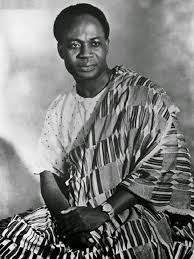
If you want to understand the modern African consciousness, you have to understand Kwame Nkrumah. He was not just the man who led the Gold Coast to independence and birthed modern Ghana. He was the intellectual architect of Pan-Africanism, a philosopher who swapped the seminary for the prison cell, and a visionary whose grand dreams ultimately collided with the brutal realities of the Cold War.
To some, he was Osagyefo, the Redeemer. To others, he became a cautionary tale of revolutionary power turned authoritarian. But long before he was a president or an exile, he was simply a young man searching for Africa's place in the world.
The Catholic Schoolboy and the "University of the Harlem Streets"
Born on September 21, 1909, in the small, southwestern village of Nkroful in the British Gold Coast, he was baptized Francis and later adopted the traditional Akan name Kwame, denoting a boy born on a Saturday. His father, Opanyin Kofi Nwiana Ngolomah, was a respected goldsmith, and his mother, Elizabeth Nyanibah, was a retail trader and fishmonger who raised him with deep traditional roots.
Young Kwame was a brilliant student. Educated by Catholic missionaries, he became a pupil-teacher and even taught at a Catholic seminary at Amissano, where the strict lifestyle appealed to him so much that he seriously considered becoming a Jesuit priest. But his trajectory shifted after hearing the Nigerian journalist and future president Nnamdi Azikiwe speak, which ignited his interest in Black nationalism.
Hungry for a deeper understanding, Nkrumah sailed for the United States in October 1935. He enrolled at Lincoln University in Pennsylvania, a historically Black college. and later at the Ivy League's University of Pennsylvania. But his true education didn't happen exclusively in the classroom.
Nkrumah was chronically broke. To survive, he worked as a dishwasher, a cleaner, and a soap factory laborer. He even sold fish on the street corners of Harlem, New York, eventually abandoning the trade because he developed allergic skin rashes. It was in Harlem that Nkrumah’s political soul was forged. He spent his evenings absorbing the fiery rhetoric of street-corner orators and interacting with the vibrant, radical intellectual cohorts of the African diaspora. Influenced by Marcus Garvey, W.E.B. Du Bois, and C.L.R. James, he began to synthesize a bold new ideology: Africa did not just need to be free from Europe; it needed to be entirely united.
While in America, Nkrumah wasn't just observing; he was actively shaping African intellectual discourse. He earned degrees in economics, sociology, theology, philosophy, and education. He preached at Black Presbyterian churches on Sundays and published academic articles arguing that Eurocentric colonial education was an "educational fraud" designed to keep Africans subservient.
The Manchester Spark and the Red Cockerel
In May 1945, Nkrumah moved to London. Amid the rubble of a post-war Britain, he helped organize the historic Fifth Pan-African Congress in Manchester alongside towering figures like George Padmore and W.E.B. Du Bois. In a shabby town hall, they declared that Africa would no longer wait for gradual reform; they demanded independence immediately.
Returning to the Gold Coast in late 1947, Nkrumah was invited to serve as the general secretary of the United Gold Coast Convention (UGCC), a moderate anti-colonial party run by conservative, middle-class professionals. But Nkrumah was far too radical for the establishment. Following the Accra riots of February 1948—where police killed protesting World War II veterans—Nkrumah and other UGCC leaders (the "Big Six") were arrested by the British.
Realizing the UGCC was too cautious, Nkrumah broke away in June 1949 to form the mass-based Convention People's Party (CPP). He chose the red cockerel as the party's symbol, a familiar local icon of alertness and masculinity, and dispatched vans painted in red, white, and green across the country to blare his message. His slogan was uncompromising: "Self-Government Now".
In January 1950, he launched a campaign of "Positive Action", a massive wave of non-violent protests, strikes, and civil disobedience. The British colonial government responded by throwing him in Fort James prison. But the colonial rulers drastically underestimated his popularity. Imprisoned with common criminals, Nkrumah continued to organize his party by smuggling notes written on toilet paper. In the February 1951 general election, while Nkrumah was still sitting in a prison cell, the CPP won a landslide victory. The British governor, Charles Arden-Clarke, had no choice but to release him and ask him to form a government.
"Free Forever": The Birth of Ghana

On March 6, 1957, the Gold Coast became Ghana, the first sub-Saharan African nation to break the chains of British colonialism. Standing before a massive, jubilant crowd, Nkrumah declared, "Ghana will be free forever".
The world watched closely. Over 100 international reporters covered the event. Among the dignitaries in attendance was Dr. Martin Luther King Jr., who shared a private meal with Nkrumah and was deeply inspired by how Ghana had utilized nonviolent "positive action" to achieve its freedom.
Nkrumah was a visionary architect. When Ghana became a Republic in 1960 with him as its first president, he poured the country’s wealth into rapid modernization. He built modern roads like the Tema Motorway, expanded ports, introduced free healthcare and compulsory primary education, and spearheaded the massive Akosombo Dam project on the Volta River to electrify the nation. He even initiated the Ghana Nuclear Reactor Project in 1961.
He also fundamentally shifted global optics. In 1961, Queen Elizabeth II visited Ghana and took to the dance floor with Nkrumah to dance the foxtrot. In an era where racial segregation was still the law of the land in the American South and apartheid choked South Africa, the image of a white British monarch dancing with a Black African president was a stunning, visual rebuke to white supremacy.
The Theorist of Neo-Colonialism
Nkrumah's intellectual contributions were just as profound as his political ones. He is credited with popularizing the concept of "neo-colonialism," arguing that even after granting formal independence, former imperial powers maintained control over African nations through financial structures, international corporations, and restrictive aid policies.
To combat this, he became a founding father of the Organisation of African Unity (OAU) in 1963, relentlessly pushing for a United States of Africa with a common currency, a common market, and an African High Command military force. "Our independence is meaningless," he famously declared, "unless it is linked up with the total liberation of Africa".
Paranoia, The Presidency for Life, and The Fall
But the higher Nkrumah built his ideological towers, the more unstable the ground beneath him became.
His massive infrastructure projects, while visionary, plunged Ghana into crippling foreign debt. When the global price of cocoa. Ghana’s primary export crashed drastically in the 1960s (dropping from £450 per ton in 1954 to just £91 in 1965), and the economy spiraled. This led to severe food shortages and massive labor unrest.
Fearing assassination and surviving multiple attempts on his life, including a bombing at Kulugungu in August 1962, Nkrumah became deeply secluded and increasingly authoritarian. As early as 1958, he passed the Preventive Detention Act, allowing him to imprison political opponents without trial for up to five years. By 1964, he pushed through a constitutional amendment (with an implausible 99.91% of the vote) that made Ghana a one-party state and declared himself President for Life. The visionary liberator had built a cult of personality, silencing the very democratic freedoms he had once fought to secure.
His flirtations with the Soviet Union and China during the height of the Cold War, and his awarding of the Lenin Peace Prize in 1962, made him a prime target for Western intelligence agencies. On February 24, 1966, while Nkrumah was on a peace mission in North Vietnam and China, the Ghanaian military and police seized power in a violent coup d'état. Later accounts by former CIA agents, including John Stockwell, suggested American involvement in the plot, though the full extent remains fiercely debated.
Exile in Conakry and an Enduring Legacy
Kwame Nkrumah never set foot in Ghana again. He lived out his final years in exile in Conakry, Guinea, where President Sékou Touré named him honorary co-president. In his final years, completely disillusioned with the democratic process, Nkrumah abandoned his nonviolent stance, arguing that armed revolutionary warfare was the only way to defeat neo-colonialism. He died of cancer in a Bucharest, Romania hospital on April 27, 1972.
How do we measure a man who was both a liberator and a dictator? Who achieved monumental leaps in education and infrastructure, yet jailed his critics?
Nkrumah’s tragedy is the classic tragedy of the post-colonial revolutionary: the sheer force of will required to break an empire is rarely the same energy required to govern a peaceful democracy. Yet, his intellectual legacy remains undeniable. In 2000, listeners of the BBC World Service voted him the "African Man of the Millennium".
Kwame Nkrumah taught a subjugated continent how to dream of total unity. And long after the controversies of his presidency have faded into history, that dream, the unapologetic demand for a powerful, self-reliant, and united Africa, endures.